
Can a Bowman charge air cooler become clogged on the air side?

Overpropping: This was half resolved. I fitted a smaller prop, I can't remember now the exact size but it was smaller in both diameter and had less pitch. It increased rpm by 500, but made no difference to boost pressure or top speed obtained.
I've since found the original spec sheet supplied by Lancing when the repower was carried out, they supplied a 16X21 long hub which is the prop currently fitted.

I can't post pictures, the turbo has been rebuilt and I didn't get any shots before it went. The compressor vanes had small chips around the edges.

The exhaust side looked Ok before rebuild, the vanes looked to be in good condition, and there was very little discernible play in the bearing from that side.

I don't know how much oil it was passing, there was a small pool of oil settled in the inlet housing when the turbo was layed on it's side after removal. It was never vast amounts, it didn't smoke excessively when running.
Play was quite considerable though, difficult to quantify but it was probably rocking by 2mm or so?

The incorrect injectors were instantly spotted by my mechanic. Originally, it would have been fitted with the Yellow spot full flow 130ps injectors, but at some point they had been swapped back to 75ps injectors. The thinking was that if the injectors were incapable of supplying enough fuel, full boost or power was never going to be achievable.

It's certainly helped, previously I was reaching 2300rpm and 2.5psi boost at WOT, with the rebuilt turbo and full flow injectors it's now reaching 3100rpm and 7 psi. But, it's still not enough to get on plane, top speed has not altered at all, only the elevation!

Apologies, did not realise that turbocharger had been rebuilt. Only one bearing in turbocharger so play should be the same, however no matter clear evidence that turbo was passing oil.

Please do not be too hung up on boost at the moment, it is a characteristic of your propeller demand curve, do not assume data sheet prop dimensions are are correct, could be a case of garbage in garbage out.

Once you have CAC back on can you confirm high idle rpm.

On the subject of propeller dimensions, let's have some data and run some numbers, accurate displacement, drive reduction ratio.
 
Apologies, did not realise that turbocharger had been rebuilt. Only one bearing in turbocharger so play should be the same, however no matter clear evidence that turbo was passing oil.

Please do not be too hung up on boost at the moment, it is a characteristic of your propeller demand curve, do not assume data sheet prop dimensions are are correct, could be a case of garbage in garbage out.

Once you have CAC back on can you confirm high idle rpm.

On the subject of propeller dimensions, let's have some data and run some numbers, accurate displacement, drive reduction ratio.

I'm a little stuck really with this project, the boat has always had these problems since day one, so I have no reference point to start from. All I can really go by is the paperwork supplied from the seller who owned the boat, and did all the work, prior to the person I bought it from.
He had a sequence of rebuild pictures on the fairline holiday owners club showing the new engine being fitted, as well as the hull being treated. He obviously spent a great deal of money on it, just the receipt from the engine is £8000.00. There's also a picture showing the boat up on plane, after the work was complete.
So, at some point, it ran well!
Frustratingly, the website folded a Year ago so I have no more details from that.
The receipt for the prop supplied at the time was for a 16" diameter, long hub with 21 degrees of pitch. That is the prop currently fitted although it is away at the moment being rebuilt.
It's immensely frustrating stabbing in the dark trying to resolve this!

Before the CAC was removed, idle at WOT was 4000rpm, it's only under load that the problems start.

Displacement is plated at 1800kg, so I'm guessing at around 2 tons, I don't have any other displacement data.
Drive reduction ration again is unknown. The outdrive was replaced with a reconditioned unit in the Summer after the OJ destroyed the internals. It was supplied to the same specification as the old unit, I don't know what gearing it uses but there was no difference in revs with the new unit compared to the old.
Considering the size of the prop, at a wild guess, I imagine it's the original gearing for the old engine (AQ130) which I believe is 1.9:1 and relying on the extra torque from the TDI to push the prop. I could be way off with this though.
By chance, I met the parents of the last owner who did all the work. They told me that she used to be capable of 25 knots. That seems a little high from what I can make out, but even using all worse case scenarios it seems it should be capable of 15 knots which is what I'd like to be able to do.

Length: 22' 1". beam 8' 6"
Drive: Volvo 270 outdrive
Engine: 140bhp @ 4000rpm

Thanks for your help with this,
 
What engine is it... from the blue CAC , is it a Lancing FSDTI?.... 140hp
What boat is it mounted in?
Edit.. just checked yr profile doh!
A couple of things...
1. Yes , clagged intercooler will have exactly those symptoms. It makes a huge difference when cleaned.
Those engines tend to breath oily fumes as mentioned before which clog up the intercooler and airside compressor wheel.
2. Clean the matrix as you are doing.
3. Clean the compressor wheel with paraffin
4. Arrange the outlet from the crankcase breathers to be filtered, you will be amazed at the amount of oil carried over.
5. Those engines are quite 'peaky' ie nothing much happens below 2800 rpm, then power comes in quite dramatically at 3000rpm. If the revs dont get up to 2800-3000, then there will be very little boost, and you won't get over 'the hump'
6. I had exactly the same symptoms in a Sunfury fitted with 2 of the blue beasts.
7. Do you have the modified oil drain pipe from the turbo... yellow hose with crimped ends?
8. Boost at 3500-4000rpm should be 15psi

All respect to Latestarter, but these have a few quirks of their own.
 
Last edited:
I'm a little stuck really with this project, the boat has always had these problems since day one, so I have no reference point to start from. All I can really go by is the paperwork supplied from the seller who owned the boat, and did all the work, prior to the person I bought it from.
He had a sequence of rebuild pictures on the fairline holiday owners club showing the new engine being fitted, as well as the hull being treated. He obviously spent a great deal of money on it, just the receipt from the engine is £8000.00. There's also a picture showing the boat up on plane, after the work was complete.
So, at some point, it ran well!
Frustratingly, the website folded a Year ago so I have no more details from that.
The receipt for the prop supplied at the time was for a 16" diameter, long hub with 21 degrees of pitch. That is the prop currently fitted although it is away at the moment being rebuilt.
It's immensely frustrating stabbing in the dark trying to resolve this!

Before the CAC was removed, idle at WOT was 4000rpm, it's only under load that the problems start.

Displacement is plated at 1800kg, so I'm guessing at around 2 tons, I don't have any other displacement data.
Drive reduction ration again is unknown. The outdrive was replaced with a reconditioned unit in the Summer after the OJ destroyed the internals. It was supplied to the same specification as the old unit, I don't know what gearing it uses but there was no difference in revs with the new unit compared to the old.
Considering the size of the prop, at a wild guess, I imagine it's the original gearing for the old engine (AQ130) which I believe is 1.9:1 and relying on the extra torque from the TDI to push the prop. I could be way off with this though.
By chance, I met the parents of the last owner who did all the work. They told me that she used to be capable of 25 knots. That seems a little high from what I can make out, but even using all worse case scenarios it seems it should be capable of 15 knots which is what I'd like to be able to do.

Length: 22' 1". beam 8' 6"
Drive: Volvo 270 outdrive
Engine: 140bhp @ 4000rpm

Thanks for your help with this,

I think 140 hp is a little optimistic, let's say 130 @ 4,000 rpm.

Based on given dimensions and a 16 X 21 three blade with 1.9:1 reduction your expectation of 25 knots sound perfectly reasonable with a cruise speed of 16/18 knots @ 3,500 rpm. Your prop demand curve indicates 122hp @ WOT with cruise demanding close to 90 hp.

I agree with many of Tico's comments, particularly high oil carryover, however we must remember propellers move boats engines merely turn them. I am concerned re your high idle number, 4,000 rpm, this is automotive spec fuel pump with at least 10% governor droop therefore I would expect to see high idle of 4,400 rpm. Slip your Morse control lever off and do high idle test, unless you are getting 100% throttle, HARD AGAINST the stop pump will not be giving the fuel, fuel is heat, exhaust heat equals boost.

Once you have your CAC re-installed just perform high idle test with Morse cable disconnected and see what you are getting, no blipping, good solid push and hold lever there and do not expect to see any boost when performing high idle test.

We will get there........
 
Sorry... meant boost pressure 'under load' at WOT was 15psi / 1bar (if no load then no boost)
BTW
I had 290 outdrives at (i think) 1.71:1 ratio
Props were 16x21 long hub PLUS 2" of 'cupping'
3.5T boat ... full speed 30-32kts @ 4000rpm and 25kts at 3500rpm
 
What engine is it... from the blue CAC , is it a Lancing FSDTI?.... 140hp
What boat is it mounted in?
Edit.. just checked yr profile doh!
A couple of things...
1. Yes , clagged intercooler will have exactly those symptoms. It makes a huge difference when cleaned.
Those engines tend to breath oily fumes as mentioned before which clog up the intercooler and airside compressor wheel.
2. Clean the matrix as you are doing.
3. Clean the compressor wheel with paraffin
4. Arrange the outlet from the crankcase breathers to be filtered, you will be amazed at the amount of oil carried over.
5. Those engines are quite 'peaky' ie nothing much happens below 2800 rpm, then power comes in quite dramatically at 3000rpm. If the revs dont get up to 2800-3000, then there will be very little boost, and you won't get over 'the hump'
6. I had exactly the same symptoms in a Sunfury fitted with 2 of the blue beasts.
7. Do you have the modified oil drain pipe from the turbo... yellow hose with crimped ends?
8. Boost at 3500-4000rpm should be 15psi

All respect to Latestarter, but these have a few quirks of their own.

Fantastic information, thank you :) very rare to find someone who's run one of these units! I don't understand why they're "peaky," I can't see why, with no wastegate, the boost pressure isn't linear. Still, it doesn't matter, I'll happily accept that they are!
Re cleaning the compressor wheel, I haven't done this as it's a newly rebuilt turbo but the CAC core is now clean and reinstalled.
The crankcase breather doesn't recirculate through the system, the hose from the cap just leads down into the bilge. I shall fit a crude sponge filter or something to this, it seems a little environmentally unfriendly in its current set up... Although, to be fair, the pipe is clean, it doesn't appear to discharge much in the way of oil vapour through the breather.
7. I'm not sure on that, although the hose is Yellow underneath all the paint.
1. Very reassuring to hear that you've experienced this with this engine, hopefully it's now resolved :)

Thanks for your time in posting, it's greatly appreciated
 
I think 140 hp is a little optimistic, let's say 130 @ 4,000 rpm.

Based on given dimensions and a 16 X 21 three blade with 1.9:1 reduction your expectation of 25 knots sound perfectly reasonable with a cruise speed of 16/18 knots @ 3,500 rpm. Your prop demand curve indicates 122hp @ WOT with cruise demanding close to 90 hp.

I agree with many of Tico's comments, particularly high oil carryover, however we must remember propellers move boats engines merely turn them. I am concerned re your high idle number, 4,000 rpm, this is automotive spec fuel pump with at least 10% governor droop therefore I would expect to see high idle of 4,400 rpm. Slip your Morse control lever off and do high idle test, unless you are getting 100% throttle, HARD AGAINST the stop pump will not be giving the fuel, fuel is heat, exhaust heat equals boost.

Once you have your CAC re-installed just perform high idle test with Morse cable disconnected and see what you are getting, no blipping, good solid push and hold lever there and do not expect to see any boost when performing high idle test.

We will get there........

Thank you for your time calculating those stats, it really is appreciated. It's extremely good to know that the desired 15knots is well within reach, and a fair bit more. I don't understand the speed/revs thing at all, but I'll start a separate thread to avoid cluttering this one.
I've refitted the cleaned CAC, but my tacho only reads to 4000rpm which is the maximum speed defined in the stats from Lancing.
The engine reaches max rpm in neutral as indicated on the tacho, and the control lever hits the stop on the pump. It also hits the stop on the pump in gear at full throttle, but this test was carried out with the engine off as there is no prop fitted and I wasn't sure if it might cause damage.
Please correct me if I'm wrong, but I gather max rpm is controlled by the pump? apparently it is possible to modify this to hit over 6000rpm although I imagine the engine wouldn't last long at that speed.
If that's correct, could it be that Lancing set maximum rpm at 4000 as that is their maximum recommended operating speed, i.e. 90% of actual maximum rpm?
Thanks again for all your assistance with this.
 
Last edited:
Thank you for your time calculating those stats, it really is appreciated. I don't understand the speed/revs thing at all, but I'll start a separate thread to avoid cluttering this one.
I've refitted the cleaned CAC, but my tacho only reads to 4000rpm which is the maximum speed defined in the stats from Lancing.
The engine reaches max rpm in neutral as indicated on the tacho, and the control lever hits the stop on the pump. It also hits the stop on the pump in gear at full throttle, but this test was carried out with the engine off as there is no prop fitted and I wasn't sure if it might cause damage.
Please correct me if I'm wrong, but I gather max rpm is controlled by the pump? apparently it is possible to modify this to hit over 6000rpm although I imagine the engine wouldn't last long at that speed.
If that's correct, could it be that Lancing set maximum rpm at 4000 as that is their maximum recommended operating speed, i.e. 90% of actual maximum rpm?
Thanks again for all your assistance with this.

Not quite there yet...........Yes maximum engine speed is controlled by the governor, however you cannot have isocronous pump governing with a mechanical pump unless you have special Stanadyne pump for engine driving a generator, your Bosch VE WILL have a degree of governor droop, suspect it will be in region of 10%, could be a little lower but I will be surprised if any less than 7%. After rated speed 4,000 rpm fuel is gradually cut back until you reach max speed out on the droop.

If throttle lever has the SMALLEST amount of travel restriction engine will make WOT but not run out the droop and will not be giving you maximum fuel, which is why I asked for Morse cable to be slipped off the pump control lever and high idle test to be carried out manually. We do not want to alter anything in the way of pump settings we need to be 100% sure you are getting max lever travel which is why Morse control has to be disconnected.

Purchase optical digital tacho off Ebay and ignore the tacho.
 
Not quite there yet...........Yes maximum engine speed is controlled by the governor, however you cannot have isocronous pump governing with a mechanical pump unless you have special Stanadyne pump for engine driving a generator, your Bosch VE WILL have a degree of governor droop, suspect it will be in region of 10%, could be a little lower but I will be surprised if any less than 7%. After rated speed 4,000 rpm fuel is gradually cut back until you reach max speed out on the droop.

If throttle lever has the SMALLEST amount of travel restriction engine will make WOT but not run out the droop and will not be giving you maximum fuel, which is why I asked for Morse cable to be slipped off the pump control lever and high idle test to be carried out manually. We do not want to alter anything in the way of pump settings we need to be 100% sure you are getting max lever travel which is why Morse control has to be disconnected.

Purchase optical digital tacho off Ebay and ignore the tacho.

Ok, thank you, I didn't realise that's how the governing worked, never really given it too much though before to be honest!
I've ordered a laser digital tacho from DX, it will take a few days to arrive though. I shall let you know what the true rpm figure is when I get it.
 
No problem, really appreciate the thought though.
It was only a few pounds from deal extreme, it might come in useful for other things too
 
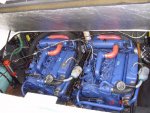
View attachment 38925Can see the filter bottles on the crankcase breathers here

we got the same mod on our Sabre 180's as well, the bottles catch the water and the foul air gets reburned. LOL

180S.jpg


The pipe from the rocker box goes into a bottle!!
 
Last edited:
That's slightly spooky, I was looking at that very image this morning! If you types "FSDTI" into Google images, it comes up with your old Sun Fury, and the engine pictures! So, yes, thank you :)
I shall knock up something similar at the weekend.
Out in the boat tomorrow for it's first run with the cleaned CAC, I've got a training session booked.
Annoyingly, the prop hasn't come back from repair so I'll have to put the spare on which is a lot smaller. Hopefully it will give an indication though.
 
we got the same mod on our Sabre 180's as well, the bottles catch the water and the foul air gets reburned. LOL

180S.jpg


The pipe from the rocker box goes into a bottle!!


If it's good enough for a Sabre, it's good enough for mine! :D
 
I have been observing this thread with interest

Please try to adopt a more systematic approach to trouble-shooting, in normal service the Bosch VE is a super reliable and trouble free pump. Lynall's comments regarding tuning the VE, caused a smile, as the the version used on Land Rover vehicles is unsuitable for tuning, however I digress.

Take some pictures all around the engine and post.


Latestarter, what inj pump or mods would you recommend for the land rover tdi installation to make it more tunable? I ask as I want a bit more get up and go, I was considering a different turbo, there is a vgt option available, but thats just over 1k.

Thanks
lynall
 
Latestarter, what inj pump or mods would you recommend for the land rover tdi installation to make it more tunable? I ask as I want a bit more get up and go, I was considering a different turbo, there is a vgt option available, but thats just over 1k.

Thanks
lynall

Lynall,

About ten years ago I was asked to take serious look at Landrover 300 Tdi for installation in Bowler Wildcat.

Putting the 300Tdi across the dyno told a story.

#1 The standard VE pump was hopeless. Land Rover VE has a non linear output, juce up the pump, max power increases but bottom end collapses, no good for off-roading.

#2 Tubomachinery did not cut it.

I found VE used on 4 liter off 71/2 tonne truck motor with a linear output, using fuel pin from MAN truck and also well known that TD5 Garrett is great widget with correct manifold.

End result was solid 200 hp at the top with no compromise bottom end, rocket ship motor, did 3 for French race team.
 
Last edited:
Lynall,

About ten years ago I was asked to take serious look at Landrover 300 Tdi for installation in Bowler Wildcat.

Putting the 300Tdi across the dyno told a story.

#1 The standard VE pump was hopeless. Land Rover VE has a non linear output, juce up the pump, max power increases but bottom end collapses, no good for off-roading.

#2 Tubomachinery did not cut it.

I found VE used on 4 liter off 71/2 tonne truck motor with a linear output, using fuel pin from MAN truck and also well known that TD5 Garrett is great widget with correct manifold.

End result was solid 200 hp at the top with no compromise bottom end, rocket ship motor, did 3 for French race team.
Come on LS, the only power plant to have in the Wildcat is the supercharged V8 gas engine :D
 
Top