Calorifier pressure relief valve dribbling

LittleSister

Well-Known Member
Joined
12 Nov 2007
Messages
20,337
Location
Me Norfolk/Suffolk border - Boat Deben & Southwold
Visit site
Just discovered this, and i know nothing about calorifiers!

The calorifier seemed to work fine previously, but the boat has stood unused for several years since. It is now leaking from the pressure/temperature relief vale when the water supply is pressured. The engine is not on, and the immersion heater has never been used.

Does this mean that the calorifier is for the scrap heap?

Is the pressure relief valve in the heating (engine) side of the system, or the heated (water supply side)? (I am trying to deduce whether there is a leak bew
tween the two sides.)

Can the temp/pressure relief valve be reset, or do I have to buy a new one?
 
Just discovered this, and i know nothing about calorifiers!

The calorifier seemed to work fine previously, but the boat has stood unused for several years since. It is now leaking from the pressure/temperature relief vale when the water supply is pressured. The engine is not on, and the immersion heater has never been used.

Does this mean that the calorifier is for the scrap heap?

Is the pressure relief valve in the heating (engine) side of the system, or the heated (water supply side)? (I am trying to deduce whether there is a leak bew
tween the two sides.)

Can the temp/pressure relief valve be reset, or do I have to buy a new one?
The PRV is to relieve the pressure in the domestic hot water side of the calorifier, it can be replaced, usually.
 
As NormanS mentions. Try turning the PRV (Pressure Relief Valve) knob a few times.

It will click each time it re-seats... and will either solve the issue (or make it drip more), but usually solves it.

You will lose water from it on each turn/click, so have something to catch the extra water in.
 
Just discovered this, and i know nothing about calorifiers!

The calorifier seemed to work fine previously, but the boat has stood unused for several years since. It is now leaking from the pressure/temperature relief vale when the water supply is pressured. The engine is not on, and the immersion heater has never been used.

Does this mean that the calorifier is for the scrap heap?

Is the pressure relief valve in the heating (engine) side of the system, or the heated (water supply side)? (I am trying to deduce whether there is a leak bew
tween the two sides.)

Can the temp/pressure relief valve be reset, or do I have to buy a new one?
The PRV definitely isn't open manually? When I bought my new to me Saga 26HT last month, I found the same problem when filling up and pressurising the water system for the first time, and discovered the previous owner had used the PRV to drain the last of the water out the system and left the little manual spring lever open a bit, so water was trickling out! Now I've closed that it's absolutely perfect :-).
 
The PRV definitely isn't open manually? When I bought my new to me Saga 26HT last month, I found the same problem when filling up and pressurising the water system for the first time, and discovered the previous owner had used the PRV to drain the last of the water out the system and left the little manual spring lever open a bit, so water was trickling out! Now I've closed that it's absolutely perfect :).

Thanks. I haven't opened it, and nobody else has been around it.

How do you close it? (And is that the same as the 'reset' I have seen mentioned?).

I haven't encountered these valves (or calorifiers more generally) before, so I don't know how one is supposed to do that. The valve head and knob are hidden under and very close to some bodywork. With the aid of a torch and a mirror I managed to see it was rated 2.5 Bar and 90 degrees, but couldn't make out the rest of the writing or any arrows/symbols.

I tried turning the knob on the top of the valve, and it felt like it wasn't moving anything or screwing into a thread, but it did make a faint click with each rotation.

I've been hunting on line, and reading various accounts and opinions about leakage problems, but in the ones I've found so far the participants assume knowledge I don't have.
 
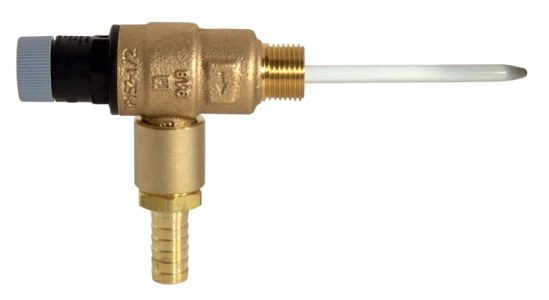
Mine is similar to this:
View attachment 194973

The left hand side of it, in this pic, beyond the drain pipe, is hidden under a sort of shelf in my installation, so i can't get a good look at it. The knob on top seems to rotate. More than that I do not know.
The knob has something akin to a cam on the end of it, which forces the valve open. If it needs changing, you change the whole thing. No need for an expensive "marine" one, you should be able to match one at a plumbers merchant/Screwfix etc
 
We recently changed boats and the instruction was 'when motoring switch off the water pump and leave the galley tap open' otherwise you will need to empty the 1 litre water bottle in the locker (connected by a pipe which disappears under the locker floor). All seems a little strange - could this be a similar issue to the OP?
 
We recently changed boats and the instruction was 'when motoring switch off the water pump and leave the galley tap open' otherwise you will need to empty the 1 litre water bottle in the locker (connected by a pipe which disappears under the locker floor). All seems a little strange - could this be a similar issue to the OP?
The engine is heating the water more than the electric element and causing it to expand, thus opening the PRV.

Possible fixes:
  • Fit a new PRV
  • Fit a PRV with a higher pressure rating
  • Connect the overflow pipe from the PRV to the water tank overflow, using a Tee
  • Fit an expansion tank to the hot outlet of the calorifier
 
We recently changed boats and the instruction was 'when motoring switch off the water pump and leave the galley tap open' otherwise you will need to empty the 1 litre water bottle in the locker (connected by a pipe which disappears under the locker floor). All seems a little strange - could this be a similar issue to the OP?
Looks like it needs an expansion vessel on the hot pipes.
 
Thanks. We're trying to sort some electrical issues first. Quite a sophisticated system with individual items failing one at a time. Looking at wiring straight to the battery for now, view to change the switch panel later in the year.
 
The engine is heating the water more than the electric element and causing it to expand, thus opening the PRV.

Possible fixes:
  • Fit a new PRV
  • Fit a PRV with a higher pressure rating
  • Connect the overflow pipe from the PRV to the water tank overflow, using a Tee
  • Fit an expansion tank to the hot outlet of the calorifier
On my 1999 Bene 381, when we first bought it, running the engine for a period of time would heat the water that much that it would expand and blow off the pipe going to the calorifier! The first time was the on the delivery from Holyhead to Pwllheli. a force 8 chasing us to Bardsey Sound and looking through the hatch to the saloon, the floorboards were awash!. A quick taste test confirmed it was fresh water so pumped and carried on.
A quick check showed the bodgers had put on a 9 bar PRV! Thats 135 psi. I fitted a 3 bar one but that dribbled. Much research showed that allegedly, Beneteau considered the plastic pipework expandable enough to allow for expansion. It wasnt! It took many months of fiddling and I ended up with an expansion Jabsco vessel fitted BUT we still switch off the house pressure water pump when engining. Just in case!. We have run the PRV valve to the sump where it runs in to a plastic bottle which we empty periodically.

Thats where the instructions from the previous owner comes from I suspect. So in my case, it dribbles, I dont want a 9 bar PRV in the system, i may as well put a blank there!
Stu
 
Just an update on the situation I opened this thread with.

I'd discovered the outlet of the calorifier relief valve was dribbling when the water pressure pump was on. When I first tried to rotate the knob on the top of the relief valve (which is hidden under a ledge) it seemed to rotate continuously without seeming to do anything except a faint click once each complete turn.

Maybe either I imagined that, or that's what it does when it is not under pressure, because on my return to the boat, with the pump on the knob would not turn at all one way, but if I turned it the other way water would change from dribbling out to gushing out. I did this back and forth a couple of times with no change, then, for some reason, I continued turning the knob in the 'gushing' direction and to my surprise the water stopped coming out completely!

I am guessing that has reset the valve and therefore (hopefully!) solved my problem.

I was going to investigate further, and also check that whatever caused the relief valve to 'blow' in the first place didn't involve a leak between the domestic water supply and the engine cooling water circuit, but the gremlins hadn't entirely departed and at that moment the water pump started running continuously - the water tank was empty, and the hoses required to refill it an hour's drive away.
 
That's exactly the procedure I tried to describe in post #4 to re-seat the valve. (Maybe my wording wasn't great)...

It sounds like yours is working normally and you have managed to resolve the dribble.

Worthwhile doing the same few 'clicks' every so often anyway to keep it from leaking in between times..
 
Last edited:
That's exactly the procedure I tried to describe in post #4 to re-seat the valve. (Maybe my wording wasn't great)...

It sounds like yours is working normally and you have managed to resolve the dribble.

Worthwhile doing the same few 'clicks' every so often anyway to keep it from leaking in between times..

Thanks for trying! I just couldn't relate it to what I'd felt the first time -then it just felt like the knob itself was spinning without being connected to anything.
 
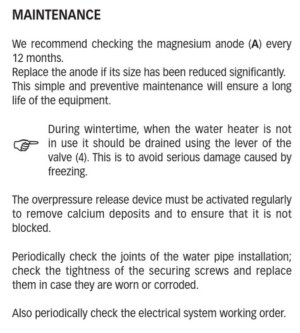
This calorifier produces hot water from the Incoloy electric heating element. Also featuring a safety / non-return valve that allows discharging of the water heater in case of disuse, set at 6 bar (±1). (Taken from Quick Calorifier 22 litre manual). So it might actually be doing it on purpose because the boat has been idle for some time.
 
Top