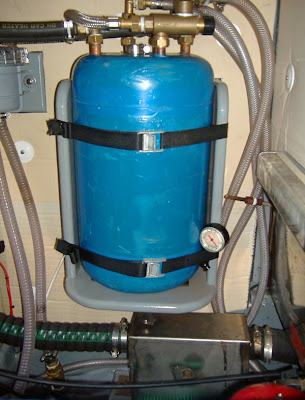
Calorifier - orientation important?

MM5AHO

Well-Known Member
Joined
1 Oct 2007
Messages
2,550
Location
Central Scotland
Visit site
Am fitting a calorifier this winter. So far have only started with the mounting place (hardwood glued to the fibreglass hull). BUt my question is about orientation.
I intend to have it lying on its side with the fittings facing to stbd and about at the centre line. (Cylinder therefore to port). But at this point the hull is sloped of course, so if make tiber supports same thickness, the cylinder will end up with the fittings facing downwards about 30 degrees, not horizontal.
Cylinder is a 22 litre Surecal with integrated PRV and thermostat. Cold supply will have an 8 litre expansion vessel.

Will this likely cause airlocks? Will it matter?

It will connect to the fresh water circuit of a Volvo 3 cyl diesel, and will have a pressure water system for the fresh water being heated. The cylinder will be less than 500mm from the engine.
Maybe the cooling pump will blow any air right through?
Maybe the pressure pump will prevent airlocks in the cylindar?

Any comment?
 
Am fitting a calorifier this winter. So far have only started with the mounting place (hardwood glued to the fibreglass hull). BUt my question is about orientation.
I intend to have it lying on its side with the fittings facing to stbd and about at the centre line. (Cylinder therefore to port). But at this point the hull is sloped of course, so if make tiber supports same thickness, the cylinder will end up with the fittings facing downwards about 30 degrees, not horizontal.
Cylinder is a 22 litre Surecal with integrated PRV and thermostat. Cold supply will have an 8 litre expansion vessel.

Will this likely cause airlocks? Will it matter?

It will connect to the fresh water circuit of a Volvo 3 cyl diesel, and will have a pressure water system for the fresh water being heated. The cylinder will be less than 500mm from the engine.
Maybe the cooling pump will blow any air right through?
Maybe the pressure pump will prevent airlocks in the cylindar?

Any comment?

Is the tank designed to lay on its side? - the tanks are made both ways but if you fit an upright tank on its side the outlet will be in the wrong place and you will not get the hot water out from the tank above the outlet assuming it is not full of air. This will be very inefficient.
 
...But at this point the hull is sloped of course, so if make tiber supports same thickness, the cylinder will end up with the fittings facing downwards about 30 degrees, not horizontal....

Will this likely cause airlocks? Will it matter?...

Yes and probably.

Forget the heating coil - that's just water being squirted along a pipe, but your fresh water can only fill to the level of the hot water outlet. If the calorifier is sloping downwards towards this fitting, then there'll be a big air bubble above this point - maybe 30% plus of your calorifier volume. If you have an immersion heater it may even be wholly or partly within this air bubble (depends on how long your tank is) which would be a Bad Thing.

Can't you put the fittings on the high side? (But then you wouldn't be able to drain it out fully....). Any recommendation from the manufacturer?

Andy
 
Yes and probably.

Forget the heating coil - that's just water being squirted along a pipe, but your fresh water can only fill to the level of the hot water outlet. If the calorifier is sloping downwards towards this fitting, then there'll be a big air bubble above this point - maybe 30% plus of your calorifier volume. If you have an immersion heater it may even be wholly or partly within this air bubble (depends on how long your tank is) which would be a Bad Thing.

Can't you put the fittings on the high side? (But then you wouldn't be able to drain it out fully....). Any recommendation from the manufacturer?

Andy

??????????????? I assume this system will be pressurized by the pump, if so opening the hot tap will get rid of any air. in fact any tap would do.
 
??????????????? I assume this system will be pressurized by the pump, if so opening the hot tap will get rid of any air. in fact any tap would do.

Only if the hot water outlet is at the highest point in the calorifier, which it won't be if the calorifier is tilted by ~30° above the fitting.

Andy
 
have the original installation instructions, but they don't mention this point about orientation. Of course a yacht isn't level that much anyway, but a bit silly to have to go on a port tack just to get the air out?

could perhaps turn the unit 180 degrees, but that'd put the connectins in an almost unreachable position. This is all in the cramped space beneath the cockpit well and above the driveshaft, and cramped to port above by the fuel tank.
have emailed the manufacturer, but they haven't had enough time to respond yet.
The tank is designed to lay horizontally, but don't know to what tolerance of horizontal.

Thanks for comments so far
 
The tank is designed to lay horizontally, but don't know to what tolerance of horizontal.

Hot water should be drawn from the top of a heating vessel, cold feed at the bottom, the heating coil is marginally irrelevant unless there is no way to bleed out the air in that. The crucial thing is that you must be able to vent the air from the top to fill the thing with water and that the heated water should be drawn from the top.

Them's the roools!
 
The coil should be vertical with feed in at the bottom and return at the top. With the coil on its side there is the possibilty iof air locks in the top of each section of the coil. The circulation may clear this, or it may not depends on the engine and the layout of the outlet and inlet. Some engines, particlaurly raw water cooled require a constant running circulation pump to force the water through the calorifier.
 
Why not have one made to fit?

What you are proposing is not the best idea, as others have said "it breaks the rules". Ask any plumber or heating engineer and he will tell you air is the bain of his life, airlocks are nasty things and not to be left to chance, e.g. an air lock in the coil will mean no hot water. The cylinder must be mounted correctly if it is to work effectively and reliably.

When I had a special requirement for a copper cylinder (calorifier) I would contact this bunch * and send them a drawing. There was only a very small premium for a special. I am not in that trade now but I would go to a GOOD builders/plumbers merchant and ask them for a few address of firms that make calorifiers - or have a look round yell.com.

Here are a few

Kingspan Hot Water Systems Tank Suppliers & Installers. Tel: 01400 272726| * Kesteven Copper Cylinders, Station Rd, Caythorpe, Grantham, Lincolnshire NG32 3EW

* I have no connection with this company except I bought from them from 1972 up to 1989 they make to the quality you specify (length of heating coil, wall thickness, insulation thickness etc) and will provide the connections you specify in the positions you specify. looking at recent directory entries not sure they still make cylinders but a phone call would tell.
 
ENGCAL24.jpg


Does your calorifier look like this? This is a Surecal Horizontal Calorifier fitted vertically. Connected to a Volvo MD 17D freshwater cooled engine with a header tank higher than the take offs on the calorifier. It works perfectly. I see no reason that your calorifier won't work in the position you propose as long as the hot water take off is to the top. There may be a slight drop off in efficiency, but more than serviceable I would have thought.
 
Nothing wrong with that except: The cold water entering the cylinder as the hot is drawn off could/might find its way to the hot outlet unless there is a tube inside the cylinder that takes it to the bottom.

If it works as you say it does then there is probably such a tube fitted.
 
Last edited:
Nothing wrong with that except: The cold water entering the cylinder as the hot is drawn off could/might find its way to the hot outlet unless there is a tube inside the cylinder that takes it to the bottom.

If it works as you say it does then there is probably such a tube fitted.

I should imagine there is a tube Marsupial, because this is the Horizontal Surecal model and works fine. It would be handy to get a pic of the OP's unit. Just to see exactly where the outlets are. Otherwise we're guessing blind.
 
The coil should be vertical with feed in at the bottom and return at the top. With the coil on its side there is the possibilty iof air locks in the top of each section of the coil. The circulation may clear this, or it may not depends on the engine and the layout of the outlet and inlet. Some engines, particlaurly raw water cooled require a constant running circulation pump to force the water through the calorifier.

No it shouldn't! The feed of hot water from the engine to the heating coil should enter at the top and exit at the bottom. This is the favoured direction for the thermodynamics, i.e. the water wants to fall as it cools, and it opposes the increase in heat of the tank contents. Connecting the wrong way around creates a strong convective flow that can be sufficient to arrest the flow of a circulation pump.

Some calorifiers are constructed such that they can be sited either horizontally or vertically, others cannot. It will normally indicate this on the device itself.
 
The pipes are calling

No it shouldn't! The feed of hot water from the engine to the heating coil should enter at the top and exit at the bottom.

Please dont take offence, my crew of heating engineers used to argue about this all time, its a very old chestnut, nothing changes!

The opposite argument is that by feeding the hot water to the bottom of the coil more of the cylinder contents will be heated to a higher temperature, I ve never seen a case where the convective flow overcomes a pump - and having seen many examples (roughly 5 a week for 17 years) of both piping systems I ve never seen a difference between them in terms of how much water is heated or the time taken to heat it, except in the mind of the engineer who fitted it! but in the end you pays your money and makes your choice.

The important thing is that the coil should be arranged in such a way that no air is trapped inside it.
 
The unit looks pretty much like the one that saxon Pirate posted.

can see that having the hottest water from the engine going in the top and out the bottom is best. If hot water rises to the top of the cylinder, then the hottest heating water is required to heat that even hotter, while after that heating water is cooled a little from that, its still hot enough to heat the cooler contents of the tank bottom. If the hottest water were fed in at the bottom, the total temp in the tank would not be as high.

But its the possibility of airlocks that I am concerned about. having the tank lie at 30 degrees seems to invite an airlock, but how is that different to a yacht heeling 30 degrees? Once the air is gone, would it ever come back? From where?
 
The unit looks pretty much like the one that saxon Pirate posted.
...

But its the possibility of airlocks that I am concerned about. having the tank lie at 30 degrees seems to invite an airlock, but how is that different to a yacht heeling 30 degrees? Once the air is gone, would it ever come back? From where?

I think that even if you could fill the tank completely with water, an 'air' bubble would eventually accumulate due to bubbles that are introduced with the cold water as (e.g.) your water tank gets low, and the dissolved gasses that come out as the water is heated within the calorifier.

A yacht heeling at 30 degrees is a very temporary situation - one would normally draw hot water when the boat was +/- on an even keel (passage making excepted) where any accumulated 'air' would be released.

Whether it matters or not is your call, but here's a the Surecal 22L horizontal calorifier rotated through 30 degrees (roughly to scale):

Drawing.jpg


1) I don't know how much of your heating coil or immersion heater will actually be under water if you can't bleed the air out.

2) If you can bleed the air out, your hottest water will accumulate above the outlet and be un-usable, so the effective capacity of your calorifier will be ~ 1/2 of the stated capacity (worse than I had guessed in my reply above).

You may or may not get air accumulating in the heating coil, but I think this would be driven out by the engine water circulating.

0.02p

Andy
 
"can see that having the hottest water from the engine going in the top and out the bottom is best. If hot water rises to the top of the cylinder, then the hottest heating water is required to heat that even hotter, while after that heating water is cooled a little from that, its still hot enough to heat the cooler contents of the tank bottom. If the hottest water were fed in at the bottom, the total temp in the tank would not be as high."


This is simply no so with a pumped system, if it was a thermosiphon then yes.

"You may or may not get air accumulating in the heating coil, but I think this would be driven out by the engine water circulating."


Who can remember the cars of the 1960's and how hard it was to get the heaters to work because of air locks? Just because there is a pump in the circuit does not mean it can and will overcome the resistance of air.

Andy,

A good drawing - now turn it upside down - air lock gone! and I suspect that the inlet or outlet has a tube that runs to the other end of the cylinder.

Many of these calorifiers dont have coils in them but small cylinders, these are easier to vent air from and are not so fickle about orientation.


well I only have 10 years experince in engines and 17 in central heating and air con - what do I know!
 
Last edited:
Lots of helpful advice here - thanks for all that.

I have heard from the manufacturers today, and thay have a neat solution.
It seems the cylinders they make have what they call a "dip tube", a pipe that goes to the other end of the tank internally. This is normally placed on the inlet, to force cold incoming water to the opposite end of the tank than where the hot is drawn from. (and in my case would be the highest end).
They propose to rotate the tank 180 degrees along its axis, putting the fitting with the tube inside to the top, and swapping the fittings (regulator etc) so that the inlet becomes outlet and vv, and this will allow the outlet to be at the highest point in the installed orientation, so removing the airlock.
They insist that the orientation is not a problem for the heating coil.

My comment, (perhaps poorly worded) about the direction of flow of the heating water is based on the temp difference between the heatING water and the heatED water. To maximise the temp of the heated water, surely the inlet of heating water must be at the place where the hottest water in the tank sits?
 
Last edited:
Please dont take offence, my crew of heating engineers used to argue about this all time, its a very old chestnut, nothing changes!

The opposite argument is that by feeding the hot water to the bottom of the coil more of the cylinder contents will be heated to a higher temperature, I ve never seen a case where the convective flow overcomes a pump - and having seen many examples (roughly 5 a week for 17 years) of both piping systems I ve never seen a difference between them in terms of how much water is heated or the time taken to heat it, except in the mind of the engineer who fitted it! but in the end you pays your money and makes your choice.

The important thing is that the coil should be arranged in such a way that no air is trapped inside it.

Not offended at all. I can say most definitely that my raw-water Bukh engine with an electric circulating pump would not work if the hot water went to the bottom of the coil. Worked fine the other way around. When I first observed it I played with it for some time and there is no doubt it happened. I dare say that with a fresh water system with a far more powerful pump it may not be an issue.
 
Top