Calorifer issues, Im baffled

lynallbel

Well-Known Member
Joined
29 Sep 2018
Messages
608
Visit site
Apologies first, as just joined and cannot see a new members/say help section?

Issue is calorfier will not get hot when under power, system works just fine using the immersion element.

Today I ran the Port engine for 20 minutes at fast idle 1000rpm, pipe to calorfier got hot but only for approx 8 feet down the pipe, which is 4 feet short of the tank, the heat did not reach the calorfier, I then upped the revs to 1500rpm for 10 minutes and hot water actually got there, but still no hot out of the tap, not even tepid.
The port engine has always run cooler than the starboard Im assuming due to the calorfier acting as an additional heat sink? but after a few hours running the engine temperature does come up, but still not as hot as the starboard engine which runs at approx 180degf, Port engine seems to hang around the 150degf mark

The whole system is fed by a single impellor pump pressurising the cold water supply which also feeds the hot water tank.

It has been fine for the last couple of months, then last weekend just packed up.
The engine had been running at approx 1500rpm for 3 hours, which on previous trips gave lots of lovely hot water.

I am thinking engine thermostat or water pump impellor?

Thanks for any replies
 
Most likely an impellor as these wear with time and suddenly give out, but you really need to check the system out first.

I wouldn't say air lock as the immersion heats it up and this should usually expand enough to remove any remaining air, but do not discount the possibility, also, heat transfer would heat up the pipes through conduction and give a warm pipe for a distance, but an impellor failure would not let the water circulate.
 
Yes sorry, Hardy 27, two VP MD22l 59bhp engines.
Not raw water cooled and as does not run hot assume impellors are fine?

How do I get rid of an air lock? and more to the point how did one get in there in the first place?
The engine take off points are higher than the calorfier.
If the tap is just cracked a knatts the water flow and the pump will surge slightly, open the tap further and and the flow turns steady, pump is 2.9 bar
I have cracked the calorfier pressure relief valve and it opens and shuts just fine, when open a steady flow of water drops into the bilge.

I cant post pics, but the two coolant hoses run from the right hand side of the Port engine, forward to the bulkhead then down the Port side of the boat to the calorfier, I reckon the pipe run is approx 10 feet maybe a little more.
 
Hi
Impeller is unlikely and an airlock too perhaps.
I’m not sure of your exact circumstances but if you have an average fairly large Diesel engine and are perhaps expecting it to heat the hot water system whilst sitting at the marina and revving the engine at 1000/1500rpm under no driven load...it will take an age for such an engine to come up to any temperature. Especially with the extra cooling effect of a hot water domestic system. Any reasonable sized Diesel engine will only really come up to operating temperature after a bit of load is out on it. Sitting in neutral revving the engine just doesn’t really do that.
Forgive me if I have it wrong ? Take her a run and see how she heats up the system and take it from there.
 
Sounds like you have quite a long run of pipe between engine and calorifier and most likely to be an air lock, the impeller is for the sea water side and has nothing to do with this.
 
As mentioned the fresh water side of the engine normally uses a centrifugal type of pump driven by an idler pulley on the main belt, and this provides circulation without a massive pressure drop. I would initially check the coolant level, and make sure the coolant looks clean. Calorifier loops are normally self venting so I doubt it is an air lock.

After that check the thermostat, although considering how much work it is to access the stat on certain engines probably simpler just to replace it.

When was the coolant last changed ?

Older and seldom used engines can build up a considerable amount of crud that settles to the lower parts of the system. Using an automotive radiator flushing agent can show a real horror story as it clears all the crud out. If this gets into the calorifier loop then this could significantly reduce the flow.
 
If the return from the calorifier is cold you have no circulation, if the flow is getting hot after time this is only by convection. The flow then runs thro an indirect coil to heat the water in the cylinder hence it is a flow problem if the engine runs without overheating. There could be several many causes, crud , air lock, delaminating hose, corrosion to the coil, impeller failure. Crud is unlikely as the bore of the domestic plumbing will be much greater than the other waterways in the system so it would probably manifest somewhere else first, also your coolant would be filthy. Delaminating is possible , I’ve seen it before. My favourite and first try would be air lock, air is very efficient at blocking flow in a coil, if so you have a leak somewhere under negative pressure . After you’ve discounted any pump impellers.You could ask VolVo Paul , sure he wouldn’t mind.
 
An indication of just how long it can take for the engine to heat water. A 2 hour run at 1000 rpm, hot water at tap barely manages luke warm. Really needs a engine working fairly hard and hot for a couple of hours to get piping hot water out of tap,give it a really decent run before starting dismantling anything ? Usually the cooling water pumped round the closed engine block by an internal pump is used to heat the calorifier , external raw water pump impeller not involved in the process of heating domestic water. Highly unlikely raw water pump impeller is faulty ?
 
Last edited:
Thnaks for all the replies.
I did reply a few hours ago. but it takes a while I assume for the mods to check the post before authorising it?

I have ordered two stats, but wont be changing them until later in October whilst I service the engines at the same time.

I will have a check this coming weekend for an air lock, if its that simple I will be well chuffed.
 
Is the water in the calorifier hot? You can test this by opening the pressure relief valve, be careful not to burn yourself! Does the hot tap run with cold water at the usual pressure?
Normally you will have useably hot water after after 20 minutes idling if the engine has the proper thermostats installed.
 
No point in considering the time taken to heat up as all installations are different . The only comparison is the time it took pre problem. A primary of approx 4 m is quite a distance , have you checked the hose all the way to the cylinder. If there is a reduction in pump performance air in the system in dips in the run would be problematical.
 
My 2 cents worth: Diesel engine themostats normally control the engine temp to about 85 deg C, and there is normally a second themostat fitted in the calorifier loop to prevent the hot water becoming scaldingly hot. This system allows the engine to reach its proper operating temp, and the calorifier should NOT act as an additional heat sink once the domestic water has reached 65 deg C or so

The OP claims his port engine 'has always' run at 150 deg F (only 65deg C) , this is imho much too low and indicates the engine thermostat is stuck wide open or has been removed.
 
My 2 cents worth: Diesel engine themostats normally control the engine temp to about 85 deg C, and there is normally a second themostat fitted in the calorifier loop to prevent the hot water becoming scaldingly hot. This system allows the engine to reach its proper operating temp, and the calorifier should NOT act as an additional heat sink once the domestic water has reached 65 deg C or so

The OP claims his port engine 'has always' run at 150 deg F (only 65deg C) , this is imho much too low and indicates the engine thermostat is stuck wide open or has been removed.
Regardless of that, the calorifier should still reach the same temp as the engine and 65° should be more than hot enough to use.
 
Is the water in the calorifier hot? You can test this by opening the pressure relief valve, be careful not to burn yourself! Does the hot tap run with cold water at the usual pressure?
Normally you will have useably hot water after after 20 minutes idling if the engine has the proper thermostats installed.

After two hrs running down the river at 1pprox 1500rpm, no the water is not hot, before it would be hot no issues.
Both taps appear to run at the same pressure/flow as before, even though both are now cold.

I have crawled up between the engines a task I was not built for! and crooked my ankle and could not walk at all the next day.
Both rubber hoses leading from the engine were hot, but as said above thats going to be thermosyphoning, or at least its trying to.

I should add the calorfier is a factory install and worked fine until the other day, I know the previous owner had issues with the calorfier but Iirc that was down to the 240v element (which he replaced) and its settings, and as that side of it works fine I have assume its all good.
 
My 2 cents worth: Diesel engine themostats normally control the engine temp to about 85 deg C, and there is normally a second themostat fitted in the calorifier loop to prevent the hot water becoming scaldingly hot. This system allows the engine to reach its proper operating temp, and the calorifier should NOT act as an additional heat sink once the domestic water has reached 65 deg C or so

The OP claims his port engine 'has always' run at 150 deg F (only 65deg C) , this is imho much too low and indicates the engine thermostat is stuck wide open or has been removed.


Jerry, I have ordered two main stats and will have to have a look see to see if there are secondary ones fitted.
The engine does eventually get hot but only after a few hours running, so that may tie in with your idea of no stat fitted.
 
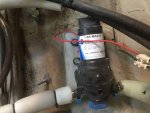
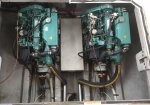
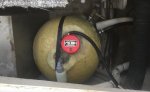
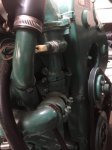
Pics of install
Any flex rubber hoses you can see are the pipes from motor to tank
Close up of engine pic you can see one hose and right at the bottom of the pic you can see the jubilee clip for the the other hose.
Both engine pic, the hoses goes from the top right hand corner of the Port engine to the bulkhead then run down the Port side hull

I have now got to go to work, so will check in tomorrow
Thank you
 

Attachments

  • Screen Shot 2018-09-30 at 03.27.13.jpg
    Screen Shot 2018-09-30 at 03.27.13.jpg
    111 KB · Views: 15
  • Screen Shot 2018-09-30 at 03.29.56.jpg
    Screen Shot 2018-09-30 at 03.29.56.jpg
    125 KB · Views: 16
  • Screen Shot 2018-09-30 at 03.27.58.jpg
    Screen Shot 2018-09-30 at 03.27.58.jpg
    66.9 KB · Views: 17
  • Screen Shot 2018-09-30 at 03.30.32.jpg
    Screen Shot 2018-09-30 at 03.30.32.jpg
    54.7 KB · Views: 17
Last edited:
Yes sorry, Hardy 27, two VP MD22l 59bhp engines.
Not raw water cooled and as does not run hot assume impellors are fine?

How do I get rid of an air lock? and more to the point how did one get in there in the first place?
The engine take off points are higher than the calorfier.
If the tap is just cracked a knatts the water flow and the pump will surge slightly, open the tap further and and the flow turns steady, pump is 2.9 bar
I have cracked the calorfier pressure relief valve and it opens and shuts just fine, when open a steady flow of water drops into the bilge.

I cant post pics, but the two coolant hoses run from the right hand side of the Port engine, forward to the bulkhead then down the Port side of the boat to the calorfier, I reckon the pipe run is approx 10 feet maybe a little more.
The fresh water pump on these are driven by the fan belt, so the pump will be turning, the impellors are cast iron so wont have worn away, anyway the engine would be overheating if it wasnt working. The pipes for the calorifier are usually plugged in to near the thermostat housing and in to the delivery hose from the pump. So not much to go wrong there. If you start the engine from cold you can feel the hot water going to the calorifier first before the thermostat opens, so start from cold, feel the top of the thermostat housing, does it stay cold until the engine AND the pipes to the calorifier are hot? Then does it warm up? If it all warms up together then the thermostat is knacked!
 
Last edited:
Top