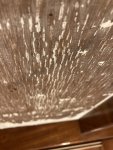
Cabin ceiling mould

oilybilge

Well-Known Member
Joined
3 Nov 2017
Messages
213
Location
Suffolk
Visit site
The decks of my Finesse 24 are made of plywood sheaved with fibreglass. The undersides (ie the cabin ceilings) are painted. It's a damp old wooden boat and we get a lot of condensation on the ceilings, and over the last couple of years hundreds of little mouldy cracks have appeared in the paint that correspond to the grains of the plywood. This week I've been stripping the paint with a hot air gun. The plywood actually seems in sound condition, and hopefully the heat gun will have killed the mould that lodged itself in the surface grains.

Question is, what do I do now? (Apart from increasing ventilation, which I'm working on). Since the mould is probably caused by all the condensation inside the cabin, would a coat of epoxy on the underneath of the plywood be a good idea, prior to painting it again? Or is that inviting more problems? Otherwise my plan is to repaint using standard marine gloss but with a mould inhibitor added. Prior to doing that, is there some anti-mould treatment I can put on the plywood?

All advice gratefully received....
 
You would be wise to treat the plywood with some bleach. Buy the cheapest supermarket thin bleach as this is not perfumed. Dilute with water, 4 parts to 1. Brush on and leave to dry. Lightly sand and then paint with primer, undercoat and top coat. Personally I would apply 2 coats of undercoat and top coat for a better seal over the wood.
 
Is it just me, or does that plywood look like it is starting to delaminate? That splitting along the grain of the veneer doesn't look right. I wonder if it would be good to coat it with epoxy resin, using a slow curing type to allow it to penetrate into the grain and crevices. Or is there too great a danger of sealing damp in?
 
Depends on how far you want to go or spend. Hawke House do some self adhesive closed cell foam which could be covered in thin ply with vinyl covering.
Just don't get the stuff that is sticky on both sides it is a nightmare to work with. I used it on my last boat.

Just about to reline the forepeak in my current boat and not using the Hawke House stuff.
 
I did my cabin interior with bathroom emulsion and was pleased with the result. It was a nice semi matt finish and mould resistant also cheap.
I agree the plywood doesn't look too good.
 
Thanks for the replies chaps. I think -- I hope -- the plywood isn't as bad as it looks in the photo. I've prodded and poked it and not noticed any softness or delamination.

I'm veering towards the idea of an epoxy primer. I know there's a danger of trapping damp in the ply, but I think the damp from the condensation on the underside is the worse of two evils here.
 
It might be useful to borrow or buy a meter to check how much moisture you have there, I think they can be under £20 now. You would be much happier sealing it if it is c 20% or less.
Possibly a generally handy piece of kit for a wooden boat owner, anyway.
 
Agree with using bleach to kill the mould spores. Difficult to get a boat built like a Finesse down to low moisture level, but worth using a moisture meter to find out what it actually is. The forepeak of my plywood roofed boat was in the 30%+ when surveyed because there are 2 leaks in the coachroof, but rest of the boat interior was 15-20%. Currently running a dehumidifier 2 hours a day trying to bring the general level in the forepeak as has temporarily sealed the leaks pending proper repair when it gets warmer.

For paint I use normal household Dulux on interior ply. One coat of their "Difficult surfaces" primer and 2 coats of satin topcoat. Much easier to apply than yacht paint particularly overhead. Household environments, particularly kitchens and bathrooms are far more hostile than the interior of most boats. I used similar on my last wooden (plywood) boat interior and after nearly 20 years was as good as new
 
A couple of hours with a fan heater will reduce the moisture contact to an acceptably low level.
You know more than I, but will that really be enough?

My boat is bigger, but if I leave the dehumidifier running then I can see it getting drier over the course of a week or two. The boat doesn't need to be hermetically sealed (this always seems to come up in discussions of dehumidifiers) as the machine appears to be able to dry the air faster than moisture disperses in.
 
I'd expect a couple of hours to go some way to drying the air and, probably the surface but, if that's the underside of the deck, it's likely to be fairly thick. It would take weeks to get it dry inside. I'd be inclined to paint it with one of those microporous paints inside, do what I can to make sure no more water gets in from the top, and see what happens.

If it really is only condensation, and the interior of the ply is dry then, yes, epoxy and paint with a kitchen/bathroom antimould paint or similar.
 
You know more than I, but will that really be enough?

My boat is bigger, but if I leave the dehumidifier running then I can see it getting drier over the course of a week or two. The boat doesn't need to be hermetically sealed (this always seems to come up in discussions of dehumidifiers) as the machine appears to be able to dry the air faster than moisture disperses in.
Hot air rises and will dry the underside of the deck far faster than the whole boat. A dehumdifier will also be pulling moisture out of the atmosphere, bunk cushions, bilges, etc. Provided the wood feels warm to the touch, it will dry far quicker than a complete boat interior.
 
Hot air rises and will dry the underside of the deck far faster than the whole boat. A dehumdifier will also be pulling moisture out of the atmosphere, bunk cushions, bilges, etc. Provided the wood feels warm to the touch, it will dry far quicker than a complete boat interior.
Correct - I am using both the fan heater for more localised drying out - and even the hot air gun in one specific place. The dehumidifier, as you say will bring down the overall moisture level in the boat - but slowly. Like many things with boats there is no one technique or solution. Interestingly, my all wood boat never suffered from mould or dampness, even when laid up outside but covered up for 9 years. Open bilges and cockpit plus flow of air from a propped open forehatch helped.
 
The coachroof on my yacht and the linings hiding the underside of the GRP deck are plywood and have found Dulux bathroom emulsion to be ideal paint for them.
Easy to use, durable and not expensive.
 
Correct - I am using both the fan heater for more localised drying out - and even the hot air gun in one specific place. The dehumidifier, as you say will bring down the overall moisture level in the boat - but slowly. Like many things with boats there is no one technique or solution. Interestingly, my all wood boat never suffered from mould or dampness, even when laid up outside but covered up for 9 years. Open bilges and cockpit plus flow of air from a propped open forehatch helped.
Strangely I remember a chat some 30 years ago with a marina security guard who lived in a small motorboat all year round. He had tried glassfibre, steel and wood boats and found the first two types incrdibly cold in winter and always covered with condensation internally. By comparison the woodern boat was able to retain warmth better and had very little condensation. So, if he had reduced condensation, the wood should not be affected if the paint was doing its job of keeping the wood moisture free.
 
Top