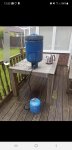
Butane transfer to small bottle

Not sure that a BLEVE is the most likely consequence. I have heard of users of stoves experiencing liquid butane at their stove, Bad enough but not as bad as a bottle rupture.

Just had a look. They do have a PRV - 21 Bar for butane, 26 Bar for propane. So BLEVE unlikely. But then they are always unlikely. They happen on the day when all possible failures line up - and overfilling is the first...
 
Last edited:
Just had a look. They do have a PRV - 21 Bar for butane, 26 Bar for propane. So BLEVE unlikely. But then they are always unlikely. They happen on the day when all possible failures line up - and overfilling is the first...
Is that PRV on Calor bottles? The vast majority of bottles I see that are DIY filled are Camping Gaz or the Greek ones that appear to be identical. I don't think they have a PRV.
 
When I was last involved in decanting gases between big and small bottles, we used to cool the 'recipient' bottle.
The two bottles are then at nearly the same pressure, but the gas condenses in the cold bottle and liquid is drawn through the connecting tube.
 
Yes. You can't compress liquids by any significant amount at gas bottle pressures, otherwise hydraulic lines on JCB's would not work, as this applies to all liquids. Similarly, if a liquid is heated the expansion will create enormous pressure if the volume is constrained, way beyond what a Calor gas bottle will hold. The bottle may spit and a BLEVE will result.
For a BLEVE to happen the contents of the gas container need to be heated.

An interesting YouTube video here

 
For a BLEVE to happen the contents of the gas container need to be heated.

Yes. However, the pressure increase from thermal expansion of a constrained liquid is so great that even a small temperature rise will create forces that will deform the containment - firstly elastically, then plastically, and then failure.

LPG are above their boiling point at room temperature, so once the containment pressure is released the liquid will vaporise rapidly, especially propane. I realize this is all a bit theoretical as it's probably difficult to fill a gas bottle to 100%, and the bottle suppliers may have designed the bottles to be able to deform plastically even if 100% full in everyday temperatures they are likely to reach short of a fire - but if a bottle was able to be filled 100% and left out in the Greek summer sun all day, perhaps it might split. It may not be as exciting as a fire triggered BLEVE as in the video, but I still wouldn't want to be standing too close. (The video does dramatize it a bit - there doesn't have to be a fire. Superheated water will do nicely). The BLEVE might not be much more than a clang, but there may be a lot of LPG liquid squirting about that would be rapidly vaporising, which could be detrimental to your health.
 
Last edited:
Yes. However, the pressure increase from thermal expansion of a constrained liquid is so great that even a small temperature rise will create forces that will deform the containment - firstly elastically, then plastically, and then failure.

LPG are above their boiling point at room temperature, so once the containment pressure is released the liquid will vaporise rapidly, especially propane. I realize this is all a bit theoretical as it's probably difficult to fill a gas bottle to 100%, and the bottle suppliers may have designed the bottles to be able to deform plastically even if 100% full in everyday temperatures they are likely to reach short of a fire - but if a bottle was able to be filled 100% and left out in the Greek summer sun all day, perhaps it might split. It may not be as exciting as a fire triggered BLEVE as in the video, but I still wouldn't want to be standing too close. (The video does dramatize it a bit - there doesn't have to be a fire. Superheated water will do nicely). The BLEVE might not be much more than a clang, but there may be a lot of LPG liquid squirting about that would be rapidly vaporising, which could be detrimental to your health.
Liquid butane expands quite a bit as it warms, maybe 5% from 25 to 50degC, so if the cylinder is say 98% full, a 10 degree rise in temperature could generate huge pressure.
Butane - Density and Specific Weight vs. Temperature and Pressure

Personally, if I was in this game, I'd aim to fill it to maybe 90% of the recommended max and refill it 10% more often.
Allow a good margin because my weighing might be wrong.
Even non-flammable gases leaving a bottle in a hurry can be dramatic.
The downside of putting a bit less in the bottle are between negligible and zero unless trading standards are going to hound you for short measure!
 
Having taken a Camping gaz bottle to bits, there is no PRV, but there is a rubber bit in the tank under the valve that has a diagonal slit in it. I suspect it is to limit the escape of gas if the connection/reg fails. As, it will close or limit the escape of gas, beyond what is normal.

Like the idea of cooling the smaller cylinder. 13kg here costs about €28 from Carrefour. Camping Gaz about the same for 2 odd kg. Bottle deposit is €5 for Carrefour, but €26 or more for CG. Can't remember the last time I exchanged a CG, always top them up from bigger cylinders.
 
Yes. However, the pressure increase from thermal expansion of a constrained liquid is so great that even a small temperature rise will create forces that will deform the containment - firstly elastically, then plastically, and then failure.

LPG are above their boiling point at room temperature, so once the containment pressure is released the liquid will vaporise rapidly, especially propane. I realize this is all a bit theoretical as it's probably difficult to fill a gas bottle to 100%, and the bottle suppliers may have designed the bottles to be able to deform plastically even if 100% full in everyday temperatures they are likely to reach short of a fire - but if a bottle was able to be filled 100% and left out in the Greek summer sun all day, perhaps it might split. It may not be as exciting as a fire triggered BLEVE as in the video, but I still wouldn't want to be standing too close. (The video does dramatize it a bit - there doesn't have to be a fire. Superheated water will do nicely). The BLEVE might not be much more than a clang, but there may be a lot of LPG liquid squirting about that would be rapidly vaporising, which could be detrimental to your health.
The video is typically American, where even a fart can be made to sound like an earth shattering event!

Many, many moons ago the local filling station caught fire in the middle of the night. At 1600 hours the following day six firemen transported a rather hot propane cylinder to the local river to 'cool down' they did not look happy men!
 
thank you . I really only wanted to know the % left in each bottle when it reached equilibrium.
I've done it many times, assuming it's full the 15kg bottle will fill it once in <30 minutes, second time around you'll get perhaps 5kg to transfer, but it'll take >1 hour; regarding the 'don't overfill' warnings, we carried a cheap spring balance: weigh the empty bottle, then stop when it's weighing 7.5kg heavier.
 
I've done it many times, assuming it's full the 15kg bottle will fill it once in <30 minutes, second time around you'll get perhaps 5kg to transfer, but it'll take >1 hour; regarding the 'don't overfill' warnings, we carried a cheap spring balance: weigh the empty bottle, then stop when it's weighing 7.5kg heavier.
Thank you thank you thank you . That's all I need to know. Now I'll look at the safety aspects etc etc. (y)(y)(y) edit : just noticed you're from G.O.C., my birthplace (Ellingstring)
 
Guess it would be easy to put a membrane or rubber ball in the thing so it could never be dangerously overfilled.
However I don't suppose they are in the business of making things simple for Practical Boatowners. ?
 
That's all I need to know. Now I'll look at the safety aspects etc...

Over and above the general info you'll find and especially when doing the second decanting, aim to hoist your donor bottle at least 6' above the empty one. Also - not so easy this time of year - try to leave the donor bottle out in the full sun for a while whilst keeping the empty bottle in the shade.
 
Liquid Propane gas is the only gas available here. I have a Primus gas cylinder which has been filled by the gas supplier. hardware store or sometimes petrol station. The storage tank is probably 200 litres sitting on the ground out side. it has I believe a pick up tube to the bottom. So when you take off gas it comes out as liquid being pressurized by the gas vapor above the liquid. They connect the hose to your cylinder. They open a small valve near the top of the cylinder so any residual gas starts to escape. They open both valve on supply cylinder and on the receiving cylinder. Liquid flows into receiving cylinder until after a few minutes the gas escaping from the tell tale valve turns noticeably to liquid. That indicates the cylinder is full ie with still a gas space above the liquid.
Now it seems that cylinders referred to in this post do not have this tell tale escape valve. So you would have to estimate by weight the volume of liquid gas in the cylinder.
If you are decanting from one cylinder to another as said you must have the supply cylinder upside down. If you don't you will only fill the receiving cylinder with gas (vapor) which won't do you much good at all. You need to get that liquid in. it is the vapor in the supply cylinder that will help push the liquid out.
Needless to say you must do it outdoors with no flame nearby and beware you can hurt your self with cold liquid if it escapes.
I understand plumbers here can play liquid LPG on to a pipe to freeze the water in the pipe to permit change of valve where you can't cut off supply pressure.
I understand that in colder climates propane is used having a willingness to evaporate at lower temperatures. Not so much of a problem here. Though hot air balloonists love to fly on the coldest mornings and will take cylinders into accommodation so they don't get too cold over night. Their cylinders have a take off at the bottom so liquid is fed to the burners where a heat exchanger vaporises to gas. They can use a lot of gas. Like 4 x 60 litre cylinders emptied in perhaps 20 mins of burning. (hint if you ever go for a ride in a hot air balloon and are tall wear head covering as radiated heat is fierce. ol'will just waffling
 
Liquid Propane gas is the only gas available here. I have a Primus gas cylinder which has been filled by the gas supplier. hardware store or sometimes petrol station. The storage tank is probably 200 litres sitting on the ground out side. it has I believe a pick up tube to the bottom. So when you take off gas it comes out as liquid being pressurized by the gas vapor above the liquid. They connect the hose to your cylinder. They open a small valve near the top of the cylinder so any residual gas starts to escape. They open both valve on supply cylinder and on the receiving cylinder. Liquid flows into receiving cylinder until after a few minutes the gas escaping from the tell tale valve turns noticeably to liquid. That indicates the cylinder is full ie with still a gas space above the liquid.
Now it seems that cylinders referred to in this post do not have this tell tale escape valve. So you would have to estimate by weight the volume of liquid gas in the cylinder.
If you are decanting from one cylinder to another as said you must have the supply cylinder upside down. If you don't you will only fill the receiving cylinder with gas (vapor) which won't do you much good at all. You need to get that liquid in. it is the vapor in the supply cylinder that will help push the liquid out.
Needless to say you must do it outdoors with no flame nearby and beware you can hurt your self with cold liquid if it escapes.
I understand plumbers here can play liquid LPG on to a pipe to freeze the water in the pipe to permit change of valve where you can't cut off supply pressure.
I understand that in colder climates propane is used having a willingness to evaporate at lower temperatures. Not so much of a problem here. Though hot air balloonists love to fly on the coldest mornings and will take cylinders into accommodation so they don't get too cold over night. Their cylinders have a take off at the bottom so liquid is fed to the burners where a heat exchanger vaporises to gas. They can use a lot of gas. Like 4 x 60 litre cylinders emptied in perhaps 20 mins of burning. (hint if you ever go for a ride in a hot air balloon and are tall wear head covering as radiated heat is fierce. ol'will just waffling
This is making more sense to me now. I lived in Australia ( Victoria) and can remember getting the bbq gas bottle filled at the servo from a tall bottle. Obviously it was different gas to what we use here in Ireland. I remember waiting to see the gas "leak" out of the small bottle and then screwing it tight.
 
Top