Burned out starter and alternator Yanmar 3YM30

pugwash01

Member
Joined
19 May 2014
Messages
30
Visit site
Have heard that inadvertently turning the 'ignition' key back to 0 with the engine still running can fry the alternator, but can it burn out both that and the starter motor? And if so how?

 
Turning off the main batt switches can fry an alternator, but I can't really see how turning the ignition switch off would on most setups. Re the starter: what are the symptoms and what happened as it seems a bit odd?
 
Have heard that inadvertently turning the 'ignition' key back to 0 with the engine still running can fry the alternator, but can it burn out both that and the starter motor? And if so how?

Its a myth.

If the battery is disconnected / switched off while the engine is running the alternator (diodes) may well be damaged but turning the key to the off position does not do it.

The operating instructions tell you not to turn the key to off while the engine is running because it will disable all the warnings and alarms
 
We had smoke in the companionway after running the engine for circa 5 minutes. Immediately stopped engine.

Had a look after smoke dispersed and starter v. hot. It also would no longer turn over. We are pretty sure the key was not at 0, but the charter company. say it must have been and that is why both the starter and alternator have burned out.

Is there any credible technical explanation for the alternator and starter having failed at the same time?
 
Turning anything and everything off wouldn't burn out the starter. Charter co. are possibly trying it on.

I wonder - if the starter stuck in, could it have an electrical effect on the alternator?
 
We had smoke in the companionway after running the engine for circa 5 minutes. Immediately stopped engine.

Had a look after smoke dispersed and starter v. hot. It also would no longer turn over. We are pretty sure the key was not at 0, but the charter company. say it must have been and that is why both the starter and alternator have burned out.

Is there any credible technical explanation for the alternator and starter having failed at the same time?

Yep, I guess the starter motor didn't did-engage when you started the engine. Once the engine is running the engine drives the starter motor and it turns into a generator. The amps it makes can be huge. This will burn out the starter and likely blow the alternator. It happened to me a few years ago in the middle of the Bay Of Biscay. We had had the starter refurbished before we set off on an Atlantic Circuit. The clown that 'refurbished' if lubricated the bendix with a heavy oil that caused the bendix to jam open. On the battery monitor I saw 250 amps positive!! I couldn't stop the engine due to the starter being engaged so had to isolate the batteries. I suspect this blew the alternator diodes. Fortunately I got to the problem quickly so the starter, although severely over heated was repairable on route. The alternator was bin material.
 
We had smoke in the companionway after running the engine for circa 5 minutes. Immediately stopped engine.

Had a look after smoke dispersed and starter v. hot. It also would no longer turn over. We are pretty sure the key was not at 0, but the charter company. say it must have been and that is why both the starter and alternator have burned out.

Is there any credible technical explanation for the alternator and starter having failed at the same time?

First, I agree with anoccasionalyachtsman that the charter co may be trying to have you on here. There is no accidental user combination which could have credibly done this. What has almost certainly happened here is that there is either a fault in the starter motor (which got jammed into / failed to retract from the flywheel and thereby acted as a generator as any electric motor may), or some problem in the ignition wiring/solenoid somewhere.

On the face of it you are as much responsible for this damage as you are for the recent SpaceX disaster !!
 
With the almost universal design of a pre-engaged starter pinion, I'd think that the most common cause of a starter remaining engaged is a stuck key-switch, the contacts not separating even if the key appears to be in the correct position. The corrosive marine environment is conducive to this type of fault.
I've no idea what the electrical characteristics are of a starter driven as a dynamo, but I can't readily see any way that dc electrical power could flow into the alternator sufficient to burn it out. If somehow the system voltage went high enough to do that, I'd look for secondary damage on items such as the battery, instruments etc. etc.
Extra thought; if the engine was running after the starter burned out, the alternator might be seeing a direct short circuit through the solenoid. Any reason why not? But the battery would complicate this theory.
 
Last edited:
Urban myth, look up the construction of the pre-engaged starter motor construction and you will note that immediately behind the pinion contained in that lump of pressed steel is a roller clutch designed to prevent engine driving the start motor.
 
Urban myth, look up the construction of the pre-engaged starter motor construction and you will note that immediately behind the pinion contained in that lump of pressed steel is a roller clutch designed to prevent engine driving the start motor.

The starter-motor-as-generator part of the story might be incorrect because of the anti-overrun clutch but it's perfectly possible for the ignition switch to be jammed on start such that the starter motor burns out.

That would ensure that the alternator would be working very hard trying to top up the battery but I'm not sure why this would cause it to burn out as well.

Richard
 
Urban myth, look up the construction of the pre-engaged starter motor construction and you will note that immediately behind the pinion contained in that lump of pressed steel is a roller clutch designed to prevent engine driving the start motor.
Quite right, brain fade on my part. In fact, an engaged pinion would destroy the starter due to high revs. That theory can be ruled out.
A stuck solenoid will still burn out the starter though.
 
Urban myth, look up the construction of the pre-engaged starter motor construction and you will note that immediately behind the pinion contained in that lump of pressed steel is a roller clutch designed to prevent engine driving the start motor.
My engine was a Yanmar 3HM35. The starter definitely stayed engaged as I heard an unusual noise, checked the instruments and the battery management display showed the 250 amp charge rate. Pulling the mechanical engine stop handle wouldn't stop the engine. The sliding bendix on examination, was stuck out. We never had an issue with the start switch and once the bendix was cleaned up, the issue never arose again.
 
My engine was a Yanmar 3HM35. The starter definitely stayed engaged as I heard an unusual noise, checked the instruments and the battery management display showed the 250 amp charge rate. Pulling the mechanical engine stop handle wouldn't stop the engine. The sliding bendix on examination, was stuck out. We never had an issue with the start switch and once the bendix was cleaned up, the issue never arose again.

That sounds like the old spring bendix/centrifugal design of starter motor. With a modern pre-engaged solenoid starter the flywheel will only turn the starter cog and not the armature.

Richard
 
........With a modern pre-engaged solenoid starter the flywheel will only turn the starter cog and not the armature....
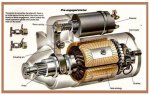
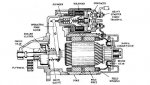
I do not agree. Once the solenoid has engaged the pinion to the flywheel it is possible for the engine to drive the starter motor.

It happened on my Volvo and the motor was entirely destroyed. The new Bosch motor had to be ordered from Germany and cost £400 and that was 20 years ago. I hate to think of the cost today.

pre-engaged starter.jpgPre-engaged starter 1.jpg
 
Last edited:
Thanks very much everyone. So is the conclusion that 'operator error' can't cause both the alternator and generator to burn out.?

Also assuming they have burnt out, at the same time, the most likely cause is with the key switch circuitry?
 
That sounds like the old spring bendix/centrifugal design of starter motor. With a modern pre-engaged solenoid starter the flywheel will only turn the starter cog and not the armature.

Richard

You're the mechanical whizzo here; I'm just wondering how common defects are in the overrunning gear which isolates the starter cog from the armature as the engine powers up?
 
I do not agree. Once the solenoid has engaged the pinion to the flywheel it is possible for the engine to drive the starter motor.

It happened on my Volvo and the motor was entirely destroyed. The new Bosch motor had to be ordered from Germany and cost £400 and that was 20 years ago. I hate to think of the cost today.

View attachment 59978

In fact shown as "Roller Clutch" in your diagram.

Richard
 
Top