Burned out starter and alternator Yanmar 3YM30

I seem to remember Bendix starters can make horrible noises too....

Indeed. Bendix starters often caused me problems back in the day, always accompanied by horrible noises. Pre-engaged starters are usually much less problematic on the mechanical side ... but this thread just goes to show that even "modern" technology is not fool-proof. :(

Richard
 
this thread just goes to show that even "modern" technology is not fool-proof. :(

Richard

Modern technology applied to engine starting is what we need. Brushless, digital, silent, neodymium permanent magnet motors connected directly and permanently to the crankshaft instead of these antiquated inertia and pre-engaged analog motors operating via a pinion and ring gear .
 
I do not agree. Once the solenoid has engaged the pinion to the flywheel it is possible for the engine to drive the starter motor.
Quite true. I did exactly this last year. There are several keys on the ring with my ignition key, and one jammed under the ignition key when I turned the engine on, preventing it from turning back to the normal running position, so the engine then drove the starter motor while it was still being powered from the battery.

We puzzled about where the smell was coming from for about 20 minutes! £425 for a new starter motor (with fitting) from IBA at Nidri.
 
Last edited:
Quite true. I did exactly this last year. There are several keys on the ring with my ignition key, and one jammed under the ignition key when I turned the engine on, preventing it from turning back to the normal running position, so the engine then drove the starter motor.

We puzzled about where the smell was coming from for about 20 minutes! £425 for a new starter motor (with fitting) from IBA at Nidri.

It didn't do what you think. The engine did not drive the starter motor, the pinion clutch would prevent that. What does happen under the conditions you describe is that the motor just runs continuously (obviously) and it's not rated to do that, so it burns out (as you found).
 
Quite true. I did exactly this last year. There are several keys on the ring with my ignition key, and one jammed under the ignition key when I turned the engine on, preventing it from turning back to the normal running position, so the engine then drove the starter motor.

We puzzled about where the smell was coming from for about 20 minutes! £425 for a new starter motor (with fitting) from IBA at Nidri.

I feel happier now that I realize that I am not the only idiot who has done this. Thanks. :o
 
It didn't do what you think. The engine did not drive the starter motor, the pinion clutch would prevent that. What does happen under the conditions you describe is that the motor just runs continuously (obviously) and it's not rated to do that, so it burns out (as you found).
Thanx PaulRainbow, I'm sure you are right. At least we were able to sail out of it. I remember when [incredibly long rant about the good old days] ... [/end of rant] know better for another time.
 
An email form the charter co.:

"Dear Mr. ****** ,

You will be aware of the fault that appeared whilst you were out on charter on September 13th.

Following discussions with **********, I have consulted both Barrus technical department, who are the importers for Yanmar marine engines, and also a local marine surveyor who is familiar with this type of yacht.

The conclusion is that operator error has allowed the ignition panel to be switched of for a period of time which has allowed an electric feed from the alternator to burn out the protective earth and subsequently the starter motor and rectifer diode. This I understand is a common fault from Barrus and Yanmar have changed the ignition panels over the years to eliminate this operator problem. The marine surveyor also confirmed the same fault and has seen the same on a number of occasions.

You will be aware that **** been in touch by email with me indicating he has spoken to people in the industry that have not come across the problem. I find this hard to accept, as did the marine surveyor. I understand that **** was the skipper on the day and should have been aware of how the yacht is operated as he has also been on the same yacht on a number of occasions.

I have attached the invoice for the repairs. Please settle the invoice within 24 hours of receipt of this email. If you do not we reserve the right to take the payment from the card details you left as a security deposit at the time.

Regards"

Any thoughts?
 
An email form the charter co.:

"Dear Mr. ****** ,

You will be aware of the fault that appeared whilst you were out on charter on September 13th.

Following discussions with **********, I have consulted both Barrus technical department, who are the importers for Yanmar marine engines, and also a local marine surveyor who is familiar with this type of yacht.

The conclusion is that operator error has allowed the ignition panel to be switched of for a period of time which has allowed an electric feed from the alternator to burn out the protective earth and subsequently the starter motor and rectifer diode. This I understand is a common fault from Barrus and Yanmar have changed the ignition panels over the years to eliminate this operator problem. The marine surveyor also confirmed the same fault and has seen the same on a number of occasions.

You will be aware that **** been in touch by email with me indicating he has spoken to people in the industry that have not come across the problem. I find this hard to accept, as did the marine surveyor. I understand that **** was the skipper on the day and should have been aware of how the yacht is operated as he has also been on the same yacht on a number of occasions.

I have attached the invoice for the repairs. Please settle the invoice within 24 hours of receipt of this email. If you do not we reserve the right to take the payment from the card details you left as a security deposit at the time.

Regards"

Any thoughts?

Get onto your card company immediately and get them to cancel that card with immediate effect. It's a 24 hour service.

The deal with the idiots at your leisure.

Richard
 
Can you remind me what boat and age we're talking about? The 3YM30 manual that I've found online doesn't mention an 'ignition switch' with a position 0 as you describe, but has a power button?
 
"protective earth"- complete and
utter bull!
edit.. time to name and shame this outfit now, and the 'surveyor' ☺
 
Last edited:
OK. Am I being a bit thick? The engine is a modern-ish unit with an electrical fuel shut-off solenoid? I had thought we might be discussing something that had a pull to stop T handle.

If that's correct then the engine should have stopped if the key had been turned to off, surely?
 
Last edited:
If that's correct then the engine should have stopped if the key had been turned to off, surely?

Most boat installations work as pugwash described: turning off the ignition key does not stop the engine, unlike every diesel car and van I've ever sat in. Why this should be is a mystery to me, although if there is a reason I'm all ears. (Our boat, for what it's worth, has no key switch, just push-buttons for glow, start and stop, so any such issues, real or imagined, can't arise.)
 
Last edited:
Thanks, it's about 50/50 on boats I've used over more recent years which have had an on/off switch or a stop button/pull.

I was looking at a manual (for the one with a power button as opposed to pugwash's rotary switch) that only warns against isolating the battery. 'We' need to find the correct manual for this panel and see what it says.
 
The paragraph at the top of page 31 could be said to deal with this, but the underlying message seems to be that the instruments and warnings won't work with the key off rather than anything to do with electrical damage. That's covered separately on p32 and specifically does mention electrical damage being caused by turning off the battery isolator.

Where to go with this now?

Didn't there used to be a Yanmar agent posting on this site?

Volvopaul might help if you contact him - he knows most boat engines.

I'd certainly contact the card provider and tell them not to allow any debits, as already suggested.

Be ready to demand access for your surveyor and engine specialist access to examine the damaged parts.

I'd also tell the charter co to read this thread.

Lastly, and they should take note of this, I'm a serial charterer and I'd really like to know who it is so that I can avoid them.
 
Last edited:
I think this is it. P.30 covers starting etc. http://j30.us/files/2YM15-Operators-Manual.pdf

Do you have the wiring diagrams that go with that?
None of the circuits I've seen show any way for the key being off to damage the alternator.
Let alone the starter.
But apparently it happens.
It could be the yacht builder uses different wiring.
I might suggest the OP asks the charter co for a copy of the correspondence from Barrus.
But this might sound like an admission of running with the key switch off.

Maybe you just have to see it as blowing up while you're skipper, buck stops with you?
 
I think this is it. P.30 covers starting etc. http://j30.us/files/2YM15-Operators-Manual.pdf

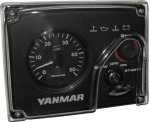
It's a Yanmar type B ....... exactly the same as my two:

IMG_4544.JPG


(The silver corners are my modification from an earlier thread.)

On charter boats the keys (they're all identical) are often locked in with a stud so they can't be lost. I have removed the studs on mine so I can remove the keys but sometimes I want to start both engines for a short test run after doing some work so I grab one key, start one engine, turn the key to "Off", put in in the other engine and start that one. Both engines are then running with only one key. It's all fine. :)

I don't know how much you are being expected to pay for this "fantasy" damage but if it was more than £100 I would have already cancelled the card.

Richard
 
I think that you are being fed complete balderdash, supposedly from "expert" sources. The term "protective earth" is, to my understanding, normally used for a circuit feature that prevents, say, electric shock to the operator. Use of the term here seems plucked from the air in an attempt at sounding technical in order to baffle the layman, ie: "bulls**t baffles brains."
The Operator's Manual that you link to warns only that the key will switch off the alarms, that is entirely as one would expect.
I would certainly ask for a copy of the Barrus communication, together with a marked up circuit diagram to highlight the wiring concerned.
If this is not forthcoming, you could take steps to prevent payment and invite a county court small claim action against you. That might focus their minds on providing real evidence.
 
Top