Bukh DV20 water pump problem

sgr143

Well-Known Member
Joined
26 Jul 2016
Messages
493
Location
Oxford & WicorMarine
Visit site
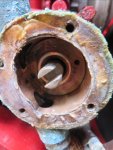
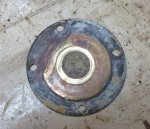
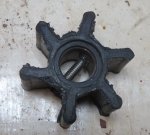
I've not been happy with the (direct seawater) cooling on my DV20. It's gone from chucking great splurts of water out the back to something rather less, and the water-T alarm just hovers on the edge of going off pretty well all the time. After a short trip yesterday I took the cover off the pump and was rather alarmed at what I found. See pictures. I wonder whether I've mistakenly fitted a slightly wrong type of impeller that has rubbed these bright tracks on the cover and the pump interior, and also presumably has been letting water round the edges of the blades, which would account for the poor cooling. Stupidly, I didn't bring the impeller and plate back home; I live 80 miles from the boat.

The big question is, what do I do now? I hope that refitting a correct impeller (assuming the one in there now isn't correct - but if it is the right type , then what?), and lapping the front plate flat again will restore enough oomph to the pump to live with, despite the damage to the pump body. Admittedly it's not ideal. Thoughts?
 

Attachments
  • Img_3882a.jpg
    Img_3882a.jpg
    375 KB · Views: 64
  • Img_3883a.jpg
    Img_3883a.jpg
    437.5 KB · Views: 68
  • Img_3884a.jpg
    Img_3884a.jpg
    129.2 KB · Views: 62
Last edited:
If its the original pump, I would probably bite the bullet and fit a new one. ASAP will probably have a replacement in stock. It might work out as being more reliable than refurbing the old pump.
 
If its the original pump, I would probably bite the bullet and fit a new one. ASAP will probably have a replacement in stock. It might work out as being more reliable than refurbing the old pump.

Sensible suggestion £107 from ASAP but cover, gasket, impeller and seals are all available too.
 
I can't see the need to replace the pump unless you've established it's faulty. (They're not cheap.* P.S. Vic's post indicates much cheaper than I thought. Maybe get one and keep the old one for spares.) There's nothing visibly wrong with it. It certainly would benefit from a good clean up, though, and you might see more when that's done.

The cam can wear down over time, as can the wear plate behind it, both giving reduced output. Both can be obtained as spares.

The impeller, and the wear on it, certainly looks odd. The cam can wear down over time, as can the wear plate behind it. Both can be obtained as spares.

You'll need a replacement impeller, whatever, and even if you ended getting a replacement pump that would give you a spare for future use.

Do you have a good inboard seawater filter before the pump? Do you have one of those external grilles that do little to filter the water but do tend to get full of creatures and crud which reduces the flow?
 
I think you will find that the entry into the engine is blocked by salts. The nozzle is partly hidden behind the flywheel, held on by two Allen bolts but can be removed without taking off the flywheel. The back pressure generated by this has caused the pump to try to deliver higher than design pressure, hence the characteristic damage. A less likely alternative is that the thermostat could be stuck open, which blocks the bypass, although water will still flow through the engine passages.
 
I think you will find that the entry into the engine is blocked by salts. The nozzle is partly hidden behind the flywheel, held on by two Allen bolts but can be removed without taking off the flywheel. The back pressure generated by this has caused the pump to try to deliver higher than design pressure, hence the characteristic damage. A less likely alternative is that the thermostat could be stuck open, which blocks the bypass, although water will still flow through the engine passages.
"I think you will find that the entry into the engine is blocked by salts. "

I might yet find a convert to the concept of fresh-water flushing after running.
 
I have not carried out an analysis but I think the salts in question are probably insoluble carbonates that are deposited when the cold water hits the hot engine. Flushing is not going to remove them. Periodic soaking in hydrochloric acid is the best option, after removing the anode, but cleaning the entry nozzle every couple of years will solve that particular problem.
 
I think you will find that the entry into the engine is blocked by salts. The nozzle is partly hidden behind the flywheel, held on by two Allen bolts but can be removed without taking off the flywheel. The back pressure generated by this has caused the pump to try to deliver higher than design pressure, hence the characteristic damage. A less likely alternative is that the thermostat could be stuck open, which blocks the bypass, although water will still flow through the engine passages.
Vyv - I took this out in November 2017 (on your recommendation I think), and it was clean as a whistle. So I don't think it's likely to have clarted up again since. Or could it have? I'll have a look, though I recall that one of the bolts is a bit of a sod to get at. I checked the thermostat operation fairly recently as well, though I could do it again.
 
Sensible suggestion £107 from ASAP but cover, gasket, impeller and seals are all available too.
Are they an easy job to fit? (I'm OK with moderate levels of spannering, up to the level of rebuilding 1960s british motorcycle engines)
[edit: just looked at the DV20 workshop manual. Looks easy enough as long as there are no unexpected surprises: remove two bolts and take it off.]
[edit 2 - mine's a later engine number where the manual says the pump is attached by a clamp. Well, I'll just have to go and have a look. Luckily the boat is very close to ASAP in Fareham, so a bit of to-ing and fro-ing should sort it out. ]
 
Last edited:
Do you have a good inboard seawater filter before the pump? Do you have one of those external grilles that do little to filter the water but do tend to get full of creatures and crud which reduces the flow?
Yes, there's a filter before the pump. I cleaned out the grille on the hull this winter (just a bit of excess paint, no beasties or crud).
 
Sensible suggestion £107 from ASAP but cover, gasket, impeller and seals are all available too.
Hi Vic - I've looked for the pump on the ASAP website but couldn't find it - could you send the URL? Thanks, Steve
[edit - actually, no worries, I'll just give them a call tomorrow!]
 
Last edited:
Just a quick one on the ASAP pumps for the Bukh engine, it is worth changing the seal springs for O-rings as they have steel springs that will fail in a couple of years only takes a few moments.
 
Vy Cox said ---I think you will find that the entry into the engine is blocked by salts. The nozzle is partly hidden behind the flywheel, held on by two Allen bolts but can be removed without taking off the flywheel. The back pressure generated by this has caused the pump to try to deliver higher than design pressure, hence the characteristic damage. A less likely alternative is that the thermostat could be stuck open, which blocks the bypass, although water will still flow through the engine passages. --

Yv what type of allen key did you use, did you have to cut the end to get it to fit and did you manage to get something on the lever end to break the joint.
David MH
 
Vy Cox said ---I think you will find that the entry into the engine is blocked by salts. The nozzle is partly hidden behind the flywheel, held on by two Allen bolts but can be removed without taking off the flywheel. Yv what type of allen key did you use, did you have to cut the end to get it to fit and did you manage to get something on the lever end to break the joint.
David MH
As far as I recall, I just used a standard allen key of whatever size it was (maybe I started the bolt moving with a standard hex, and then shifted it out with a ball-ended one?), and once the bolts were out, just wiggled the pipe by hand to get it to come out. I seem to recall it was rather more trouble to get the more awkwardly placed of the two bolts started to go back in than it was to get it out.
 
Top