
You are using an out of date browser. It may not display this or other websites correctly.
You should upgrade or use an alternative browser.
You should upgrade or use an alternative browser.
Building dinghy cruiser
- Thread starter Wansworth
- Start date

veshengro
Well-Known Member
Nice to see all those youngsters cooperating to turn out lovely boats. 
Puffin10032
Well-Known Member
That's not a dinghy. Dinghies don't have lids.
Wansworth
Well-Known Member
PickyThat's not a dinghy. Dinghies don't have lids.

DownWest
Well-Known Member
When I saw the thread title, I thought Wansy had abandoned his sofa and started building a boat (as he doesn't seem to be able to find one to suit locally)
But....not.
A 'dinghy with a lid' has been common parlance for quite a while. Probably because of boats with centerboards and not much ballast, so need to be sailed as such, like dinghys.
But....not.
A 'dinghy with a lid' has been common parlance for quite a while. Probably because of boats with centerboards and not much ballast, so need to be sailed as such, like dinghys.
Egret
Well-Known Member
Hunter 19 design brief - I want a Squib with a lid.
Last edited:
DownWest
Well-Known Member
Knew Oliver Lee and built trailers for him. Mostly Squibs. Nice guy.Hunter 19 design brief - I want a Squib with a lid.

Greenheart
Well-Known Member
Here's an idle bank-holiday ramble through the reasons I don't have a boat right now, with observations on dinghy cruising.
I'm still tempted to get a Mirror. It's so incredibly versatile, cheap and easily modified. The chap David Sumner with the Mirror Cruising channel has shown that with careful planning, a Mirror can cruise significant distances. I'd be wary of his totally unsupported round-the-Island trips or Solent-to-Poole, especially in the brisk weather he seems happy to launch in, but clearly it can be done.
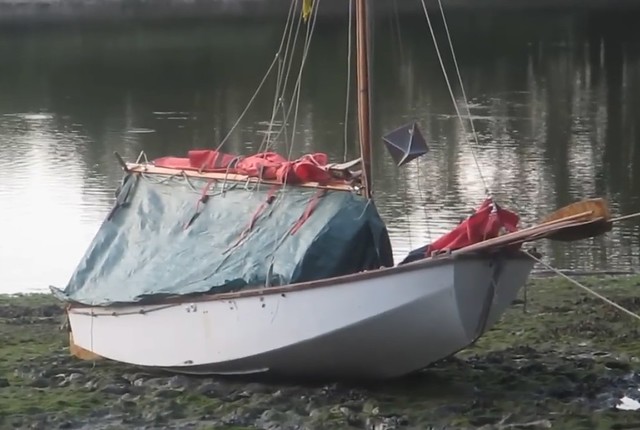
Going up the scale of cost and size, dinghy cruisers seem to be split between conventionally recognised cruising designs like the Wayfarer and GP14 (and many other unballasted open boats that are also raced keenly); and significantly heavier designs, often of traditional style, rig and construction, made mainly or purely for cruising.
Many of the latter style have some fixed ballast and generous hard cuddies that form better accommodation than a tarp over a boom. Whether such a vessel is still a dinghy hardly matters - its use is still basic cruising, which may be no worse for that.
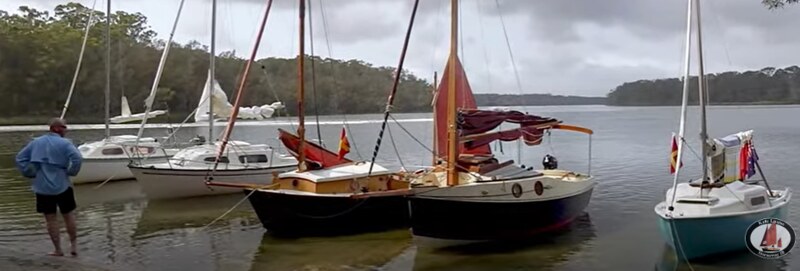
But that photo is from one of the Australian Sailing Kate Louise videos. The participating group has an all-inclusive approach to members' different boats but I especially like that it is all done under the dinghy cruising banner, despite the fact that hardly any boats there would conventionally be classified as dinghies. Again, it hardly matters, but it raises a practical question.
The problems I've always seen (and to which I've found no solution), are as follows:
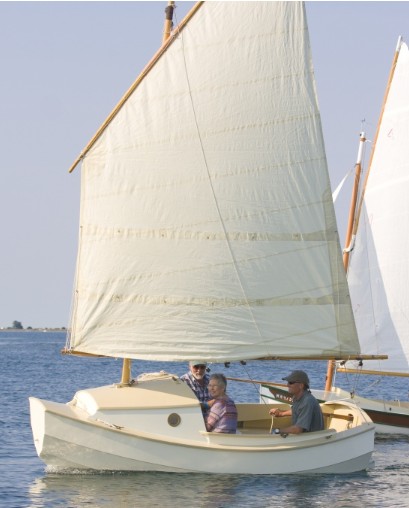
...but, here's the two-pronged problem - firstly, the Scamp definitely can capsize - so there's no reason to assume that it won't, in a seaway on an ambitious cruise (and nor is it certain to stay upright even on a mooring, during gales); and secondly, at the literal end of the day, weighing over 200kg it is too ruddy heavy to haul out without the tow-car backing the trailer down...
...and if you accept the need for a tow-car every time you sail, why not just sail a mini-yacht like a Leisure 17?
The Leisure 17 can just as readily be left on a mooring when it suits; it will never capsize, it can have a heater fitted, and your outboard, galley-box, dry clothes and duvet can stay aboard, rather than invariably needing lugging to and fro, each trip.
I don't say dinghy cruising cannot work, but for me, dinghies' combined openness and vulnerability limits the fun.
There is a class of boat I dream of but haven't seen yet: it will be light enough for the singlehander to haul up a slipway without a vehicle, but will carry enough ballast to be self-righting, thereby enabling open water passages without inviting calamity; and it will have an enclosable portion of the cockpit that effectively forms a draughtproof, rainproof sleeping shelter. I suppose it won't be a dinghy in any purist's view, but if it can be stored inexpensively at a dinghy club, it will escape the costly curse of having to be kept afloat.
.
I'm still tempted to get a Mirror. It's so incredibly versatile, cheap and easily modified. The chap David Sumner with the Mirror Cruising channel has shown that with careful planning, a Mirror can cruise significant distances. I'd be wary of his totally unsupported round-the-Island trips or Solent-to-Poole, especially in the brisk weather he seems happy to launch in, but clearly it can be done.
Going up the scale of cost and size, dinghy cruisers seem to be split between conventionally recognised cruising designs like the Wayfarer and GP14 (and many other unballasted open boats that are also raced keenly); and significantly heavier designs, often of traditional style, rig and construction, made mainly or purely for cruising.
Many of the latter style have some fixed ballast and generous hard cuddies that form better accommodation than a tarp over a boom. Whether such a vessel is still a dinghy hardly matters - its use is still basic cruising, which may be no worse for that.
But that photo is from one of the Australian Sailing Kate Louise videos. The participating group has an all-inclusive approach to members' different boats but I especially like that it is all done under the dinghy cruising banner, despite the fact that hardly any boats there would conventionally be classified as dinghies. Again, it hardly matters, but it raises a practical question.
The problems I've always seen (and to which I've found no solution), are as follows:
- Few (if any) dedicated cruising designs are light enough to treat like a 'real' dinghy (enabling easy launching and hauling out without vehicular assistance) for cheap storage ashore at dinghy clubs.
- Many very robust, seaworthy and heavy cruising dinghies are not self-righting; so adventurous crews risk the worst denouements offshore in rough conditions, should they suffer capsize.
- The bigger and heavier these custom dinghies grow, the more they become mini-yachts which achieve what dinghy-cruisers really wanted, better than any dinghy...they have weatherproof cabins and they can't capsize.
...but, here's the two-pronged problem - firstly, the Scamp definitely can capsize - so there's no reason to assume that it won't, in a seaway on an ambitious cruise (and nor is it certain to stay upright even on a mooring, during gales); and secondly, at the literal end of the day, weighing over 200kg it is too ruddy heavy to haul out without the tow-car backing the trailer down...
...and if you accept the need for a tow-car every time you sail, why not just sail a mini-yacht like a Leisure 17?
The Leisure 17 can just as readily be left on a mooring when it suits; it will never capsize, it can have a heater fitted, and your outboard, galley-box, dry clothes and duvet can stay aboard, rather than invariably needing lugging to and fro, each trip.
I don't say dinghy cruising cannot work, but for me, dinghies' combined openness and vulnerability limits the fun.
There is a class of boat I dream of but haven't seen yet: it will be light enough for the singlehander to haul up a slipway without a vehicle, but will carry enough ballast to be self-righting, thereby enabling open water passages without inviting calamity; and it will have an enclosable portion of the cockpit that effectively forms a draughtproof, rainproof sleeping shelter. I suppose it won't be a dinghy in any purist's view, but if it can be stored inexpensively at a dinghy club, it will escape the costly curse of having to be kept afloat.
.

Chiara’s slave
Well-Known Member
I sadly fear that anything with sufficient ballast to be self righting and have even a vestigial lid is going to be way too heavy. Your limit to pull up a slipway is surely about 150kg. At a 30% ballast ratio, that gives 100kg for a ‘dinghy with a bit of a lid’ and sails etc. you either build it from carbon, including the rig, or it could be barely long enough to lie down in.
Wansworth
Well-Known Member
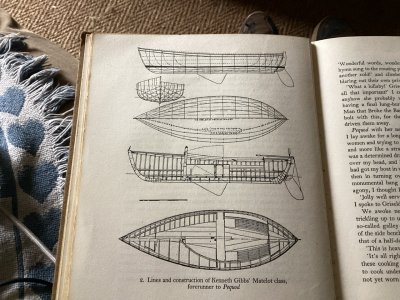
I bought one of these in Plymouth back in 1974 and sailed it back to Chichester as I was an open boat I covered the well with plastic sheeting .Looking back I must have been mad !.An open boat an be sailed and weather quite big seas and there is no need to be caught out .Before that I had sailed a 15 foot Macwester from Littlehampton to Falmouth and back one summer.It had a small cabin but only fit for one .I recon say one of the22foot macwesters with bilge keels can be kept cheaply in a mud berth.Too small a cabin is no fun in inclement weather
Wansworth
Well-Known Member
DownWest
Well-Known Member
I trail sail, so use the car each time I sail and can choose from several launching sites on the Atlantic coast near here, or on the Charente river.
Boat for a while has been an Oughtred Whilly Tern, but I have never tried to sleep on her. I have been in company with several of the DCA guys, including Roger. Arriving at the slip to sailing off is about 10 minutes
Close to launch is my micro cruiser. A development of the Bolger Micro. Bit longer and less square. Cabin for two with porta potty and cooking. A lot heavier than the WT at 450kg verses 70 kg, but I am working on rigging her quickly (two unstayed masts) so to get off the slip quickly. Plus a trailer that makes launching easy and quick.
Ballast ratio is close to 50%, so can come up from 'mast in the water' without water coming in, so suites my slightly aging bones, another factor in moving on from the WT, which I doubt is self recovery from a capsize (got close a couple of times..)
Boat for a while has been an Oughtred Whilly Tern, but I have never tried to sleep on her. I have been in company with several of the DCA guys, including Roger. Arriving at the slip to sailing off is about 10 minutes
Close to launch is my micro cruiser. A development of the Bolger Micro. Bit longer and less square. Cabin for two with porta potty and cooking. A lot heavier than the WT at 450kg verses 70 kg, but I am working on rigging her quickly (two unstayed masts) so to get off the slip quickly. Plus a trailer that makes launching easy and quick.
Ballast ratio is close to 50%, so can come up from 'mast in the water' without water coming in, so suites my slightly aging bones, another factor in moving on from the WT, which I doubt is self recovery from a capsize (got close a couple of times..)
veshengro
Well-Known Member
Here's my 14 foot Trident. She sets a jib as well, but I was fiddling with main in this photo. Spent a few nights in her last summer using my camping gear and a cheap Poly Tarp tent that I rigged up. I'll get round to making a proper tent but the Tarp is good for light winds and medium rain so I've been a bit lazy.
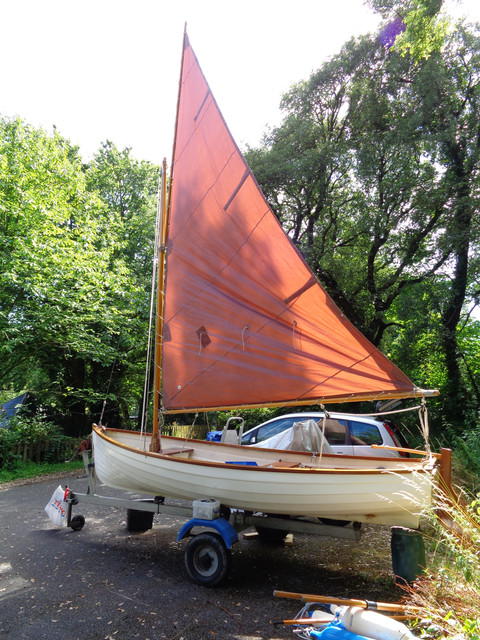
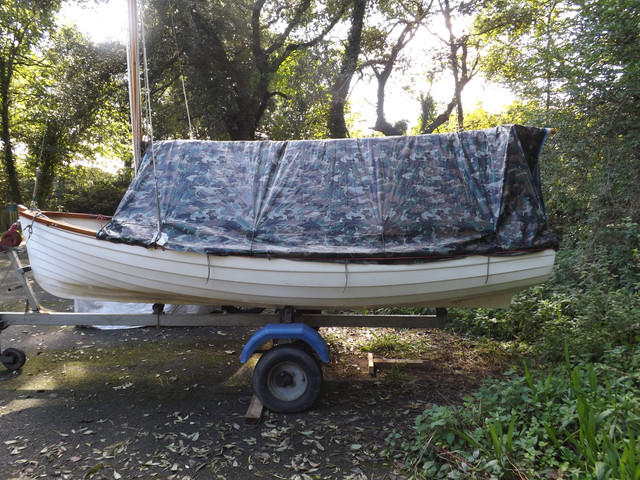
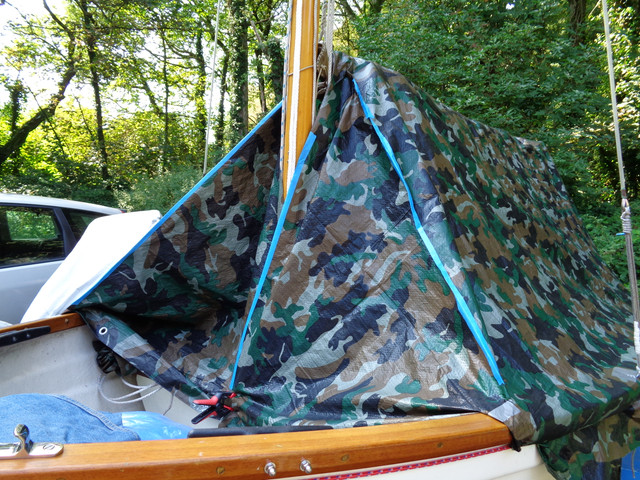
Waking up when dried out far up a Creek surrounded by woodland is great and the feeding Red Shanks get a surprise when I look out from under the Tarp..
Waking up when dried out far up a Creek surrounded by woodland is great and the feeding Red Shanks get a surprise when I look out from under the Tarp..
DownWest
Well-Known Member
Footnote on the trailers shown..
For my WT, I built a coil spring with damper swing axle trailer, but put the spine quite low. That means that only the tyres need to be in the water, not the hubs, so the bearings keep dry.
My opinion of the standard 'indispension' type of suspension is less than low...It just files the legal requirement, but is rough on the boat.
Can't show a photo, PC probs.
For my WT, I built a coil spring with damper swing axle trailer, but put the spine quite low. That means that only the tyres need to be in the water, not the hubs, so the bearings keep dry.
My opinion of the standard 'indispension' type of suspension is less than low...It just files the legal requirement, but is rough on the boat.
Can't show a photo, PC probs.

ianc1200
Well-Known Member
Hunter 19 design brief - I want a Squib with a lid.
There's a nice Anderson 22 for sale at Titchmarsh, £950 I believe. Oliver Lee design and another Squib with a lid/extension of the Hunter 19.
Do love those Sailing Kate Louise video's, have watched loads over the last couple of years, very pleasant and easy viewing, although the times when they've had sharks in the middle of the flotilla looked worrying.
Greenheart
Well-Known Member
Chiara's Slave - "I sadly fear that anything with sufficient ballast to be self righting and have even a vestigial lid is going to be way too heavy...to pull up a slipway"
You're probably right; but I'm sure the smallness of the market for cruising dinghies means design possibilities haven't been significantly explored. The dominant thinking seems to be that existing designs are proven, and in them, many bold and resourceful dinghy-cruisers often imitate full-size, fully fledged cruisers, cutting only a few corners.
Unfortunately the corners that are cut - dispensing with shelter under a hard roof, and avoiding (rather than eliminating the risk of) capsize, redoubles dinghy-cruisers' pride in themselves - "look what we can do without!" ...and I understand that it's fun to avoid cost and complexity while achieving what others thought wasn't possible - like the money and time saved by people who commute by bicycle.
But the side-effect of dinghy-cruisers relishing their vessels' shortcomings is that no designers have looked on their behalf at whether the characteristics which distinguish a yacht from a dinghy, may be reduced in scale to fit within dinghy proportions.
The snagging points which stop me yachting or dinghy-cruising are:
a) the cost and bother of mooring/antifouling a yacht;
b) the physical exposure and instability that make dinghies less safe and comfortable than yachts; and
c) the fact that there isn't (yet) a yacht small enough for me to haul out and store at a dinghy club.
Literally the only self-righting boat I've ever pulled up a slipway was a K1 ballasted dinghy (or keelboat if you choose to see it as one)...
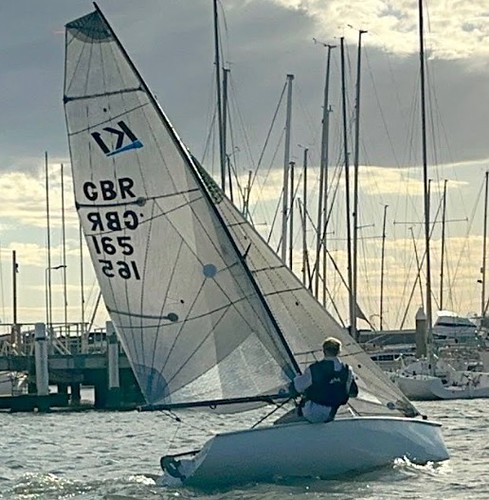
...the K1 is a 15ft racing one-design, likely too slender and stripped down to offer much if any cruising potential. But its existence encourages me to believe that self-righting might still be possible, reworked with smaller sail area in a shorter and beamier hull (say, 12ft x 5ft, which would allow some cruising comfort and stowage) and could even be a little heavier, yet still be recoverable singlehanded.
Thinking only on what is possible and accepting that the solution need not be slick, it wouldn't matter if the cabin 'lid' was a removable bolt-on piece which the boat could be sailed with or without, enabling partial dismantling (thereby weight-saving) before hauling out. And even the ballast-torpedo could be made removable from the drop-keel at the water's edge...as I said, not slick, but surely possible.
I said above these are only my idle thoughts – I’m no designer. But I’m not convinced all that could be done to devise a comfortable, stable ‘minimum cruiser’, has yet been seen.
You're probably right; but I'm sure the smallness of the market for cruising dinghies means design possibilities haven't been significantly explored. The dominant thinking seems to be that existing designs are proven, and in them, many bold and resourceful dinghy-cruisers often imitate full-size, fully fledged cruisers, cutting only a few corners.
Unfortunately the corners that are cut - dispensing with shelter under a hard roof, and avoiding (rather than eliminating the risk of) capsize, redoubles dinghy-cruisers' pride in themselves - "look what we can do without!" ...and I understand that it's fun to avoid cost and complexity while achieving what others thought wasn't possible - like the money and time saved by people who commute by bicycle.
But the side-effect of dinghy-cruisers relishing their vessels' shortcomings is that no designers have looked on their behalf at whether the characteristics which distinguish a yacht from a dinghy, may be reduced in scale to fit within dinghy proportions.
The snagging points which stop me yachting or dinghy-cruising are:
a) the cost and bother of mooring/antifouling a yacht;
b) the physical exposure and instability that make dinghies less safe and comfortable than yachts; and
c) the fact that there isn't (yet) a yacht small enough for me to haul out and store at a dinghy club.
Literally the only self-righting boat I've ever pulled up a slipway was a K1 ballasted dinghy (or keelboat if you choose to see it as one)...
...the K1 is a 15ft racing one-design, likely too slender and stripped down to offer much if any cruising potential. But its existence encourages me to believe that self-righting might still be possible, reworked with smaller sail area in a shorter and beamier hull (say, 12ft x 5ft, which would allow some cruising comfort and stowage) and could even be a little heavier, yet still be recoverable singlehanded.
Thinking only on what is possible and accepting that the solution need not be slick, it wouldn't matter if the cabin 'lid' was a removable bolt-on piece which the boat could be sailed with or without, enabling partial dismantling (thereby weight-saving) before hauling out. And even the ballast-torpedo could be made removable from the drop-keel at the water's edge...as I said, not slick, but surely possible.
I said above these are only my idle thoughts – I’m no designer. But I’m not convinced all that could be done to devise a comfortable, stable ‘minimum cruiser’, has yet been seen.
Last edited:
Egret
Well-Known Member
I'm guessing Oliver Lee had it sorted in 1972 with the Hunter 490 or for more comfort there's something like a Gem - many dry store / trailer launching options which should self right if blown flat, without taking in water, and buoyancy can be fitted for reassurance if not already present.
Haul up ramp no problem - with car same as powerboats & jetskis - and Wayfarer / National 18 - people have been doing it with sailing boats for years - also can have a mini tractor, lawn mower with tow hitch or something like an adapted rotovator (with power to wheels) with tow hitch - various permutations have been used at my locality. Just need to be in a place where these options are possible - how does the club pull up the rescue boat?.
Haul up ramp no problem - with car same as powerboats & jetskis - and Wayfarer / National 18 - people have been doing it with sailing boats for years - also can have a mini tractor, lawn mower with tow hitch or something like an adapted rotovator (with power to wheels) with tow hitch - various permutations have been used at my locality. Just need to be in a place where these options are possible - how does the club pull up the rescue boat?.
Last edited:
Greenheart
Well-Known Member
Hmm, that's rather the point. My club always relied on the energy of eight or nine keen members, roped-in to haul up the safety RIB.Just need to be in a place where these options are possible - how does the club pull up the rescue boat?
I'll probably end up with a pocket cruiser on a mooring. Unlike the man in the OP video, I can't be bothered to build what I want to sail.

.
Egret
Well-Known Member
Pocket cruiser on a mooring - and a dinghy to wizz around on/race - has been my option - can't just have one boat - can sail alone, cook and eat on board, sleep overnight or take a crowd - can't get to boat every weekend but when I do want to sail for more than a couple of hours -Launching of a pocket cruiser each time also possible single handed with the right equipment - some do it locally - depends on where you are and what the options are locally
Last edited:
DownWest
Well-Known Member
I can understand that, but I like making things, so I build my boats. Four so far..I'll probably end up with a pocket cruiser on a mooring. Unlike the man in the OP video, I can't be bothered to build what I want to sail.
.
The Scamp, pictured up the thread, is by John Welsford, one of his several designs for camp cruising. Popular builds.
Other threads that may be of interest

- Replies
- 21
- Views
- 807
