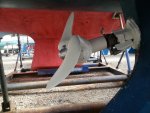
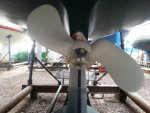
Brunton Auto Props

Just lifted my yacht out after six months in. Boss anode well eaten but not yet in danger of falling off. My third season with the prop and well satisfied, especially with the manoeuvring ability in a marina and the stopping on a sixpence.
The first boss anode was well worn around the brass bolts and I was advised by Brunton to put a dab of antifoul around them. Brunton supplied plastic bolts for the last anode fitted which did not cause any extra wearing around them.

<hr width=100% size=1>
 
I used a bit of epoxy putty - but far better was to fit a ring shaft anode.

After 15 months in the water in the Western med, the ring anode a €3.85 has needed replacement but the boss anode has had little wastage.

The main anode has definitely seen some work - it's lost about 50% of its bulk in that period.

whilst I was at the Salon Nautic in Barcelone I looked on one of the Spanish anode manufacturers' stands - they produced boaa anodes for the Maxprop but, until now haven't done so for the Autoprop.

<hr width=100% size=1>
 
Thanks Charles. If it has disappeared again when we lift out I'll add the shaft anode as well, like you we do have a main hull anode wired in. The nose anode is more than just that, it acts like a sort of fairing piece too, otherwise I wouldn't bother and just add a shaft collar.

<hr width=100% size=1>
 
I just rebuilt an H6 Autoprop that I had been carrying on the boat for a few years. I have used it on only one day and not sailed - just motored around for an hour or so and noticed the following with regard to its performance versus a fixed prop. It takes much longer to respond (2 to 3 seconds to make the boat move) as compared to a fixed prop. This lack of initial response makes it considerably more challenging to negotiate getting into a berth at a marina, especially if Med mooring (stern to the dock). After waiting 5 to 10 seconds, the prop really digs in and propels the boat well, both forward and reverse. The reverse speed is much faster than a fixed prop, even into 15 kts of wind and chop. Forward at 2000 rpm, it really digs in and propels the boat well. My boat is a Catalina 42.
 
new prop with velox 2014 pic 1.jpgnew prop with velox 2014 pic 2.jpgJust fitted a two blade autoprop to my Feeling 286/yanmar2GM20......in a nutshell, HUGE amount of thrust forward or astern (less revs for any given speed) over fixed 2 blader, and 10% faster under sail???? Question is, can I go slowly enough in marinas?????
As my prop is 1/2 boat length...almost from rudder (exits immediately abaft keel), a little delay in bite is not a problem......
Vibration off tickover..DEcreased, but am using less revs and have changed the standard engine mounts......

Very pleased so far.........
 
Last edited:
We persevered with an autoprop for two years on our 40 foot motor sailer, during which time we suffered from excessive vibration and rapid wear on the cutless bearing. Much depends on the hull configuration. If there is any chance of aerating the propellor you may suffer severe banging and stalling the engine. All in all it was an expensive learning curve.

In contrast we have now had a 4 blade Variprop for ten years and have been delighted with it. (It's very similar to a maxprop).
 
Hello all!!

Who has actual experience good or bad of the Brunton Auto Prop??

The reason I asked...

Having just fitted one, these are the results. Max achievable rpm has increased although within the correct operating parameters of the engine. Boat speed is the same as was with its 3 blade fixed propeller. At the high rpm range cavitation is now felt from the Auto Prop. Generally vibration has increased.

Everything is in very good order, ie shaft bearings, engine mounts etc etc.


<hr width=100% size=1>

We fitted one in 2004 it is great. I spent a lot of time getting the size right with Brunton. It gives us more speed or the same speed fpor less revs. As a liveaboard that moves around we have sailed over 20K miles with it. Call Brunton I have found them very helpfull.
 
Agree Brunton are great to deal with
However, my Auto prop uses more fuel - 2 ltres per hour ( 2.33 if I run at max power) up from 1.66 litres per hour (averaged use over 2000-00 miles) on my original fixed 2 blade prop
Same speeds as fixed prop
Much greater prop wash & going from astern to forward can make the boat spin 90 degrees before it bites
Delayed response times - but have got used to that
Max engine revs now 2500 instead of 3500 with fixed prop
Poor drive in 1 metre chop (that one gets in places like Fishermans Gat or the Wallet)- boat slows & then one has to wait for it to re pitch by which time next chop has arrived
Eats anodes as if they grew on trees
Have just paid £ 350-00 to have it serviced- One has to have the internal rubber part changed every few years

So much for the negative - on the positive side:-
Absolutely terrific for motor sailing. Leave the engine in fast tickover & it will pitch itself to give drive whereas a fixed prop would have to run a bit faster than the speed the boat is sailing at to give any drive.
Get another 1/2 knots (at about 5Kts)under sail only, due to less drag

Re the fouling
I just smear it with grease before launching & then use the boat a lot so never really had a fouling problem
 
We bought ours before the thread was started! Had it something like 12 years now, bought in Holland, sailed across to the Orwell to fit it dried on the scrubbing grid at Suffolk Harbour.

Agree about the anodes, they go fast if on their own, but in conjunction with a shaft anode we get 2-3 years out of one.

I have posted several times about antifouling them. Hammerite Special Metals primer is excellent, also seems to be good on stainless steel, then Velox antifouling paint. We find that two coats is best, any more and it chips off in a cavitation pattern.

No problems at all with it as a prop but I doubt the 'up to a knot improvement in sailing performance'. Any improvement over our previous skinny two blade prop is marginal.
 
My boat had a 3 blade H5 on when I bought it 7 years ago. I stripped it down after about 1 year, and have re-set the bearing play once since then. I haven't done any real measurements on speed. There is a slight delay as it pitches, but then it gives good thrust, either ahead or astern. There is a slight rumble at towards 3000 engine rpm, I assume this is slight pitch changes during the propeller revolution. I give it a polish when it goes in the water, and give it a wipe over when I have a swim, comes out quite clean in the Autumn. The boss anode does disappear quite quickly - must try the paint/epoxy trick to see if that improves it! Otherwise trouble free and entirely satisfactory.
 
Bruntons auto Prop

View attachment 42347View attachment 42348View attachment 42349View attachment 42350View attachment 42351

Interesting thread. We inherited ours when we purchased the boat and it was my first experience of the type. I found that transverse thrust when going astern was hardly noticeable, lots of 'bite' ahead and astern. I cannot comment on increase in speed etc as the prop was already on the boat.
Eats anodes at an alarming rate, but this may be due to being marina based for a high percentage of the time.
Fouling was a problem, but last year I polished it as usual and then applied Dr. Barnacle. When we lifted out in November it was free of - yes - barnacles, and only a little slime.
Some rattle at mid revs, but easily avoided by throttle adjustment.
Bearings seem tight.
I use lithium grease from 3in1 just before launching.
I purchased a set of special tools from Brunton's so that I can service the prop. but it seems ok for now so the tools and bearings can stay in the spares dept. for this year.

Cheers,

Michael.
 
Top