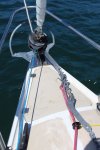
Brucey anchor bonus for me due to failed anchor swivel

yotter

Well-Known Member
Joined
3 Aug 2007
Messages
794
Location
Me Inverkip, boat Kip in winter, Craobh in summer
Visit site
Apologies for digging up anchors yet again.....
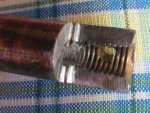
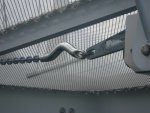
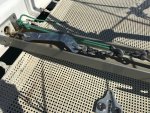
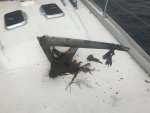
We were anchored at the Garvellach Islands at the weekend and on recovering our very fine Knox anchor we got a brucey bonus caught in the anchor. There was no chain and the state of the swivel quickly told me why. This looks like a good example of how not to attach a swivel (without the Viv Cox recommended 3 chain links between swivel and anchor)! I can only assume that a large sideways load caused it to fail, it was perhaps undersized also. Not sure of Bruce anchor weight, 12 to 15kg probably, but currently too dirty to read anything.

Well done Knoxy:-)

If anyone wishes to claim the lost anchor let me know.
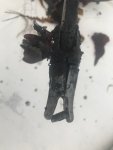
 

Attachments

  • brucey swivel.jpg
    brucey swivel.jpg
    241.1 KB · Views: 191
  • brucey.jpg
    brucey.jpg
    455.6 KB · Views: 191
Apologies for digging up anchors yet again.....
We were anchored at the Garvellach Islands at the weekend and on recovering our very fine Knox anchor we got a brucey bonus caught in the anchor. There was no chain and the state of the swivel quickly told me why. This looks like a good example of how not to attach a swivel (without the Viv Cox recommended 3 chain links between swivel and anchor)! I can only assume that a large sideways load caused it to fail, it was perhaps undersized also. Not sure of Bruce anchor weight, 12 to 15kg probably, but currently too dirty to read anything.

Well done Knoxy:)

If anyone wishes to claim the lost anchor let me know.
Yes there are horrendous side loads imposed on the swivel if it passes over the bow roller at 90 degrees to the correct position. The forces tend to force the jaws apart and then the Allen bolt may fail. This started to happen on a club boat I drive. I remover the swivel and lif became easier without it.
 
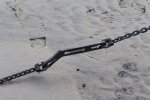
Swivels are entirely unnecessary. I have short link of round bar with a bend in it, and an eye on each end, three chain links away from the anchor. As soon as the bent link reaches the bow roller, it automatically rotates the anchor into the correct orientation.
Well done for hooking up a Bruce. I hope it's a genuine one.
 
Swivels are entirely unnecessary. I have short link of round bar with a bend in it, and an eye on each end, three chain links away from the anchor. As soon as the bent link reaches the bow roller, it automatically rotates the anchor into the correct orientation.
Well done for hooking up a Bruce. I hope it's a genuine one.
I like your idea, my Kong swivel works well, but it does worry me as an extra failure point.
I will check once its had a good clean:-) How do I know if its genuine?
 
I like your idea, my Kong swivel works well, but it does worry me as an extra failure point.
I will check once its had a good clean:) How do I know if its genuine?
Unfortunately genuine Bruce anchors are no longer made. Plenty of copies are, but copies never seem to be as good. When they were made, they were confident of their products, and the name "Bruce", and latterly, "Belgium", along with the weight, are proudly embossed on the shank. No cheap sticky paper labels for them!
Beware! The present day anchor fashionistas don't like them, and as they are no longer made, there is no money being spent on marketing.
 
I agree that copies are often not as good as the originals, we have a CQR on another boat which says Made in Scotland on it (no mention of From Girders:-). I do not think that we will retain the Bruce as a kedge, will likely be donated to boat jumble for charity, I suppose I could put it for sale here, thinking out aloud...... Needs a good scrub first.
 
Lucky you! I had to dive for my free anchors and haul them up with the rope drum on the windlass. We kept the 25kg Kobra as a spare and traded the CQR for a full gas bottle in Greece.

Oh, the Kobra also came with a broken swivel like that. It's a great counterweight to hang on the back of the gimballed cooker to offset the weight of a tea towel hanging on the oven door handle! :)

Keep digging! ?
 
Lucky you! I had to dive for my free anchors and haul them up with the rope drum on the windlass. We kept the 25kg Kobra as a spare and traded the CQR for a full gas bottle in Greece.

Oh, the Kobra also came with a broken swivel like that. It's a great counterweight to hang on the back of the gimballed cooker to offset the weight of a tea towel hanging on the oven door handle! :)

Keep digging! ?
Must be a fairly hefty tea towel to need an anchor to balance it:-)
 
If you look at many swivels they use sex bolts, inter screws, where the bolt is split into two portions - a threaded barrel and an insert to the barrel. The barrel may have an ID of 10mm with say a 6mm threaded hole. But the thread cannot reach the end of the hole - so at one end of the device you don't actually have a solid bit of rod - but a space into which the insert can fit - as the thread does not go to the end of the hole. The threaded portion, or its head - often a recessed Alan key is also pretty wimpy and the hole end can fail - and then the the inter screw works its way out. All exacerbated if the swivel is not divorced from the anchor and the slot prized open.

I don't recall if this picture is in the link but it illustrates the problem. The 'bolt' has a threaded hole into with a threaded pin is inserted. Where the 2 components overlap you have an almost solid, say, 10mm rod. At the end however there is a void and you have a cylinder that is simply the volume of the wall of the cylinder.

IMGP2950 2.jpeg


NormanS has the answer, if you really need a device to help self right the anchor, see above or search for Boomerang here:

Sail Delmarva

This is our Boomerang, which I make at home. I modified the design to allow me to connect high tensile 6mm chain with compatibly strong HT Omega links.
IMG_4758.jpeg

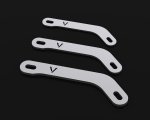
Viking anchor asked if they could use the design in the link, above, and sell them mail order. I do not receive any income from their sales, just happy to have my ego stroked and support industry in Ukraine. The 'V' in the image is not cut right through but is a surface engraving :). The blog in the link for the Boomerang is Thinwater.
Bumernang 6 8 10mm.jpeg

As NormanS says you can make your own at home. I use a bench drill, angle grinder and files. I have made them from Duplex stainless and Norman's was welded 316 otherwise you need to have them galvanised (which I do when arranging HT rodes).

There are no moving parts and the strength of the Boomerang, recommended made from a HT steel or Duplex, is dictated by the holes at each end - and if made to the correct dimensions is stronger than the shackles, used at each end.

When I was in design mode Norman kindly sent me a picture of his 'device' and the fact Norman had made his own encouraged me to do something similar.

The idea is not original (though Norman may have been unaware when he made his). I had seen them, see below, in the Med and I have heard of one called a 'Banana' in the US - but never seen one.

These are 2 I have seen

I have no idea who makes the first one
July 2011 007.jpeg

This second one is from Oscalutti - and it looks as inadequate as many swivels - and I would not touch one with a barge pole (you would be safer making your own - or buying a Boomerang from Viking Anchor).

IMGP2831.jpeg


Jonathan
 
Last edited:
If you look at many swivels they use sex bolts, inter screws, where the bolt is split into two portions - a threaded barrel and an insert to the barrel. The barrel may have an ID of 10mm with say a 6mm threaded hole. But the thread cannot reach the end of the hole - so at one end of the device you don't actually have a solid bit of rod - but a space into which the insert can fit - as the thread does not go to the end of the hole. The threaded portion, or its head - often a recessed Alan key is also pretty wimpy and the hole end can fail - and then the the inter screw works its way out. All exacerbated if the swivel is not divorced from the anchor and the slot prized open.

I don't recall if this picture is in the link but it illustrates the problem. The 'bolt' has a threaded hole into with a threaded pin is inserted. Where the 2 components overlap you have an almost solid, say, 10mm rod. At the end however there is a void and you have a cylinder that is simply the volume of the wall of the cylinder.

View attachment 138646


NormanS has the answer, if you really need a device to help self right the anchor, see above or search for Boomerang here:

Sail Delmarva

This is our Boomerang, which I make at home. I modified the design to allow me to connect high tensile 6mm chain with compatibly strong HT Omega links.
View attachment 138644

Viking anchor asked if they could use the design in the link, above, and sell them mail order. I do not receive any income from their sales, just happy to have my ego stroked and support industry in Ukraine. The 'V' in the image is not cut right through but is a surface engraving :). The blog in the link for the Boomerang is Thinwater.
View attachment 138645

As NormanS says you can make your own at home. I use a bench drill, angle grinder and files. I have made them from Duplex stainless and Norman's was welded 316 otherwise you need to have them galvanised (which I do when arranging HT rodes).

There are no moving parts and the strength of the Boomerang, recommended made from a HT steel or Duplex, is dictated by the holes at each end - and if made to the correct dimensions is stronger than the shackles, used at each end.

When I was in design mode Norman kindly sent me a picture of his 'device' and the fact Norman had made his own encouraged me to do something similar.

The idea is not original (though Norman may have been unaware when he made his). I had seen them, see below, in the Med and I have heard of one called a 'Banana' in the US - but never seen one.

These are 2 I have seen

I have no idea who makes the first one
View attachment 138650

This second one is from Oscalutti - and it looks as inadequate as many swivels - and I would not touch one with a barge pole (you would be safer making your own - or buying a Boomerang from Viking Anchor).

View attachment 138651


Jonathan
Hi Jonathan, my "bent link" is the one in your top photo of these devices (the one made from half-inch round bar. It was made from a long bolt, so maybe marginally stronger than mild steel. It was subsequently galvanised. I have since modified the installation by fitting a couple of links of chain next to the anchor, because very occasionally the link locked up against the anchor. My wife, who is Anchorer-in-Chief, thinks it's a wonderful device, so it must be good. ?
PS. What are "sex bolts", and what do you do with them? ?
 
PS. What are "sex bolts", and what do you do with them? ?

I confess total confusion as one translation of the characters (to avoid confusion - Chinese writing) of the term sex bolt (or inter screws) is 'mother and son bolts' - maybe an Oedipus Bolt....?? Now consider that a derivative is called a Chicago Bolt.

I am sure they all have their place - but not in an anchor rode.


Your wife has good taste and can identify excellent engineering at its best.

Jonathan
 
Norman,

I'm feeling very guilty.

I had forgotten, completely, that the first image, in post no 11, above, of a 'bent link' was yours. Age is wearying my memory.

I remembered, possibly incorrectly, that your link was bent stainless rod with stainless rings welded at each end (nothing wrong with that - no need for galvanising). I suspect that you made a number of prototypes and each was an improvement of the previous iteration.

I commend your active mind and your ideas.

Jonathan
 
Convinced by your arguments and because I like to try new things I decided to buy from Viking. Cost for an 8 mm unit is €22 with VAT to be added, making it more than €26. But then, bearing in mind that the delivery address is in EU, I was only offered a courier, plus duty (?) Making the total getting on for €70. No thanks, perhaps I will make one or stick with my Kong
 
You should order an anchor with it to overall lower the shipping cost:cool:

I have an 8mm bridle in my boat in Leros that I don't use (when using a Viking anchor you don't need alignment accessories) that I can give you at no cost if you are in the neighborhood.
Thanks for your offer, which I do not fully understand. What's a bridle in this context? Alignment accessories?
I will be in Leros in September.
 
Using an angled bar to align the anchor on the bow roller works well, but inserting it between two separate lengths of chain introduces two extra failure points - the shackles.
I would shackle the bar to an uncut chain leaving two or three links of slack in the chain between the ends of the bar. The slack could be tie wrapped to the bar if it was thought necessary.
 
Using an angled bar to align the anchor on the bow roller works well, but inserting it between two separate lengths of chain introduces two extra failure points - the shackles.
I would shackle the bar to an uncut chain leaving two or three links of slack in the chain between the ends of the bar. The slack could be tie wrapped to the bar if it was thought necessary.
A decent shackle is far stronger than grade 30 or 40 chain.
 
Vyv beat me to it!

We use a 6mm high tensile chain with a UTS of 4.4t, it replaces a 8mm G30 chain. the WLL of the G30 chain is 750kg. A conventional safety factor for chain would be 4:1. We used 3/8th" Crosby G209a shackles (or equivalent) that have a WLL of 2t (or 1t if side loaded at 90 degrees). We Loctite (blue) the shackle pin and also use a cable tie to secure the shackle pin (I replace the cable tie every so often). Because we 'belt and braces' secure the shackle pin and the shackle is stronger than the chain I don't see the shackle, 2 off, being a weak link in the rode.

Shackle failure does occur - almost exclusively incorrect choice of quality of shackle (and, related, operator error).

However because we use 6mm chain we need to faff about.

Originally we used enlarged links, omega links (because the 3/8th shackle's clevis pin is too big for 6mm chain) but then I custom made a Boomerang to accept the omega links (no shackles). The Omega links I test and are stronger than the HT 6mm chain.

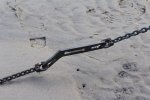
This was our original set up with a Viking boomerang (angled bar). There is a shackle attached to the boomerang and and an omega link to the chain, with the shackle pin through the Omega link.

IMG_1755.jpeg

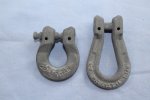
These are Omega links - the clevis pin is secured using hammer in pins. Omega links come in a variety of shapes - the small one is the most common. The right hand link is a G80 x 6mm link with a WLL of 1.12t.
IMG_4999.jpeg

I made my own Boomerang to accept the Omega links, below

IMG_4758 2.jpeg

If you were using conventional metric G30 or G40 chain then the Crosby shackles would be more than adequate - IF you secure the shackle pin!

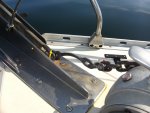
The Viking anchor on this yacht using G30 8mm, WLL 750kg, chain is secured with a 3/8th" shackle with a 2t WLL between rode and anchor and similar shackles between rode and Boomerang. The red rope is the snubber, secured with a galvanised hook from the lifting industry.
IMG_4844.jpeg


Jonathan
 
Top