Brown Rusty Stuff Coming From Rudder

Weight of a 34' boat balanced spade is about 80kg. One thing to check is any stray electrical connections to the rudder/steering system.

That's the sort of weight that can easily drop onto the concrete if it is dropped unexpectedly.

We took one of ours out - and I was surprised how heavy it was. Its not the sort of weight you want to support for long without help

Jonathan
 
Weight of a 34' boat balanced spade is about 80kg. One thing to check is any stray electrical connections to the rudder/steering system.
Ours is not a spade, it's skeg hung but nowhere near 80 kg. I lowered it to the ground and lifted it back to put timber blocks beneath it for the winter. I struggle with a 25 kg bag of cement these days so I know that 80 kg would defeat me.
 
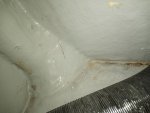
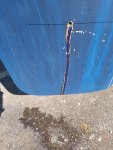
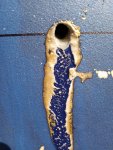
Well so I have an update and it's not great news. I found out from another Storm owner on the Westerly forums that these boats have a flaw after many years that a crack forms at the top forward section of the rudder, right where it was noticed earlier in this thread. Yep. That's likely a crack. And the real bad news is that the rudder itself fills up with water and the rust comes out. He showed me a few photos and his looks far better than mine, which is basically pouring rust :(

The other bad news is that this particular rudder is very very 'unbelievably' heavy and considering it's a Westerly I'm guessing he's not exaggerating. Add the fact that it's likely full of water and well you get the picture. On top of which I'm in really pretty terrible physical condition (part of the reason I bought a sailboat IE therapy) so I will be of little use right now in such brute force work.

So I'll need to enlist help and likely use some kind of leverage. I'm thinking perhaps two lines each running under the rudder for support, each attached to a separate winch. Then slack one a little, then the other, sort of back and forth. Hopefully I don't make my teak even worse doing this. For extra safety in case the lines break, I'll put a series of wood blocks, taking them off one by one as it's lowered.

I've even considered having a yard guy just pull up a forklift and lower it down. An idea that's actually sounding better the more I think of it.

Also it sounds like the design is what Concerto described, which is no surprise as the Fulmar and the Storm are so similar in many respects.
This also means that basically everything is in one tube so I don't think I'll see much from the cockpit locker though I'll check anyway.

More bad news, the other Storm owner had to drill a hole about 300mm off the bottom of the rudder and let it drain. For a number of months. NICE.
Wonderful news to be getting now :)

Now I don't mind doing work for months or even as long as I own the boat, but not getting her in the water anytime soon is a major setback to all my plans.
Also now all my marina fees are effectively going straight to the boat maintenance/repair category.

Maybe most of all I just don't care for the space on the hard. It's not a space to enjoy. Power tools, dirty chemicals, and right by the entrance gate with almost constant auto traffic in and out. I've tried three times, never slept well there. I don't mean to whine and moan just to say there's a lot more to my wanting to get her in the water ASAP to enjoy her while fixing up.

This is a big setback. And I'm a little bit ticked at surveyor and vendor for telling me when I pointed at that very seal, oh its nothing- just go sailing!
Hmm...

Well I'm off to the boat early tomorrow and will pick up smaller projects until I can get some help with this, as suggested.
Best to keep working and try not to get too disgruntled at times like these :)
 
Well so I have an update and it's not great news. I found out from another Storm owner on the Westerly forums that these boats have a flaw after many years that a crack forms at the top forward section of the rudder, right where it was noticed earlier in this thread. Yep. That's likely a crack. And the real bad news is that the rudder itself fills up with water and the rust comes out. He showed me a few photos and his looks far better than mine, which is basically pouring rust :(

The other bad news is that this particular rudder is very very 'unbelievably' heavy and considering it's a Westerly I'm guessing he's not exaggerating. Add the fact that it's likely full of water and well you get the picture. On top of which I'm in really pretty terrible physical condition (part of the reason I bought a sailboat IE therapy) so I will be of little use right now in such brute force work.

So I'll need to enlist help and likely use some kind of leverage. I'm thinking perhaps two lines each running under the rudder for support, each attached to a separate winch. Then slack one a little, then the other, sort of back and forth. Hopefully I don't make my teak even worse doing this. For extra safety in case the lines break, I'll put a series of wood blocks, taking them off one by one as it's lowered.

I've even considered having a yard guy just pull up a forklift and lower it down. An idea that's actually sounding better the more I think of it.

Also it sounds like the design is what Concerto described, which is no surprise as the Fulmar and the Storm are so similar in many respects.
This also means that basically everything is in one tube so I don't think I'll see much from the cockpit locker though I'll check anyway.

More bad news, the other Storm owner had to drill a hole about 300mm off the bottom of the rudder and let it drain. For a number of months. NICE.
Wonderful news to be getting now :)

Now I don't mind doing work for months or even as long as I own the boat, but not getting her in the water anytime soon is a major setback to all my plans.
Also now all my marina fees are effectively going straight to the boat maintenance/repair category.

Maybe most of all I just don't care for the space on the hard. It's not a space to enjoy. Power tools, dirty chemicals, and right by the entrance gate with almost constant auto traffic in and out. I've tried three times, never slept well there. I don't mean to whine and moan just to say there's a lot more to my wanting to get her in the water ASAP to enjoy her while fixing up.

This is a big setback. And I'm a little bit ticked at surveyor and vendor for telling me when I pointed at that very seal, oh its nothing- just go sailing!
Hmm...

Well I'm off to the boat early tomorrow and will pick up smaller projects until I can get some help with this, as suggested.
Best to keep working and try not to get too disgruntled at times like these :)

Looking at your photographs the rust stain is not coming out of the rudder it's coming from above so whilst there may be a crack in the gel coat which you can check out tomorrow by some careful removal of the antifoul where it looks like there maybe a crack. Although at this stage I wouldn't advise it you could carefully drill a hole at the bottom of the rudder to see if it's waterlogged but for now there is plenty of other stuff to be going on with. Start by cleaning the boat and the heads, remove some antifoul at the top of the rudder, check if the water could have come from the locker then come back to us.
There is no reason why the rudder should suddenly start to leak at the top it would imply that water was getting in and somehow overflowing. It could be that water is running down the transom under the hull to the top of the rudder and bearing as simple as that.
 
Nothing unusual to have water in the rudder of that design and construction - it is very common even up to this day. Can go on for years if you drain the water out. Drill a couple of 6mm holes in the bottom and see what comes out. You can always fill them with epoxy afterwards - indeed some people drill and tap for a plug which they remove every time they lay up for the winter. As already noted, water only becomes a problem if the weld between the tangs and the stock fail and the stock turns and not the rudder. This is more common when the tangs are mild steel, but I think they are stainless in your rudder. What happens is some crevice corrosion from the damp foam in the core and the welds on the tangs. The "rust" is like blood - a little bit goes a long way and that staining which is oozing out of the crack looks far worse than it actually is.

So calm down, drain the rudder and when it has stopped dripping, seal the holes up. Drop the rudder enough to be able to seal the crack at the top and see how it goes. The long term solution is of course to remove the rudder, split it, check and if necessary reweld the tangs and re-assemble with new foam, but I think you are a long way off that.
 
You can’t change the laws of physics… gravity works downhill.
To me it looks like the rusty water is coming from above the top of the rudder blade.

As Tranona says, if you’re worried about it then drill a 6 - 8 mm hole in the side of the rudder near the bottom and leave it to drain, or to find out whether it is full of water. I did this with mine and nothing came out. After 3 weeks, before I refitted the rudder, I filled the hole with microfibre reinforced epoxy, sanded it flat, re-epoxied and anti fouled. You cant tell that I ever touched it.

id be inclined to leave it alone for the moment, do the other stuff that you’ve been talking about, and plan on removing it for a thorough inspection when you do haul her out.

To remove it, use a cheap trolley jack. Much easier and allows you to drop it right down under full control.

Oh, and rudder blades are heavy; much heavier than you would expect. Remember that there’s a 50mm solid steel bar, probably 2 m long, with 6mm thick grp around it. Mine must be over 50 kg and my boat is 31’, so yours will probably be heavier. 70-80 kg wouldn’t surprise me, even without any water in it!

Out of curiosity, where are you based?
 
Last edited:
Nothing unusual to have water in the rudder of that design and construction - it is very common even up to this day. Can go on for years if you drain the water out. Drill a couple of 6mm holes in the bottom and see what comes out. You can always fill them with epoxy afterwards - indeed some people drill and tap for a plug which they remove every time they lay up for the winter. As already noted, water only becomes a problem if the weld between the tangs and the stock fail and the stock turns and not the rudder. This is more common when the tangs are mild steel, but I think they are stainless in your rudder. What happens is some crevice corrosion from the damp foam in the core and the welds on the tangs. The "rust" is like blood - a little bit goes a long way and that staining which is oozing out of the crack looks far worse than it actually is.

So calm down, drain the rudder and when it has stopped dripping, seal the holes up. Drop the rudder enough to be able to seal the crack at the top and see how it goes. The long term solution is of course to remove the rudder, split it, check and if necessary reweld the tangs and re-assemble with new foam, but I think you are a long way off that.
I agree with Tranona. I took the rudder off my Fulmar several years ago, and took it home. A 1982 boat that needed around 20 several osmotic blisters removing. In short the rudder was fairly full of water, drilled drain holes top and bottom. While attending to the blisters I poked around in some of the skimed backed blister holes close to the shaft tang joints and while I could see some of the tang joints I apprised them as structurally sound but visualy poor, ie some staining and mild corrosion on them.
Now I know that " Crevice Corrosion" is the one to look out for on Stainless steel and this inspection really could not see it I felt reasonably happy that the rudder was heavily built on the stainless steel shaft and fundamentally it had may more years left before a structural faileur was likly.

As Tranona says if you want long term peace of mind then do the rudder removal job outlined. In my opinion it's not that difficult a job to do DIY. I found the fulmar rudder just manageable to lift , it must have been around 70 KG.
 
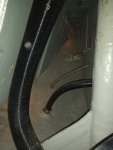
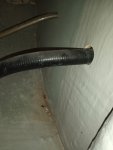
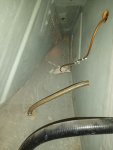
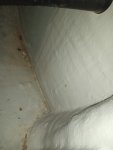
So I pulled everything out of the cockpit locker and squeezed in the back portion and took some photos.
I don't see anywhere that rust or dirt could have gotten in. Looks like my boat is the same as Concerto's, with the rudder post in a sealed off tube.
I'm awaiting advice from a Storm owner on the Westerly forums (again props to the Westerly forums, they rock!) who has been tremendously helpful, and see if that tube is open somewhere on the front side maybe from behind the gas tank or from pulling the aft cabin walls out to get to it. Otherwise it appears there is no way to fit for example an underdecks autopilot on this boat. Curious to find out...

IMG_20220829_183813_631 (Large).jpgIMG_20220829_183829_906 (Large).jpgIMG_20220829_183839_929 (Large).jpgIMG_20220829_184012_978 (Large).jpgIMG_20220829_184049_424 (Large).jpg
 
Just curious, do you get any rust out of there?
The "rust" - that is stained water just drains out from the sodden core. As post#28 says the staining comes frrom the small amount of corrosion from the welds of tangs to stock, but both are stainless so unlikely to actually fail. The water gets in either through poor sealing where the stock enters the rudder or a crack in the bonding of the 2 halves of the rudder. Suspect yours is from the crack at the top and the rudder is full of water which weeps out the way it got in. nothing unusual on a 40 year old boat. Drain it first then you might be able to seal the crack without fully dropping the rudder.
 
I detect a reluctance to drill the rudder - and cannot understand why (the reluctance). As mentioned its not an uncommon practice. The yacht is on the hard, it take 5 minutes to drill, the rudder if it contains water can dry out (over time) the drilled hole can be closed easily and quickly. Finding how the water gets in is a different issue - strip off all AF and check for cracks - its really not rocket science.

Water in the rudder will be discoloured, anyway. Its been in there for years (I guess).

If the yacht is to be slipped every year - then is the time to split the rudder - as tests seem to indicate the rudder is otherwise sound - and you might squeeze in a month or two of sailing before winter sets in - and you can then split the rudder (not a difficult task). I'd drop the rudder when it is lifted to come onto the hard and I'd take the rudder home to work on there, not in the yard. The rudder can be replaced when it is lifted to be dropped back in the water.

But if it is sodden - drain it - now. You really don't need to be sailing with a rudder full of water. I think you might find that the hole you drill needs constant prodding as 'stuff' inside will constantly block it. If you have the time, whilst the yacht is on the hard - strip off the AF and see if you can see any cracks that may allow water to enter. My guess is, drilling, water runs out, strip off the AF - a days work (though draining to dry may take longer). Post pictures here of any cracks - advice will be given - repairs or cracks will be simple. Later splitting rudder is not difficult, a bigger task - needs days.

What were these rudders built from balsa or foam - if its balsa - and wet - it will be rotten. Because of its age - I guess balsa (and rotten balsa stains water? ).

The big concern is that the staining is from the welds on the tangs. But the wrestling with the rudder against the stock seems to indicate it has integrity. So it might be rust - but superficial, equally the stain might simply be stagnant water - you would hardly expect it to be crystal clear even after only a short period (think of bilge water).

Jonathan
 
Not read the entire threads but I’d like to offer some input.
Refurbishing a boat fully before getting it in the water is not the best solution for everyone. To keep the momentum and spirits high perhaps put her in the water. Enjoy the remaining season. Have some fun. Your rudder will be fine for a long time.
Find a nice place to haul out then enjoy some diy in the spring sunshine. Can be a good mix.
Your boat sounds wonderful.
Steveeasy
 
Oh seen some great boats ruined one in particular from being left on the hard with a small leak. Can never understand why they don’t just drill a hole in the hull.

Steveeasy
 
Always difficult to make an informed assessment when you don’t have much experience to match against what appears to be in the photos.

Every one of us will go about investigating these things differently .

My suggestion would be therefore :
An on-site second opinion from a grp boatbuilder/repairer ( NOT a bloke with a loud voice or opinions or great beer talk but an actual working grp guy?) and this might save a lot of doubt .
Arm him of course with a drawing from the Westerly owners association showing the internal construction of the metal parts ..

I could write about what I would do and about rebuilding rudders that I and chums have done , but there’s no point.

Best of luck
 
Well first sorry for skipping threads like rocks on water. Suddenly the rudder just jumped to the top of the priorities list.
I figure if I need to drill it and it needs to dry, then this will take time.
By the way I ordered some compression straps:
https://www.amazon.de/dp/B0777HFSX2/
And I'm thinking I will use them to drop the rudder to the ground. I don't expect at this point to see any brown rusty stuff coming out of the rudder tube, and so I'm planning to drill right away to get her drying ASAP. If nothing comes out, fine, easy troubleshooting step done, and I'll patch her up.
I'll get a look in that tube either way.

The "rust" - that is stained water just drains out from the sodden core. As post#28 says the staining comes frrom the small amount of corrosion from the welds of tangs to stock, but both are stainless so unlikely to actually fail. The water gets in either through poor sealing where the stock enters the rudder or a crack in the bonding of the 2 halves of the rudder. Suspect yours is from the crack at the top and the rudder is full of water which weeps out the way it got in. nothing unusual on a 40 year old boat. Drain it first then you might be able to seal the crack without fully dropping the rudder.

OK, sounds like a plan.

I detect a reluctance to drill the rudder - and cannot understand why (the reluctance). As mentioned its not an uncommon practice. The yacht is on the hard, it take 5 minutes to drill, the rudder if it contains water can dry out (over time) the drilled hole can be closed easily and quickly. Finding how the water gets in is a different issue - strip off all AF and check for cracks - its really not rocket science.

Water in the rudder will be discoloured, anyway. Its been in there for years (I guess).

If the yacht is to be slipped every year - then is the time to split the rudder - as tests seem to indicate the rudder is otherwise sound - and you might squeeze in a month or two of sailing before winter sets in - and you can then split the rudder (not a difficult task). I'd drop the rudder when it is lifted to come onto the hard and I'd take the rudder home to work on there, not in the yard. The rudder can be replaced when it is lifted to be dropped back in the water.

But if it is sodden - drain it - now. You really don't need to be sailing with a rudder full of water. I think you might find that the hole you drill needs constant prodding as 'stuff' inside will constantly block it. If you have the time, whilst the yacht is on the hard - strip off the AF and see if you can see any cracks that may allow water to enter. My guess is, drilling, water runs out, strip off the AF - a days work (though draining to dry may take longer). Post pictures here of any cracks - advice will be given - repairs or cracks will be simple. Later splitting rudder is not difficult, a bigger task - needs days.

What were these rudders built from balsa or foam - if its balsa - and wet - it will be rotten. Because of its age - I guess balsa (and rotten balsa stains water? ).

The big concern is that the staining is from the welds on the tangs. But the wrestling with the rudder against the stock seems to indicate it has integrity. So it might be rust - but superficial, equally the stain might simply be stagnant water - you would hardly expect it to be crystal clear even after only a short period (think of bilge water).

Jonathan

Yeah I'm kind of reluctant to do anything considering my batting average so far is below expectations.
Somehow the auto shop and home (some) maintenance work hasn't exactly translated into boat pro. Turns out boats are a different beast entirely.
I'm treating it like a doctor 'first do no harm' since I got a boat that I couldn't normally afford anyway.
And then I'm conflicted because I want to sail RIGHT NOW haha :)

By the way the other Storm owner from the Westerly forums says the rudder is solid GRP in the bottom foot (300mm) or so. Then constructed with a very large stainless pole and tangs, and filled with foam. If the problem with mine is the crack in the top fore section of the rudder then I have exactly the same problem as his. He drilled, dried, and patched it up, and plans to split it and repair or maybe even build his own semi balanced rudder at some point.

BTW he says it's 'incredibly, unbelievably heavy' which sounds like something Westerly would do! I'm guessing I'm on his path, not so far behind...
The next trick is going to be repairing what most likely is going to be a crack on top. But I'll cross that bridge when I have the AF stripped per instructions, and photos to show...

I plan (hope!) to sail this winter, and pull her out for hull work in the spring. If I need to split the rudder I'll likely do it then.

Not read the entire threads but I’d like to offer some input.
Refurbishing a boat fully before getting it in the water is not the best solution for everyone. To keep the momentum and spirits high perhaps put her in the water. Enjoy the remaining season. Have some fun. Your rudder will be fine for a long time.
Find a nice place to haul out then enjoy some diy in the spring sunshine. Can be a good mix.
Your boat sounds wonderful.
Steveeasy

Yeah I'm leaning that direction now. I mean of getting some use out of her before a few of the bigger projects.
I don't want to cut corners on anything that I can't do better later. I really want to fix up this boat properly in the end.
But you're right, keeping motivation and spirits up does matter so I'll get some use in as soon as I can :)

Always difficult to make an informed assessment when you don’t have much experience to match against what appears to be in the photos.

Every one of us will go about investigating these things differently .

My suggestion would be therefore :
An on-site second opinion from a grp boatbuilder/repairer ( NOT a bloke with a loud voice or opinions or great beer talk but an actual working grp guy?) and this might save a lot of doubt .
Arm him of course with a drawing from the Westerly owners association showing the internal construction of the metal parts ..

I could write about what I would do and about rebuilding rudders that I and chums have done , but there’s no point.

Best of luck

Yep, lack of experience makes a lot of things a unique challenge.
I'm getting as much experienced opinions as I can, without paying to 75 E /hour local going rate!
Though once I have some photos and info it's a lot easier to ask around ;-)
 
I don't expect at this point to see any brown rusty stuff coming out of the rudder tube, and so I'm planning to drill right away to get her drying ASAP. If nothing comes out, fine, easy troubleshooting step done, and I'll patch her up.
I'll get a look in that tube either way.

Yeah I'm kind of reluctant to do anything considering my batting average so far is below expectations.
Somehow the auto shop and home (some) maintenance work hasn't exactly translated into boat pro. Turns out boats are a different beast entirely.
I'm treating it like a doctor 'first do no harm' since I got a boat that I couldn't normally afford anyway.
And then I'm conflicted because I want to sail RIGHT NOW haha :)

By the way the other Storm owner from the Westerly forums says the rudder is solid GRP in the bottom foot (300mm) or so. Then constructed with a very large stainless pole and tangs, and filled with foam. If the problem with mine is the crack in the top fore section of the rudder then I have exactly the same problem as his. He drilled, dried, and patched it up, and plans to split it and repair or maybe even build his own semi balanced rudder at some point.

BTW he says it's 'incredibly, unbelievably heavy' which sounds like something Westerly would do!

I plan (hope!) to sail this winter, and pull her out for hull work in the spring. If I need to split the rudder I'll likely do it then.

I don't want to cut corners on anything that I can't do better later. I really want to fix up this boat properly in the end.
But you're right, keeping motivation and spirits up does matter so I'll get some use in as soon as I can :)
Lets hope there is no crack at the top of the rudder. When I bought Concerto, the surveyor suggested cutting some holes in the side of the rudder blade to check the condition of the welds as he had seen water running down from the rudder stock. Watching the way water ran down the hull, it soon became clear there was no water coming out of the rudder, but it was run off from the hull. I drilled into the base of the rudder to check, no water, so I left the rudder blade untouched. With your water being rusty, makes me think it is the welds on the tangs inside the blade.

Some skills learnt elsewhere can give you a starting point on working anything marine, but understanding why something is designed and manufactured a particular way is a steep learning curve. Boats are part floating home as well as being able to sail. The stresses and strains the structure of the hull goes through can be immense, especially in rough weather. I have know people who talk about moving or removing bulkheads, only to be told they will damage the integrity of the hull, not to mention loosing a huge amount of value in the boat. Your cautious approach is the right way to proceed.

Being desparate to get sailing can concentrate you attention to those items that need immediate work. Making the boat look clean and tidy is not essential, checking rudders and fixing spreaders are very important. Once you do have her in the water new problems will appear or your list of priorities will change. You will understand how everything works, or does not work. Somethings can be fixed on the water, but others cannot, this may dictate exactly when you will need to come out. Generally I prefer to work on a boat in the summer months as the days are longer and warmer, even if I miss a few weeks sailing. Once I was out of the water for 21 days and worked on her for 20 long days, something you would be very unlikely to do in the winter.

Do not scrimp on trying to use non marine items on the boat unless you are sure they will be fine. The forums are full of advice and tips on where non marine items can be substituted. If you do the job right now, then it will make it easier in the future when you come to sell. A boat with lots of poor DIY jobs is usually avoided as there are probably many other things either not maintained or poorly maintained.

Continually working on a boat can get you down as progress can be very slow at times. As a general rule of thumb working on boats takes 3 or 4 time longer then you expect. Complex curves and poor access can cause a lot of delays, not to mention dropping a tool and either loosing it overboard or somewhere with the hull that is impossible to reach. Tools like spanners, socket sets, screwdriver and pliers, you should have multiples available. This will save you time as the socket you have just lost is always the one you need for the job, so work stops until you get another one the right size.

Just remember what PBO stands for - Poor Bloody Owner. Bring a boat back from some neglect is a costly and expensive business, as I know from experience. I am glad I have done it, but I doubt I would want to do it again, but am happy to advise anyone who wants to. Currently I am assisting 2 Fulmar owners in rebuilds. One is getting near to completion after 4 years work, the other one still has a number years ahead, but Concerto has been the inspiration for them.
 
Well I finally drilled the hole this weekend and yep- water came out. Dripped at a pretty good pace for several hours then stopped completely after about a day. Then started dripping once again very slowly the second day where it looked stopped except for a small wet 3 inch circle on the pavement under.

Interestingly l drilled a hole a bit higher up and it was all dry. The 'foam' inside is very solid and seems very secure. Took a fair bit of force to drill into. Maybe it's running down from the crack in the top, which seems more obvious now, down the front or aft portion, or down the steel post, without actually saturating everything in between.

My tie downs (compression straps) arrived so I will be lowering the rudder this week, and sanding down around the top to get a better look. Will update with photos. Thanks again for all the assistance!

IMG_20220902_144050_841 (Large).jpgIMG_20220902_152330_769 (Large).jpg
 

Attachments

  • IMG_20220902_144113_666 (Large).jpg
    IMG_20220902_144113_666 (Large).jpg
    546.1 KB · Views: 3
Top