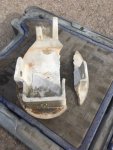
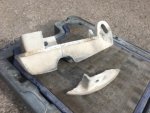
Broken Selden Mast Heel no replacement

yelbis

Well-Known Member
Joined
10 Nov 2005
Messages
380
Location
Hove
Visit site
Hi All.

My Dehler 34 1992 was severely damaged during storm Eunice. The mast has been removed to discover the mast heel
has been cracked and broken in various places. Welding is an option however the finished strength can not be guaranteed.

Seldon have informed me the heel is obsolete and there is no replacement due to the mast section itself being obsolete.

Would anyone know of a company or boat jumbler that may have one gathering dust. Or perhaps other manufacturers
used the same mast section??

Selden mast heel Part Number is : 502-107-01 HEEL NO EXIT,HINGE (SER 2)

Mast section. 420. 611

Thanks
 

Attachments

  • IMG_3804.jpg
    IMG_3804.jpg
    64.7 KB · Views: 99
  • IMG_3802.jpg
    IMG_3802.jpg
    42.7 KB · Views: 101
  • IMG_3803.jpg
    IMG_3803.jpg
    60 KB · Views: 96
That looks in a bad way as well as the detached piece, it's also got several other cracks. I'd get a new one fabricated in ss. Presumably you are covered by insurance so the cost is not important.
 
Find a small aluminium smelters and they will soon cast a new one and normally out of a better quality aluminium. You could also increase the thickness of the casting to give extra strength.
The smelters will stick the old one together for use as a mould.
 
+1 for casting. The ability to patch the old one up easily for use as a mold/plug is the clincher.

Failing that, the form looks like something a fabricator could reproduce from various stock and skilled welding. I'd still go for aluminium over stainless, so as not to introduce such an lump of dissimilar metal in a location where corrosion could be quite catastrophic. (There's ways to mitigate this and insulate the surfaces, of course.)
 
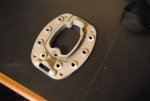
Thank You, however I require a hinged heel. It actually goes up into the mast and then that assembly sits on a plate not dissimilar to your photo.
Why do you need it hinged? You would never try to lower the mast on a hinge on a boat the size of yours, surely.
But if you want a bracket up the inside for some reason, you could easily bolt a piece of aluminium channel to the base , bolt it down through the base then drill 2 horizontal holes in it would sit it up inside the mast
 
Take it to a decent welder and get his opinion. If viable (looks to be from here) then way cheaper than casting.
I am definitely not a decent welder but I know a few. Welding aluminium that has spent time in marine service is notoriously difficult. The weld pool constantly exposes corrosion that has to be 'chased' and the job becomes impossible.
 
I am definitely not a decent welder but I know a few. Welding aluminium that has spent time in marine service is notoriously difficult. The weld pool constantly exposes corrosion that has to be 'chased' and the job becomes impossible.
You have much more experience than I do, but I thought it was worth a look by a welder. It is fairly chunky, so less of a problem with corrosion?
 
I don't think that is a Selden part. The new Dehlers are, but the old masts were John Mast. Maybe try sending them a picture and see if they can help.
 
You have much more experience than I do, but I thought it was worth a look by a welder. It is fairly chunky, so less of a problem with corrosion?

My pivoting mast foot shattered end of last season and I left it till this year to fix. Its a different design - but Cast Alloy as well ....

Pal of mine owns a Metal Fabrication Workshop ... his welder guy took it and later gave it back to me repaired. He was concerned about the Alloy as it is over 50yrs old and had weathered a lot. But the repair has proven successful and we consider it as strong as original.

bzAGgiam.jpg


exLOgRLm.jpg


wZ7daaRm.jpg


yDyFOv3m.jpg


Ready to enjoy :

eaIHB1N.jpg
 
Our Selden, cast aluminium mast foot was badly corroded a few years ago (after 40 years of service). We removed it from the spar and took it to a machine shop to see what they could do. They welded new material to it and then ground it down to the right size and shape. Since then we've covered about 20,000 miles and crossed both the Atlantic and Pacific oceans.
 
Top