

jamie N
Well-Known Member
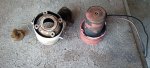
'Rule 1100GPH' bilge pump, powered through a remote float switch. The item failed mechanically through a sheared shaft at the attachment point between the motor and the impeller. The motor was unaffected. This on a wooden Folkboat that was/is still 'taking up', so does require bilge pumps, which is the reason why I fitted a separate automatic bilge pump, run from a separate battery in order to provide redundancy. On the 2nd pump, which had an internal float, and is a 3 wire system, the pump was never activated by virtue of the fact that it's slightly higher in the bilge, but was tested by switching its manual operation switch, and hearing the response. Pretty secure so far, but for the bit where the power wire for the automatic side of this pump had been dislodged from its connector, rendering the auto bilge pump function U/S.
The boat was very nearly sunk by this, with the water level being up around the bunks when I arrived in the morning. I activated the manual side of the 2nd pump, and switched on a 3rd pump to recover the situation.
The batteries and the engine weren't compromised by a margin of a couple of cms, above which are both oil dipstick holes, and the starter motor, which was electrically disconnected from the batteries remained dry, indeed the only capital damage was buying a replacement pump and some tools such as a DVM and cordless screwdriver.
The boat was very nearly sunk by this, with the water level being up around the bunks when I arrived in the morning. I activated the manual side of the 2nd pump, and switched on a 3rd pump to recover the situation.
The batteries and the engine weren't compromised by a margin of a couple of cms, above which are both oil dipstick holes, and the starter motor, which was electrically disconnected from the batteries remained dry, indeed the only capital damage was buying a replacement pump and some tools such as a DVM and cordless screwdriver.

