Broken battery terminal repair/work around?

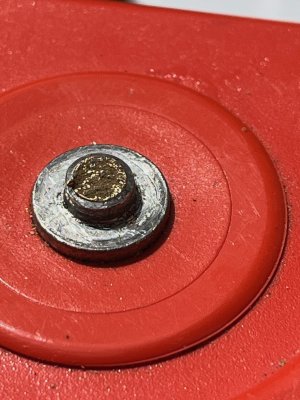
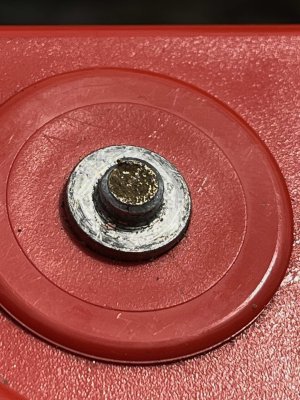
Curiously, there's a grainy (dirty? rusty?) appearance to the surface exposed where the post broke. (Though looks much less dark/dirty to the naked eye than photos below. I might try cleaning it with some alcohol later.) I wonder whether there might have been an original fault in the metal, or a crack in it from damage prior to me receiving it. I didn't think I was applying excessive torque to the nut when it broke.

It had been stored, never anywhere damp, and periodically charged for about a year (expected installation delayed), and the guarantee specifically excludes broken or damaged terminals. :rolleyes:
Red Flash 5.jpgIMG_1170.jpg
 
Probably best to buy a new battery if none of the above are suitable.

Sadly, money is very tight, and these batteries are now £400!

It was intended to free up the original engine battery space for an additional domestic battery. (Originally - 1970s - only a single domestic battery, now not up to keeping pace with the fridge, heater etc. that the boat has had installed over the years.)
 
Maybe brazing, soldering a new stud on to the top of the old one, can be done. No idea if welding could be done, but there are welders that can weld small things successfully. I suspect that the cost, unless you can do it yourself, would be prohibitive, compared to buying a new battery.
 
I’d go with this myself. A 1” ratchet strap wound up bar tight pulling down a ring terminal-ended piece of 35mm2 cable. No need for the bar I would have thought.

I think it would need something higher, otherwise the strap will be pulling across the terminal, rather than down onto it.

A bar across the top, standing above the battery case, could be being pulled/held downwards either side. I fancied that some of that industrial packing tape that's secured with a metal crimp would be an ideal negligible-stretch and not in the way solution, but don't know anyone that has the gear. Your suggestion of a standard ratchet strap is a more readily available solution, particularly if I can arrange a screw arrangement through the bar to clamp down on the terminal (maybe using a M7 or M8 version of the female/male stand-offs that Alex Blackwood links to in post #10. I think I have somewhere a plastic bike tyre lever that might serve as the bar.
 
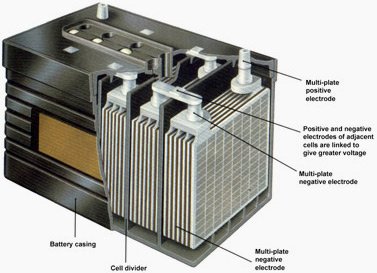
I strongly suspect the internal post is larger than 6mm. The threaded stud has been formed/cut from the piece above the top of the battery. I am VERY familiar with high output motorcycle batteries with small terminal posts, most of these have a see through clear case. The internal posts can be clearly seen. It should accept a 5mm drill and a 6mm tap.

Tranona's answer is good. Obtain an overlength nut-found easily enough online-and that should make a very satisfactory repair.
Point taken about the diameters. Would the act of tapping the new hole overcome the torque resistance of the terminal though? Of course there may be a square section to that component to resist the terminal being tightened in normal use so may be no worries.
 
Curiously, there's a grainy (dirty? rusty?) appearance to the surface exposed where the post broke. (Though looks much less dark/dirty to the naked eye than photos below. I might try cleaning it with some alcohol later.) I wonder whether there might have been an original fault in the metal, or a crack in it from damage prior to me receiving it. I didn't think I was applying excessive torque to the nut when it broke.

It had been stored, never anywhere damp, and periodically charged for about a year (expected installation delayed), and the guarantee specifically excludes broken or damaged terminals. :rolleyes:
View attachment 196207View attachment 196208
Good pics - looks like a crappy casting.
If you were to drill and tap for a female thread, you will need a plug tap in the chosen size.
I would go for the external clamp method probably.
 
Clean all the remains to bright metal.
Drill the stud to take a self tapping screw of reasonable gauge.
Get a large steel washer with a hole that will fit around the stud, glue and it down to the plastic battery top with silicone.
Using LaCo flux and a small gas torch, tin the screw and stud remains trying not to get the washer or battery top too hot, a wet cloth on the washer will keep it cooler.
Drill a 13mm hole in a piece of 16mm thick wood bigger than the washer and glue it on to the washer.
Clean and reflux the screw and stud
Pour molten lead into the hole.
Split off the wood and you have a battery post with a good connection.
 
I'd personally try to avoid doing anything likely to damage the battery further for my first attempt. That probably leaves a bar pressed or pulled downwards. A downward pull will be easier to manage unless the battery has a shelf above it. Ideally some angle iron or box section to reduce bending. Perhaps drill a hole and put a stainless washer over the stub. Should give reasonable contact area and locate well. Drill a hole in the side of angle iron or top of box section to take a bolt for electrical connection. Downward pull could be either straps or threaded bar to a flat plate underneath. All very Heath Robinson but good chance of it working.

I'm guessing current is going to be ludicrously high but short duration as it's a Red Flash. That's the main worry but you can monitor how hot it gets and decide if it's adequate.

If that fails it's time to try something such as drilling that might cause damage. Or see if you are any good with molten lead.:D
 
Last edited:
Clean all the remains to bright metal.
Drill the stud to take a self tapping screw of reasonable gauge.
Get a large steel washer with a hole that will fit around the stud, glue and it down to the plastic battery top with silicone.
Using LaCo flux and a small gas torch, tin the screw and stud remains trying not to get the washer or battery top too hot, a wet cloth on the washer will keep it cooler.
Drill a 13mm hole in a piece of 16mm thick wood bigger than the washer and glue it on to the washer.
Clean and reflux the screw and stud
Pour molten lead into the hole.
Split off the wood and you have a battery post with a good connection.
I think this is a pretty good suggestion but I would try to cut off the red plastic disc first to give some idea of the thickness of the base below the threaded part. It may even be possible to drill and tap to 6 mm rather than a self-tapper.
 
I can't imaging wanting any of those fixes on my boat. As an insurer, I would say "nope." Exploding or leaking batteries are very bad.

My guess is that just inside the case the stainless post is crimped or cast or something to a lead terminal. I'm very comfortable with taps and drilling, but there is just too much unknown.

1752608556419.jpeg

I'd sooner sail without power. If it is not the sole battery, can't you just combine until you can get a new one? I just don't see the risk benefit.
 
I would get a 6mm die nut and try to run a thread further down the stump. A die nut usually has a lead in on one side but a thread cut much closer on the other side. It may just enable a nut to be more securely screwed on.
I guess before you throw the battery away you could try to bore a hole in the stump to tap a thread in deep enough to serve.
I would not try the molten lead thing unless it is a last resort. You would need to make a dam to keep the lead over the stump If you do get a lump of lead attached then tap a thread into it or use self tapping screw.
In the end a clamp over the top might be the best answer. ol'will
 
What about a Spot Welder ? The speed the welder works will not risk the plastic case or other around the terminal as molten lead / usual welding would.

There are Spot Welder kits for small money ..... mine cost me about 40 euros and runs of any 12v source ...

The tab you spot onto the post will of course not be as substantial as the old post - but careful application of multiple nickel plates could give you a reasonable terminal.

Here's an example video of such a Spot Welder ..... (this is a self powered version - mine uses an external power source) :


Once the strips are welded to the broken stud - you can solder a wire and connector to thye strips ...
 
I've broken the positive terminal of a very expensive Red Flash AGM battery (tiny size, high CCA) I had yet to install (while 'borrowing' it to start another boat's engine). The terminal is M6, and I'm left with a short stub with a damaged thread.

Any suggestions how this could be repaired or worked around?

I am guessing that welding or similar could not be done without potential damage to the battery or the person doing it.
Is there any kind of conductive adhesive I could use to fix some type of supplementary terminal to the remains of the original?

I could perhaps secure some kind of bar across the top of that end of the battery using a strap under the battery, then that bar either bearing directly on a ring wire terminal on the battery's terminal base, or with a bolt through the bar to clamp the wire terminal against the remaining base, but would welcome suggestions of other potential solutions.

(First 2 photos show the undamaged negative terminal. The last photo shows an M6 nut just nipped on the top of the damaged terminal thread, which allows me to clip my battery charger to it for the moment, but doesn't give enough contact area or pressure for a proper secure connection for engine starting amperage.)

View attachment 196180View attachment 196184

View attachment 196181View attachment 196182View attachment 196183

I did exactly the same.
Filed it flat.
Pillar drill, so you drill square.
Threaded bar screwed in.

YouTube videos told me how to do it.
I went right through, it is really not deep. 5mm or so on mine. Doesn't seem to matter.
 
I did exactly the same.
Filed it flat.
Pillar drill, so you drill square.
Threaded bar screwed in.

YouTube videos told me how to do it.
I went right through, it is really not deep. 5mm or so on mine. Doesn't seem to matter.

I would guess that as long as the threaded stud you put in seals in the threads - and add a nut with soft washer to further seal ... ??
 
obtain a bit of Brass ,about 5 mm thick and 25 mm ish wide x 30-40 mm long. Drill a hole at one end togive a tight clearance on the stub and fit to post , attach to flange using small self tappers. Drill hole in other end and fit a 6 mm stud to attach battery cable.
Clean everything to bright metal and use terminal paste to protect.
This way you have the area of the flange as well as the stud as conductor.
Make sure that the attached battery cable has an attachment close to the battery so as not to put any strain on the terminal setup.
 
Last edited:
Top