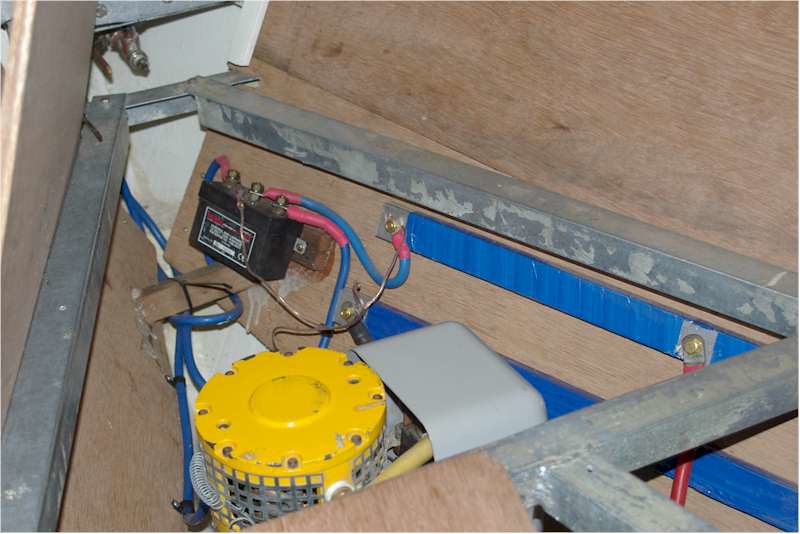
Bow thruster battery & wiring

Listen up everybody , pvb is going to replace your alternator if you blow it up drawing 300-odd amps from it.
Pillock.

You can't draw "300-odd amps" from an average alternator, it will only supply what it can, based on its design and the engine speed. Your post simply shows that you don't know anything about it, which most people are already aware of.
 
You can certainly damage the typical simple boat alternator by overloading it.
A bow thruster connected too directly can overload it.
It will indeed supply what it can, based on its design and the engine speed. But also based on the load it sees.
If it's designed to give 90A at 14V, something like a thruster might drag it down to say 10V, where it might put out a fair bit more current and there endeth the warranty.
 
You can certainly damage the typical simple boat alternator by overloading it.
A bow thruster connected too directly can overload it.
It will indeed supply what it can, based on its design and the engine speed. But also based on the load it sees.
If it's designed to give 90A at 14V, something like a thruster might drag it down to say 10V, where it might put out a fair bit more current and there endeth the warranty.

No, this is simply reinforcing the fact that your "advice" is unsound. Why bother?
 
The biggest risk, IMHO, is ending in a situation - planned or through a simple failure - where you exceed the current capacity in the cables going forward and things catching fire.

OP has cables already, a good battery to battery charger is about £120 and will avoid or reduce pretty much all the risks mentioned so far. It also provides an independent backup in emergencies.
 
You can certainly damage the typical simple boat alternator by overloading it.
A bow thruster connected too directly can overload it.
It will indeed supply what it can, based on its design and the engine speed. But also based on the load it sees.
If it's designed to give 90A at 14V, something like a thruster might drag it down to say 10V, where it might put out a fair bit more current and there endeth the warranty.

What a load or total drivel.
 
The biggest risk, IMHO, is ending in a situation - planned or through a simple failure - where you exceed the current capacity in the cables going forward and things catching fire.

OP has cables already, a good battery to battery charger is about £120 and will avoid or reduce pretty much all the risks mentioned so far. It also provides an independent backup in emergencies.

How can you exceed the current capacity of the cables and cause a fire, if you fit a fuse or circuit breaker rated for the cables current carrying capacity ?
 
Listen up everybody , pvb is going to replace your alternator if you blow it up drawing 300-odd amps from it.
Pillock.

I will provide here, in writing, a warranty to the OP that connecting his bow thruster as i described, will not harm his alternator and will not overload the 10mm cable connecting it to the engine battery.

My contact details are in my signature and my boat is berthed in the same marina as the OP, so he'll have no trouble tracking me down in the event of a warranty claim.

Furthermore, i am prepared to make, in addition to my warranty, a donation of any sum you would care to name, to the charity of your choice, if my advice results in either, the destruction of the OPs alternator, or a fire caused by the cable being overloaded. Provided that you will match that amount, to a charity of my choice, should my advice do exactly what is says on the tin.

Money where your mouth is time ?
 
My thoughts. I've had 2 boats with bow thrusters. Absolutely essential on the present boat due t layout etc. BUT, WE'VE NEVER USED THE THRUSTER FOR MORE THAN 15 SECONDS on either boats. Otherwise, you risk some serious overheating.

Oter self imposed rule; always wait 2 seconds between port and starboard activation... you may shear the pin if the prop is not fully stopped. BTDT

All has been said about the electrics.

GL
 
BUT, WE'VE NEVER USED THE THRUSTER FOR MORE THAN 15 SECONDS on either boats. Otherwise, you risk some serious overheating.

The manual for mine says it is good for around 3 minutes continuous operation (not that I envisage using it for longer periods than you). After about 3 minutes continuous running an overheat device will stop it, and then limit it to running around 10% of the time until it's switched off and allowed to fully cool.
 
I will provide here, in writing, a warranty to the OP that connecting his bow thruster as i described, will not harm his alternator and will not overload the 10mm cable connecting it to the engine battery.

My contact details are in my signature and my boat is berthed in the same marina as the OP, so he'll have no trouble tracking me down in the event of a warranty claim.

Furthermore, i am prepared to make, in addition to my warranty, a donation of any sum you would care to name, to the charity of your choice, if my advice results in either, the destruction of the OPs alternator, or a fire caused by the cable being overloaded. Provided that you will match that amount, to a charity of my choice, should my advice do exactly what is says on the tin.

Money where your mouth is time ?
I really can't be bothered any more. (and I have serious aversion to gambling).
If anyone is really interested in the possible bad effects of overloading an alternator, they can find people who've destroyed alternators with such things as winches in LandRovers, or maybe talk to people who've fitted big inverters to certain vehicles with lots of aerials on them. All alternators are not the same when it comes to pushing the limits.
Bosch will even tell you that a regular car alternator isn't even actually intended to charge a flat battery.

For the sake of balance, most of Paul's advice is sound and little of it actually contradicts anything I've said.
 
I see no good reason to connect the bow battery to your main domestic bank, for me the whole purpose of it is to service the thruster. Keeping it charged is not a big deal as explained. (possibly a small solar dedicated to it) In fact your bow battery could be used for both windlass and thruster as it is hard to imagine them both being used at the same time.
This seems to be, by far, the easiest solution. No need for big cables running along the boat or diodes or relays. Keep it simple. :)
 
I took an alternative approach to charging my bowthruster battery in the bows. I could not face paying the £250 for heavy duty cables from batteries at the port rear to the lead acid BT battery in the sb bow so I installed light charging only wires with a plug key to disconnect the charging wires. I hang the plug key that disconnects the charging wire on the BT joystick so if the plug is not there I should not use the BT. The charging wire is fused for that light wire connected to one of the battery banks. Although my boat is only 8.5m, being a cat and needing to go across the boat as well well as forward I was concerned about voltage drop unless I had ridiculous size of cable. So my system is not ideal but works for me.
 
I took an alternative approach to charging my bowthruster battery in the bows. I could not face paying the £250 for heavy duty cables from batteries at the port rear to the lead acid BT battery in the sb bow so I installed light charging only wires with a plug key to disconnect the charging wires. I hang the plug key that disconnects the charging wire on the BT joystick so if the plug is not there I should not use the BT. The charging wire is fused for that light wire connected to one of the battery banks. Although my boat is only 8.5m, being a cat and needing to go across the boat as well well as forward I was concerned about voltage drop unless I had ridiculous size of cable. So my system is not ideal but works for me.
You could disconnect the charging wire automatically when the thruster runs. A relay or two, lot of change out of £250.
A FET maybe.
Or put some sort of current limiter in the charge wire. Slippery slope towards a home brewed B>B charger perhaps.
In the old days, people used to add a notion of current limiting to model railway controllers by putting a car headlight bulb in series. Low resistance when cold, drops 12V (or so) at 5A. No doubt people would use a microprocessor to emulate this nowadays...
 
I have a 3Kw thruster. Its driven from a battery fitted in the Bow very close to the thruster itself.
It is fed directly from the House Batterys (ie ,)in parallel with the house batterys from the Alternator. There is a Breaker switch which cuts supply to the Thruster battery. I use this to disconnect the Thruster from the Battery Bank when in port or not requiring the thruster , so that the thruster Battery remains at high charge. I flip off the Thruster Breaker at the same time as I turn the isolation switch for the Engine Battery once I dock , no big deal , the system works fine. VSR would automate the need to manage this.
You will get a decent assist to the thruster from you Alternator when your engine is running through your 50mm sq charging cables. so I'd advise to charge from the alternator rather than from solar as mentioned earlier.
Originally I had a Spiral wound battery which was incorrectly blamed for very poor operation of the Thruster. After replacing the Spiral with a 110 Ah Leasure battery , I discovered the source of the problem was a badly pitted Forward/Reverse relay cotacts. I replaced the relay and this fixed the issue. Ive been operatin the thrusters for 2 seasons on the Leasure Battery with no issues. I think that the Spiral Wound battery was technically more suited to this job though and bean yo revert back to it.
Kinsale 373
 
Following on from this useful thread I have a question. My (new to me ) boat has a side power bow thruster fed from a bow battery. There appears to be a pair of 4mm wires running to the engine start battery for charging? I can't find any fuse on these lines, surely there should be? What size would be ok? I guess its all ok as long as the bow battery stays in good condition and charged, otherwise , would the current now try and flow from the start battery via the small cables? I would like to fit something to put my mind at rest, perhaps just a fuse or a b to b charger?

Any thoughts very welcome

Thanks
 
Following on from this useful thread I have a question. My (new to me ) boat has a side power bow thruster fed from a bow battery. There appears to be a pair of 4mm wires running to the engine start battery for charging? I can't find any fuse on these lines, surely there should be? What size would be ok? I guess its all ok as long as the bow battery stays in good condition and charged, otherwise , would the current now try and flow from the start battery via the small cables? I would like to fit something to put my mind at rest, perhaps just a fuse or a b to b charger?

Any thoughts very welcome

Thanks
This is essentially what I have. I wondered what the current draw may be through these small wires with the thruster operating but failed totally to calculate that so I just have a plug isolating switch and a fuse to avoid me finding out by setting these wires alight, perhaps. I think you need a fuse anyway.
 
With sufficiently heavy gauge cables a thruster can be run directly from batteries aft, eliminating the need for a battery at the bow. That was my original intention, and would have required minimum 70mm2, and recommended 95mm2, cables for the c6m each way (c12m total round trip). For various reasons too complicated/boring to explain here I'm now revisiting my original strategy.
That was my approach when I built my 50 ft 24 ton steel boat.

My bow thruster has a max current draw of 600 Amps being a Vetus 95Kgf thruster.

I fitted my aluminium buss bars 38mm x 25mm from battery to thruster to drive thruster and windlass .

The only issue I have is my battery isolation switches are not high enough current rating so do get some voltage loss.

12 off 110 Ah batteries in my domestic bank drive the thruster but I could also drive then from my engine start battery.

36046267306_7d24c8f2b7_c.jpg


Colour of positive buss bars have been changed now to red.
 
Top