Bow thruster battery charging

iainw

New Member
Joined
3 Mar 2021
Messages
10
Visit site
Hi there,

I have just recently purchased a 40ft sail-boat with a bow thruster that has a dedicated battery about 8 meters forward of the start and house battery bank.
The previous owner had the battery wired directly to the house battery bank, which unsurprisingly, both drained the house bank quickly as well as causing overheating in the wiring under bow-thruster use.

I would like to set up a battery to battery charger from the start battery. (This way I can hook up solar charging to house bank without it being drained to the bow thruster battery if solar input exceeds 14v but is not enough Amps to match the B2B capacity).

I have a few questions though which I cant seem to get straight answers to.

Info: The thruster is around 4hp, (Dont have the amps measure but I guess around 250-300 Amps).
It sits 8 meters from the house batteries
It has a 100amph dedicated battery in the bow.
The alternator is 140Amp/h (so 70 amp at 50% realistic max output), This already has a VSR to the house and starter battery.
B2B will be of Victron type, with automatic charging only when start battery exceeds 14V (i.e engine running)
So:

What size B2B would I realistically need? (Thinking that if its too big it will drain the start battery if it exceeds the Alternator input)
What size cabeling /fuses do I need from the starter battery to the B2B.
What size cabeling /fuses from the B2B to the bow battery.
Is the B2B safe if the bowthruster tries to draw a massive load?

Many thanks in advance for your help, this has been a bit of a headache, but this is last piece of the puzzle.
Iain
 
If you connect the B2B to the engine battery, the bow thruster battery will never get charged, unless you are on shore power. It would make more sense to connect to the domestic bank, where it will get charged when the engine is running, the mains charger is on or solar power is charging.

You'll need to post the current draw from the thruster and the existing cable sizes to the thruster battery to get best answers;, anything else is just guess work.
 
I've got an Adverc B2B (4 amp) for my bowthruster that requires 250 amps. The B2B is fed from my only battery bank and the only problems that I have had is when the BT battery failed. I rarely use a shore power charger and rely upon the solar panels (about 80W max) and meager output from my outboard to keep everything charged. All worked very well in 2019 when I was away for a month.
 
If you connect the B2B to the engine battery, the bow thruster battery will never get charged, unless you are on shore power. It would make more sense to connect to the domestic bank, where it will get charged when the engine is running, the mains charger is on or solar power is charging.

You'll need to post the current draw from the thruster and the existing cable sizes to the thruster battery to get best answers;, anything else is just guess work.
Thanks for you quick response guys.
Why wont the B2B charge the bowthruster from the start battery while the engine is running? Or when the VSR in the shore power charges both the start and house bank?
Also here are the specs I found for my bow thruster model:
8CB68113-208E-4FE9-8ED6-64F60280E12B.jpeg

many thanks again for the help
Iain
 
I've got an Adverc B2B (4 amp) for my bowthruster that requires 250 amps. The B2B is fed from my only battery bank and the only problems that I have had is when the BT battery failed. I rarely use a shore power charger and rely upon the solar panels (about 80W max) and meager output from my outboard to keep everything charged. All worked very well in 2019 when I was away for a month.
Hi there, thanks for your answer.
I get that your system works as you only have a 4ampere B2B on the bow thruster.
That helps with my problem that my 100w solar panels can only provide a max of 8 amperes (100w/12v) so the issue is that if the solar is charging and I use a 10amp or above B2B it would just suck power from the house bank everytime the sun shines.

But is 4 amp enough to charge the Bow thruster? Bear in mind I have a sailboat so only motor for about 15-20mins in and out of the marina. This would only provide about 2-3 amp hours of charge for each use.

Thanks again
Iain
 
But is 4 amp enough to charge the Bow thruster? Bear in mind I have a sailboat so only motor for about 15-20mins in and out of the marina. This would only provide about 2-3 amp hours of charge for each use.

Bow thrusters are typically used for very short periods. Try timing how many seconds you use the thruster for, and you'll then be able to see how many Ah you've taken from the thruster battery. You may be surprised how little it is.

PS Welcome to the forums!
 
Bow thrusters are typically used for very short periods. Try timing how many seconds you use the thruster for, and you'll then be able to see how many Ah you've taken from the thruster battery. You may be surprised how little it is.

PS Welcome to the forums!
Thanks for that. Yep I figured a 350A thruster only uses about 3-4 amp/h over 30 seconds. And 30 seconds is ALOT of bow thruster use. So I guess a 10A B2B would be plenty enough ”recharge” capacity.
 
Why wont the B2B charge the bowthruster from the start battery while the engine is running?

Because how you describe things in post #1, the only time the bow thruster battery will be getting any charge is when the engine is running, so unless you run the engine a lot, you'll never fully charge the battery. In the meantime, your solar power could very well be doing nothing, because the domestic bank is charge, that surplus power could go to the thruster battery.

Or when the VSR in the shore power charges both the start and house bank?

In post #1 you said "This way I can hook up solar charging to house bank without it being drained to the bow thruster battery if solar input exceeds 14v but is not enough Amps to match the B2B capacity"

Those two statements contradict one another.

If i understand you correctly, you have the alternator connected to the engine battery and a mains charger connected to the domestic bank, with a dual sensing VSR between the two banks, is that the case ?
 
Because how you describe things in post #1, the only time the bow thruster battery will be getting any charge is when the engine is running, so unless you run the engine a lot, you'll never fully charge the battery. In the meantime, your solar power could very well be doing nothing, because the domestic bank is charge, that surplus power could go


In post #1 you said "This way I can hook up solar charging to house bank without it being drained to the bow thruster battery if solar input exceeds 14v but is not enough Amps to match the B2B capacity"

Those two statements contradict one another.

If i understand you correctly, you have the alternator connected to the engine battery and a mains charger connected to the domestic bank, with a dual sensing VSR between the two banks, is that the case ?

Hi, sorry for the contradiction.
Just now the setup is:
Alternator (140A) runs via a VSR to both house and starter batteries.
Shore power via victron multi battery charger 50A runs to both start and house batteries.
Solar 100w (so max 8A) runs via victron solar controller to just house batteries.

My worry is that if the B2B from the house batteries to the bow thruster is more than 8A, when the solar controller kicks in (lifting the voltage to 14v) the larger B2B will draw too many amps from the house batteries?

Hope this helps ??‍♂️ Thank you for your patience with me ?
 
My worry is that if the B2B from the house batteries to the bow thruster is more than 8A, when the solar controller kicks in (lifting the voltage to 14v) the larger B2B will draw too many amps from the house batteries?

You said in post 1 that you were planning to use a Victron B2B charger. Which model exactly do you have in mind?
 
Hi, sorry for the contradiction.
Just now the setup is:
Alternator (140A) runs via a VSR to both house and starter batteries.
Shore power via victron multi battery charger 50A runs to both start and house batteries.
Solar 100w (so max 8A) runs via victron solar controller to just house batteries.

My worry is that if the B2B from the house batteries to the bow thruster is more than 8A, when the solar controller kicks in (lifting the voltage to 14v) the larger B2B will draw too many amps from the house batteries?

Hope this helps ??‍♂️ Thank you for your patience with me ?

No problem Iain, just want to be sure of your setup before giving advice. What VSR do you have ?
 
You said in post 1 that you were planning to use a Victron B2B charger. Which model exactly do you have in mind?
Thats sort of my problem too, how big does it need to be to effictively recharge the bowthruster battery. Thinking that engine running time is usually around 20-30 mins when coming in/out of port and absolute max bow thruster use will be about 20 secs at 350Ah
 
Thats sort of my problem too, how big does it need to be to effictively recharge the bowthruster battery. Thinking that engine running time is usually around 20-30 mins when coming in/out of port and absolute max bow thruster use will be about 20 secs at 350Ah
Ps the model I heard best review from is the orion 30A
 
View attachment 110476
Hi Paul,

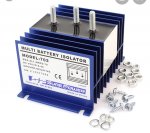
Sorry its this one

That's not a VSR, that's a split charge diode.

So, the only time the thruster battery can get any charge current is with the engine running, via the diode, which has around a 0.7v drop, that's not really a good plan Iain.

I'd connect the charging to the domestic bank, then you get a charge to the battery when the Sun is shining. If the thruster battery is charged, it won't continue to draw current. Just because you've connected a xxa B2B charger does not mean that xxa will constantly flow to the thruster battery.

The thruster battery will almost never be very discharged so it's pointless fitting a large current B2B charger, if you fitted a 10a one it would be rare that you'd see 10a going to the thruster battery for anything other than a few minutes, as the battery state of charge increases, its ability to take current decreases.

If you want to fit a B2B fit a 10a one, use 10mm cable and fuse both ends with 15a fuses.

Job done. The thruster battery will now get charged by the alternator, shore power and solar.
 
Very slight thread drift please as I am planning a thruster bank installation this coming winter,...

I plan to use a VSR between domestic bank and thruster bank so the thruster bank is charged when the V is high enough in the domestic bank to close the VSR. Essentially when the engine is running the VSR closes and the thruster bank is charged. But consider for a moment the instant when the thruster is used and the engine is running - the VSR will be closed so the thruster draws 800A from the thruster bank but also from the domestic bank because the VSR is closed. Won’t this result in the VSR melting as, say, 500 A rushes through it? Or will the voltage drop which happens on the domestic bank when the thruster is energised cause the VSR to instantly open thereby protecting itself and the domestic bank? But this is then a circular argument because the domestic bank V will increase the moment the VSR opens because the alternator is providing 14.2V and the whole horrible sequence starts again and repeats? I think I might be confused here.....
 
Very slight thread drift please as I am planning a thruster bank installation this coming winter,...

I plan to use a VSR between domestic bank and thruster bank so the thruster bank is charged when the V is high enough in the domestic bank to close the VSR. Essentially when the engine is running the VSR closes and the thruster bank is charged. But consider for a moment the instant when the thruster is used and the engine is running - the VSR will be closed so the thruster draws 800A from the thruster bank but also from the domestic bank because the VSR is closed. Won’t this result in the VSR melting as, say, 500 A rushes through it? Or will the voltage drop which happens on the domestic bank when the thruster is energised cause the VSR to instantly open thereby protecting itself and the domestic bank? But this is then a circular argument because the domestic bank V will increase the moment the VSR opens because the alternator is providing 14.2V and the whole horrible sequence starts again and repeats? I think I might be confused here.....

You need to fuse the cable from the VSR to the thruster battery at both ends, to protect the cable and the VSR. To prevent these fuses blowing if the thruster tries to draw excessive current from the charging battery you can fit relays to the VSR negative to disengage it when the thruster is running.
 
That's not a VSR, that's a split charge diode.

So, the only time the thruster battery can get any charge current is with the engine running, via the diode, which has around a 0.7v drop, that's not really a good plan Iain.

I'd connect the charging to the domestic bank, then you get a charge to the battery when the Sun is shining. If the thruster battery is charged, it won't continue to draw current. Just because you've connected a xxa B2B charger does not mean that xxa will constantly flow to the thruster battery.

The thruster battery will almost never be very discharged so it's pointless fitting a large current B2B charger, if you fitted a 10a one it would be rare that you'd see 10a going to the thruster battery for anything other than a few minutes, as the battery state of charge increases, its ability to take current decreases.

If you want to fit a B2B fit a 10a one, use 10mm cable and fuse both ends with 15a fuses.

Job done. The thruster battery will now get charged by the alternator, shore power and solar.
Thats a brilliant answer paul.
Thank you for your time on this one.
Happy sailing
Iain
 
Top