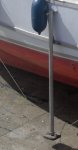
Boat/Yacht Leg fitting

Freddie100

New Member
Joined
1 Nov 2018
Messages
8
Visit site
Hi all, I am looking to fit a set of legs to my coastal cruiser and in need of some advice, I have read many forums and items but could do with further advice.
I plan to use a set of French legs I brought second-hand and seem in very good strong condition, they will connect through the hull with a single 18mm H/T bolt, on the inside of the hull I will bond probably with Sikaflex or similar adhesive a 460x150x25mm oak block to take the through bolt with washer and nut.
my thoughts are should I fit a oak block on the outside of the hull to take the through bolt or would a steel plate of say 150mm square fixed back into the wooden block, in using a block of wood on the outside this would increase the bolt length of 25mm or so maybe imposing more load onto the bolt
also should the legs which will be about 1400mm long splay at an angle outwards of the hull to increase stability when landed on the sea bed.
any thoughts appreciated

Freddie
 
Hi Freddie,
I designed and built a set of legs for our boat, 8.5 tons. After much agonizing regarding the loads, I settled on 2.5" OD heavy wall aluminum pipe. The legs fit into an aluminum bayonet style attachment on the hull.legs.jpg.
This is held in place by four 10mm bolts. My hull at this point is about 12mm thick and I epoxied an 18mm, 30cm x 20 cm piece of ply to the inside.
The legs are splayed out slightly and are about two inches shorter than the keel. This is important; I didn't cut enough off at first and this put quite a load on the legs when the keel sinks into the mud. The actual load on the legs is fairly low; two adults walking from one side to the other will make her tip from side to side - this is the true load.
You should take care not to have a bolt or something sharp&nasty sticking out when going alongside other boats.leg.jpg
 
You don't say how big your boat is, or what materials the hull and legs are. These might help formulate answers to your questions.

You'll find some useful info here on the excellent website of Vyv Cox (a regular contributor to this forum): Installing Yacht Legs

I'm no expert on this at all, but a long while ago had a 22 foot GRP boat with heavy wooden legs which were shaped to fit the curve of the hull, and had carpet fixed to the hull facing part of the legs.

These were fixed to the hull by a ring-headed bolt, perhaps about 14mm IIRC, screwed through a hole in the GRP into a captive nut mounted on a wooden backing plate inside the boat. There was no plate outside the hull (I'm not clear what purpose you envisage for such a plate).

I found the ring on the bolt very helpful when fitting the legs, as I could turn the bolt by hand when first inserting them, and nip up the the last turn or so with a screwdriver through the ring. Had it been a hexagon headed bolt, using a spanner would have been at least a nuisance, and possibly a nightmare, to get started. (In my case the load on the legs was mostly taken by the curve of the hull and legs, and such load there was on the bolt was in shear, so there was never any need to have the bolt extremely tight.)

The other thing that seemed neat to my untutored eyes was that the hole in the GRP hull was countersunk, and I had short countersunk slot-headed screws (of the same thread as the bolt) which fitted in and (with a bit of mastic on the back of the countersink) sealed the bolt holes and left an almost flush surface when the legs weren't in use.

p.s. Just to, er, support what Laminar Flow said - it is important that the legs are a little shorter than the depth of the keel, so the keel is taking most of the weight, and there is very little weight on the legs if you are on a flat-is surface: I could easily push my 1.7 tonnes 22 footer from one leg to the other when standing alongside.
 
Last edited:
I’ve got a Hurley 18 fitted with legs. The legs are wooden posts about 4 inches square, shaped to conform to the hull at the top. There’s a square plate glassed to the inside of the hull and a 4 inch square plate on the outside, bolted through to the inner plate. Single hole through both plates to take the bout which goes through the top of the leg to hold it in place; single nut onto that bolt on the inside of the hull. Bit of a scramble to get the leg in place and then get the nut on. Tightened with an adjustable spanner.

There‘s two eyebolts near the foot of the leg, lines taken from them fore and aft to secure the leg in the right place vertically. As above, the legs are a couple of inches shorter than the depth of the keel.

I‘ve got a couple of bolts with rubber washers that I fit into the holes when the legs are removed to stop water coming in....

Ive also got a couple of wedges fixed to one leg as steps. Works fine once you’ve practised using them.
 
The advantage with the Yacht Leg style fitting is that you can put them on from the outside and in a flash; handy for making accidental groundings look intentional.

We sat out a couple of tide cycles on legs in the Aulne River, waiting for the look to open. A French yacht tried to dry out along the outer lock wall where their keel slipped off the bed rock bottom and the boat was damaged.

As Duncan points out above, steps are a handy feature to have.

Another improvement was to sleeve the 7' long legs so that they can be disassembled for storage in the bilge when not needed. (On close inspection one can see the joint in the picture).
 
The Yacht Legs bayonet fitting is excellent and not all that difficult to make. The company want an arm and a leg(!) to buy a pair but they should not be too expensive if made by a general engineering shop.
Agree. Cost me about a hundred in materials and aluminum can be quite easily worked with wood tools.
 
Top