Boat supports

bowler

Well-Known Member
Joined
13 Oct 2014
Messages
514
Location
Ireland
Visit site
Hello all.

I need to lift the boat out this winter to sort props out. The yard I usually use is not an option. My other options involve providing the supports etc myself. I can get some legs locally and sleepers for under the keel are plentiful.

Having not done this before I am naturally cautious.

I have read all I can find online but thought I'd ask here out of interest. Does anyone else do this themselves?

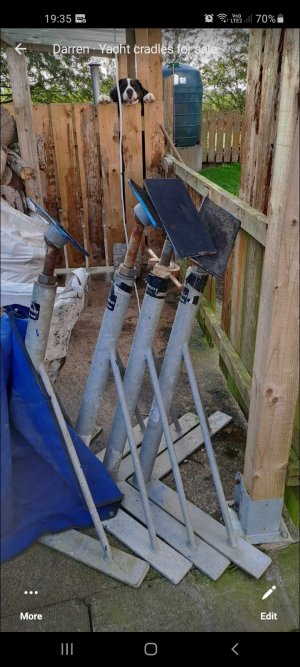
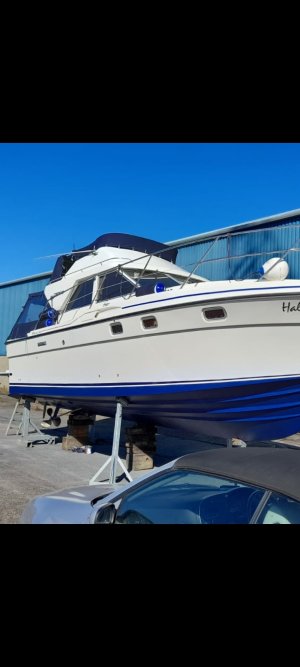
Attached are pics of the boat on the yards stuff last year, and the legs I can get locally.

Boat weighs about 6 tonnes.

So....

Lift, set on sleepers while on the slings and pop in props, screw them up tight and brace with straps or similar. Remove slings. Simple?

D
 

Attachments

  • Screenshot_20231018-193631_WhatsApp.jpg
    Screenshot_20231018-193631_WhatsApp.jpg
    315.3 KB · Views: 88
  • Screenshot_20231018-193536_Messenger.jpg
    Screenshot_20231018-193536_Messenger.jpg
    806.5 KB · Views: 90
31ft. The set up in the pic is how the yard support her every time she has been out. From what I have read, 3 stands on each side would be preferable.

There is a 3rd stand under the keel at the bow that you cant really see in the pic.
 
Most of the weight goes through the keel blocks, the props are only there to stop it falling over. TBH I'd want more keel supports and the stacks of blocks look a little precarious.
 
She seems to be sitting very high. Was that requested to make antifouling easier? My marina sits the boat on two blocks so the keel is around 12-18 inches off the ground.
My marina use steel barrels and wooden wedges instead of those supports and I’ve never seen any problems.
Just make sure to put a ratchet strap between the stands.
 
No, the boat goes from a crane to a trailer and I think it is to do with the height of the trailer. I just need it high enough that I can remove a shaft if needs be, so a little lower would certainly do. Roger on the ratchet straps.
 
Learnt from the yard that does our boat, don't make the props too tight as the boat settles a little when the strops are totally loosened. They screw the props so just touching the Hull. Then check that they feel solid once no load on strops.
 
She seems to be sitting very high. Was that requested to make antifouling easier? My marina sits the boat on two blocks so the keel is around 12-18 inches off the ground.
My marina use steel barrels and wooden wedges instead of those supports and I’ve never seen any problems.
Just make sure to put a ratchet strap between the stands.
I've heard of barrels collapsing, think most yards use the adjustable props now.
 
Grand so. I think I will aim for as low as possible. I need a bit of room incase I need to pull a shaft out but I reckon I could lose a few inches compared to above. Prop stands are on the way. Probably three sets of blocks underneath. Cheers for the feedback.
 
Why are you needing to pull a shaft? It's not a routine thing, unless there's a problem propping the boat nearer the ground would be normal.
 
Most of the weight goes through the keel blocks, the props are only there to stop it falling over. TBH I'd want more keel supports and the stacks of blocks look a little precarious.
Agree about the keel blocks being precarious. That arrangement may work for "side wind" loads but is terrible for "headwind/tailwind" loads. The keel blocks need a decent square footprint not a railway sleeper linear athwartships foot print.
 
Just to add fwiw on here I have seen yard operatives tap the hull at the keel and place the keel supports under the more solid sounding areas…..just sliding them back / Fwds a few cm before lowering the boat down .Dull thud instead of a hollow sound .

Idea being rest it on its bulkheads and heavy built sections as opposed to thin ( by comparison) hull sections .
Seems sensible .
 
My 32 which is a similar weight usually gets sat on two sets of blocks stacked about 2 high. There is then at least 3 boat stands down each side. If out for more than a quick antifoul I would opt for 3 sets of blocks.
 
Just to add fwiw on here I have seen yard operatives tap the hull at the keel and place the keel supports under the more solid sounding areas…..just sliding them back / Fwds a few cm before lowering the boat down .Dull thud instead of a hollow sound .

Idea being rest it on its bulkheads and heavy built sections as opposed to thin ( by comparison) hull sections .
Seems sensible .
Normally boats have a lift markings where to apply lifting straps, so I would have thought no need to go tapping around as you already have an indication of the safest load points, unless of course those lift markings are missing.
 
Normally boats have a lift markings where to apply lifting straps, so I would have thought no need to go tapping around as you already have an indication of the safest load points, unless of course those lift markings are missing.
Those “ lift marks “ have a different purpose .1- to get the aft strap fwd of the shafts so s not to foul .2- to get the fwd ( assuming a twin strap set ) in a safe balance position so the boat doesn’t inadvertently slip out if the fwd one is on the bow slope area .

Additionally the surface area of the straps is far greater if you sum it than a contact patch near the size of your hand of the keel blocks .


We are talking about settling down the keel where the vast majority of weight ends up pressing down and in some cases very long periods eg months / even yrs positioning the said keel blocks , not lifting the thing out hanging it in the slings for what 1/2 hr ?
 
My 32 which is a similar weight usually gets sat on two sets of blocks stacked about 2 high. There is then at least 3 boat stands down each side. If out for more than a quick antifoul I would opt for 3 sets of blocks.

Could be a few months so I agree. 3 sets of blocks.

Those “ lift marks “ have a different purpose .1- to get the aft strap fwd of the shafts so s not to foul .2- to get the fwd ( assuming a twin strap set ) in a safe balance position so the boat doesn’t inadvertently slip out if the fwd one is on the bow slope area .

Additionally the surface area of the straps is far greater if you sum it than a contact patch near the size of your hand of the keel blocks .


We are talking about settling down the keel where the vast majority of weight ends up pressing down and in some cases very long periods eg months / even yrs positioning the said keel blocks , not lifting the thing out hanging it in the slings for what 1/2 hr ?
I am at the boat now a taking a look. The stringers that the engines bearers are mounted to, which I would imagine are the strongest part of the hull, are not at the lifting points. The aft lifting mark is close to the aft stringer, but about 10" behind, just forward of the shafts. The front stringer is about a foot or so aft of the front lifting point so I think you are right. At least I have two good points for 2 of the blocks. I will find a home for the 3rd.

Ordering some sleepers as we speak and have managed to get hold of 6 stands, with 4 more potentially so all good that way.

The sleepers are only 100mm wide so I reckon that is a little on the narrow side, so each block set will be 2 sleepers wide, 200mm and around 2ft tall giving me a cube of 200mm x 600mm x 600mm per block.

Sound reasonable?
 
Sorry, I mispoke. Sleepers are 200mm wide, so two laid side by side per block would give me a cube of 600mm tall x 400mm x 600mm.

I hope this makes sense.
 
A hired crane on site or a yard crane in a boat yard that may not be possible given the river level. Either way the boat is coming out.
 
Top