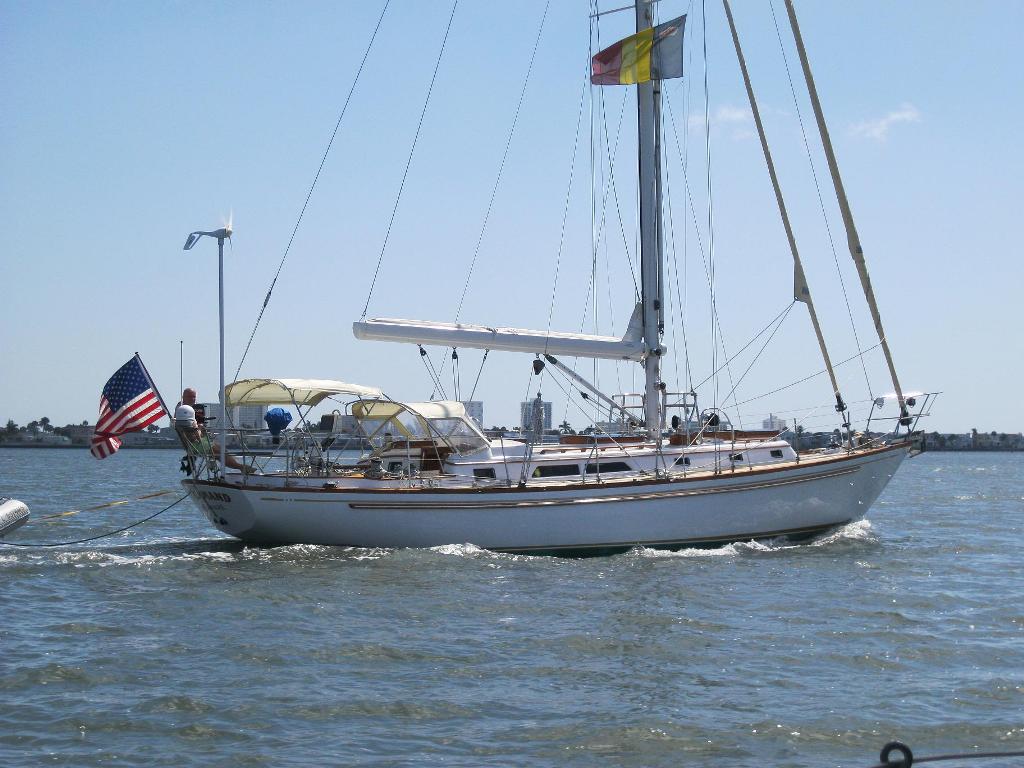
Boat requirements for Atlantic crossing

I would suggest you do some shorter passages before undertaking one which could take up to 40 days. 40 days on a smallish boat can be hard going for some one with little experience in terms of fatigue (just going for a pee when the boat is bouncing up and down is hard) and boredom.

Otherwise consider what might happen in anything were to fail and not be bodgeable on the spot. In particular, how you are going to charge your batteries if your engine fails, or the alternator burns out or the charger itself packs up. Or if for some reason a battery short circuits and kills the others at the same time.

What about the food in the fridge? Does your radio still work?

My starter motor burnt out last week and we had no way of charging the batteries while on the move. As a result when we got low on battery power, the radio stopped working and the fridge stopped working. This is not much of a problem in home waters only 10/20 miles off the coast, but in the middle of the Atlantic this can easily turn into a really big pain.

"just going for a pee when the boat is bouncing up and down is hard "

Rubbish! :D

Even 'olde men' can pee.

The "hard" bit is getting the pee to where you want it to go, without spraying the neighbourhood. Gravity takes it in hand & 'pointing percy', takes on a whole new meaning, so sitting down becomes the norm.

"Boredom"?
Not if you have no sailing experienced & are petrified by the whole experience, when 2-3 weeks from a landfall! :D

As others have strongly hinted, without prior experience of any kind, this seems to be a pipe dream destined to become a disaster.

Maybe the OP has found a novel way of smuggling naughties?
 
Here's a good book if you fancy an Atlantic crossing. This guy is an experienced sailor & has had 3 failed crossings due to boat failures.

It may help you understand some of the risks involved in taking older cruising boats across an ocean. Of course, you may be lucky, but most people accept that you need to make your own luck, or at least shift the odds in your favour rather than Neptune's.
 
"just going for a pee when the boat is bouncing up and down is hard "

Rubbish! :D

Even 'olde men' can pee.

The "hard" bit is getting the pee to where you want it to go, without spraying the neighbourhood. Gravity takes it in hand & 'pointing percy', takes on a whole new meaning, so sitting down becomes the norm.

Staying sitting down while healed over at a rapidly varying angle between 0 and 30 degrees plus the heavy pitching while slamming into the waves while beating into a gale is hard work in itself while hanging on to whatever you can find to avoid hitting your head on the deck (or anything else) as the boat dives down the back of the next wave.

I should have been more precise - peeing is the easy bit. Making it go where you want is something else :)

Oh and also getting in and out of the lifejacket and the wet weather gear as well while lying on the saloon floor trying not to hit your head on the saloon table......
 
Last edited:
im also quite new to sailing but the boat i go out on is a moody 44 ketch called border collie (those of you who read yachting monthly may of heard about our storys) she has sailed the world and you can tell that she has. one every cuboard there are stickers sayingthings like "spam, tinned food, tennis raquets" this is good idea because i cant imagine the stress of lifting up all of the cuboards and rumaging through them in a storm to find something essantial. Also all of her water is operated by a pedal pump you can get sea water from one pedal and fresh from the other so you dont have3 to waste the battery which is always in such jepready. another thing is batten everything down sling neets over shelves latch down cushions and anything else.:D:D:D:D;);):p
 
Plenty opinions already, but a few thoughts after crossing both ways.

AIS reciever is massive bang for you buck, cheap and useful.

Weatherfax can easily be recieved with a cheap radio like this http://cgi.ebay.co.uk/DEGEN-DE1103-...71169?pt=Shortwave_Radios&hash=item335054ddc1 plugged into a laptop with free software. http://www.jvcomm.de/index_e.html Schedule here http://www.jvcomm.de/index_e.html Some wire strung around should be enough for an aerial, I alligator clipped onto the fm radio aerial.

For rainwater, play around with the main so with 1 reef in the water runs into the bunt then out at the gooseneck, rig a funnel and a bucket under that and off you go. If washing then shampoo quick! Those squalls usually don't last long.

Azores are lovely, Flores looks like the land that time forgot after a few weeks at sea, waterfalls off the edge of cliffs. all that's missing are pterodactyls :)

Maryland looks ideal latitude, keep between 38 & 40 and should be ok, with the bottom of the lows giving you a nice fast sail. Was for me anyway by the time I drifted up that far into the wind.


Blog here of a crossing. http://conachair.blogspot.com/2010_06_01_archive.html
Starts at the bottom.
 
Save yourself a shed load of grief and money... and ship it over. Cost around 7k or so... less than doing it up to sail back.
 
Nice boat!

TCs-boat.jpg
 
That's what TC has just done here.

I think it's a good option - people often underestimate the wear & tear on long passages.

IIRC Jonic of this parish did it too.

What? And miss probably the only chance to experience life truly away from the rat race, weeks away from everything, ticking to a different clock.

Miss offshore????

You lot are mad :p:p
 
What? And miss probably the only chance to experience life truly away from the rat race, weeks away from everything, ticking to a different clock.

Miss offshore????

You lot are mad :p:p

Totally agree. I did a similar trip, Boston, MA to Plymouth, UK in 2004 having bought the boat on a whim while working in the States.

It ranks as one of the high points of my life.

And although, yes, the fitting out did probably cost as much or more than shipping cost would have been, much of the benefit of that is still in the boat (wind vane, liferaft, EPIRB etc).
 
Totally agree. I did a similar trip, Boston, MA to Plymouth, UK in 2004 having bought the boat on a whim while working in the States.

It ranks as one of the high points of my life.

And although, yes, the fitting out did probably cost as much or more than shipping cost would have been, much of the benefit of that is still in the boat (wind vane, liferaft, EPIRB etc).

I agree, as I said shipping's an option.

When you did it did you have a professional skipper on board your boat (ie in charge) as inferred might be the option for the OP or were you your own man (woman)? The ultimate sense of achievement is different in my book.
 
Everyone is in such a hurry nowadays. Why learn to sail thru a graduation of bigger boats when you can just buy a new 38 footer for 100k and go for it.
Why crew when you can ask a few Internet questions and pack a literacy and sat phone ( for follow up questions?) and go for it
Why learn at all when you can employ a 'professional' and tag along and go for it
Er, having crossed that big adventure off, then what?
Whatever happened to savouring the journey as well as the destination?

With all respect to the OP who I suspect is a lot more thoughtful than my theoretical 'I wannit now ' character.
 
I agree, as I said shipping's an option.

When you did it did you have a professional skipper on board your boat (ie in charge) as inferred might be the option for the OP or were you your own man (woman)? The ultimate sense of achievement is different in my book.

Nope, no professional skipper onboard. Actually nobody else.
But i think it would still be special even with someone else calling the shots. (And handling that 24h a day constant low key stress).

Not for everyone but for me offshore is where the magic lies. Takes a week or so to slip into it but it's not a place you'll forget. Though some might hate it. Not a place many people have the opportunity to visit. Seems a shame to miss that.
 
Heartfelt thanks to one and all who replied. I can't reply to each individual post but all were read and all valued greatly, just the kind of info I was hoping from you chaps.

What? And miss probably the only chance to experience life truly away from the rat race, weeks away from everything, ticking to a different clock.

Miss offshore????

You lot are mad :p:p

EXACTLY, I want to do it just because I can. I want to do a one-way Atlantic crossing if work/time allows, so I figure starting over there and sailing back to be a good option. The skipper is an old friend I haven't seen for years, ever since he set off on his own yacht sailing around the world, he is currently somewhere off the coast of Austrailia, he was up for it the last time I spoke to him. Failing him I have another skipper with many years experience and who also is a live-aboard on standby (even though he doesn't know it yet:), I know he would love to do it if the chance arose).
I figure a 34 ft boat is a good size for such a journey.

I will certainly give much consideration to all suggestions, I know it is all sound advice and the seemingly little things can be so vital. It is still some 6+weeks away before I will have time enough to give this my full attention due to current work projects, probably getting late in the year but I want to plan for it now anyway.This time last year I thought I would have it done by now already!!!

I know the preparation for the trip will cost quite a bit, but getting the boat updated and prepared will be part of the fun. Hiring a delivery skipper or getting it shipped over is obviously the wise move, but it is for the adventure of the journey rather than simply moving a boat from A to B. Thanks again to all, much to absorb.
 
It was hubby and myself on our own, and yes, I think that did add to the sense of achievement.

The precis of the story is that I was working in the US and spotted the boat for sale, very much unloved and in cosmetically a fairly poor state. (She was too old, at 20 years, too small at 33 feet and too English (a Westerly) to appeal to the market).

A structural survey showed that she was reasonably sound except for a leak into the deck which had caused rot and delamination, and which we negotiated with the seller to pay for a professional repair, and some recommendations for rigging which we had carried out by a contractor.

Hubby joined me for a few months, but basically I spent about a year preparing us and her for the voyage, and had a 'back to basics' mentality. I worked on the basis that if we managed to stay on the boat, keep the water out, had some method of steering and propulsion, then, with enough food and water we would make it across.

We assumed the engine would pack up so fitted a wind generator.
We assumed the water pump would pack up, so actually didn't even have it turned on, but fitted a foot pump. We also carried 4 x 20 litre jerry cans of water which we calculated would be enough emergency rations to see us through if we lost our tank full (75 gallon tank). (if water had been lost in first 2 weeks we would have turned back to US).
We fitted a wind pilot self steering as nothing could convince me I could keep an autopilot going with what little electrical power we had - and of course little charging ability if the engine packed up.
We fitted a twin line reefing system to enable reefing from the cockpit, and a downhaul for our jibs so the jib could also be doused from the cockpit.
We assumed that we couldn't keep the fridge going, so all food had to be stored at ambient temperature.
To appease family we carried a satphone and called home every 2 or 3 days. We also carried a liferaft and EPIRB though to be honest I'd never expect any rescue out in the ocean.

Our sailing experience was limited - we'd both only done competent crew on yachts before buying the boat, and I came home for a holiday and we both did day skipper nine day course. We had some familiarity with boats however, having owned a rib, been a keen diver, and hubby was in merchant navy many years ago.

The summer before we left we did a handful of day sails, but there never seemed to be enough time left over after working and fixing the boat. I was definitely more of a 'theoretical sailor' having spent many more hours poring over books (Nigel Calder was my hero!) than actually on the water.

We pointed our bow east in early July 2004, and once out of the harbour we finally managed to rig the windpilot for the first time - we hadn't even had time to test it. Fortunately it worked, and was to become our best crew. It was by anyone's judgement a slow passage - 39 days to Plymouth, but that was because we were not that experienced in getting the best out of the boat, and also because we were very loathe to push her too hard in case we broke anything.

We had very little very bad weather - a series of lows passed over at about weekly intervals and we got into a routine of a bit of calm, winds around the clock for a few days then a bit blowy for a day or two.

Until just as we thought we were nearly home - we had crossed only the continental shelf - the barometer went into freefall and we were caught up in the remains of hurricane Alex. We hove to with just a triple reefed main and while I can't say we were comfortable, I had every faith in the boat by that time. When the wind abated a little and I crawled out to the cockpit the seas were simply awe inspiring as we rode the swell up so you could see forever, and in the trough's there was a wall of water high above you, all around.

We had very little damage or wear and tear - the key in the engine broke off, and I had to use a little battery dremel to grind a slot in the remains - we then used a screwdriver to switch the engine on. I broke the lee board on starboard side when she fell off a wave just as I was getting up - I had a sewing machine on board and made a more comfortable canvas lee cloth instead. A couple of minor sail repairs were also taken care of by the machine - a sailrite which comes with a manual handle.

And the weirdest thing? navigating by water temperature just south of the grand banks. We needed to miss the ice, and didn't want to be in the full force of the gulf stream. We tacked when we got down to 5 or 6 degrees centrigrade, then back again when we got up to about 20 degrees - in only 8 or 9 hours if I recall correctly.

These are the things that memories are made of.
 
Whatever happened to savouring the journey as well as the destination?

With all respect to the OP who I suspect is a lot more thoughtful than my theoretical 'I wannit now ' character.

Savouring the journey is the only reason I am considering to do this at all, I certainly don't need to but I want to.
I understand and appreciate your concerns which are valid, and I think you are correct in your final assessment!!!
 
Great story Maree and well done for having the courage and skill to pull it off. I will have to give serious consideration to the wind-pilot, others have also mentioned it as a useful addition.
Why did you say power was such an issue when you had a wind-generator fitted, didn't that keep adequate power in the batteries?
 
Thanks. As we proved not too much skill was required, though thorough preparation was required and then I think it's as much to do with having the right mindset as anything.

For the electrics we didn't do too much to the system before we left, and these were the days before led nav lights and cabin lights. We only had a basic 30A alternator on the engine (an old volvo - the boat's original), and no means of monitoring consumption apart from reading the voltage which is of course very crude.

I hoped to run the fridge for the first couple of weeks by running the engine for an hour or so a day but that wasn't keeping up with the consumption of nav lights, some fridge and instruments.

The wind generator was a rutland 913 and although it looked pretty it never really put much power in. I dumped it a couple of years later, and am thinking of adding solar panels next year as I'll be on a mooring. If I did the trip again I'd definately be thinking solar instead of wind, and I also now have a 100A alternator on a new engine with a smart regulator so can get much more value out of engine running.
 
Oh, just to add - I don't think we could have done it without the windpilot self steering - apart from when we were hove to it steered the entire distance.

With just two of us on board we had enough to do with looking after ourselves and our boat, and trying to get enough sleep (we always had 1 of us on watch).
 
It was hubby and myself on our own, and yes, I think that did add to the sense of achievement.

The precis of the story is that I was working in the US and spotted the boat for sale, very much unloved and in cosmetically a fairly poor state. (She was too old, at 20 years, too small at 33 feet and too English (a Westerly) to appeal to the market).

A structural survey showed that she was reasonably sound except for a leak into the deck which had caused rot and delamination, and which we negotiated with the seller to pay for a professional repair, and some recommendations for rigging which we had carried out by a contractor.

Hubby joined me for a few months, but basically I spent about a year preparing us and her for the voyage, and had a 'back to basics' mentality. I worked on the basis that if we managed to stay on the boat, keep the water out, had some method of steering and propulsion, then, with enough food and water we would make it across.

We assumed the engine would pack up so fitted a wind generator.
We assumed the water pump would pack up, so actually didn't even have it turned on, but fitted a foot pump. We also carried 4 x 20 litre jerry cans of water which we calculated would be enough emergency rations to see us through if we lost our tank full (75 gallon tank). (if water had been lost in first 2 weeks we would have turned back to US).
We fitted a wind pilot self steering as nothing could convince me I could keep an autopilot going with what little electrical power we had - and of course little charging ability if the engine packed up.
We fitted a twin line reefing system to enable reefing from the cockpit, and a downhaul for our jibs so the jib could also be doused from the cockpit.
We assumed that we couldn't keep the fridge going, so all food had to be stored at ambient temperature.
To appease family we carried a satphone and called home every 2 or 3 days. We also carried a liferaft and EPIRB though to be honest I'd never expect any rescue out in the ocean.

Our sailing experience was limited - we'd both only done competent crew on yachts before buying the boat, and I came home for a holiday and we both did day skipper nine day course. We had some familiarity with boats however, having owned a rib, been a keen diver, and hubby was in merchant navy many years ago.

The summer before we left we did a handful of day sails, but there never seemed to be enough time left over after working and fixing the boat. I was definitely more of a 'theoretical sailor' having spent many more hours poring over books (Nigel Calder was my hero!) than actually on the water.

We pointed our bow east in early July 2004, and once out of the harbour we finally managed to rig the windpilot for the first time - we hadn't even had time to test it. Fortunately it worked, and was to become our best crew. It was by anyone's judgement a slow passage - 39 days to Plymouth, but that was because we were not that experienced in getting the best out of the boat, and also because we were very loathe to push her too hard in case we broke anything.

We had very little very bad weather - a series of lows passed over at about weekly intervals and we got into a routine of a bit of calm, winds around the clock for a few days then a bit blowy for a day or two.

Until just as we thought we were nearly home - we had crossed only the continental shelf - the barometer went into freefall and we were caught up in the remains of hurricane Alex. We hove to with just a triple reefed main and while I can't say we were comfortable, I had every faith in the boat by that time. When the wind abated a little and I crawled out to the cockpit the seas were simply awe inspiring as we rode the swell up so you could see forever, and in the trough's there was a wall of water high above you, all around.

We had very little damage or wear and tear - the key in the engine broke off, and I had to use a little battery dremel to grind a slot in the remains - we then used a screwdriver to switch the engine on. I broke the lee board on starboard side when she fell off a wave just as I was getting up - I had a sewing machine on board and made a more comfortable canvas lee cloth instead. A couple of minor sail repairs were also taken care of by the machine - a sailrite which comes with a manual handle.

And the weirdest thing? navigating by water temperature just south of the grand banks. We needed to miss the ice, and didn't want to be in the full force of the gulf stream. We tacked when we got down to 5 or 6 degrees centrigrade, then back again when we got up to about 20 degrees - in only 8 or 9 hours if I recall correctly.

These are the things that memories are made of.

Very envious, makes me wonder if I should do a crossing...
 
Top