Blown air vs liquid heating system

mrming

Well-Known Member
Joined
28 Jul 2012
Messages
1,921
Location
immaculateyachts on Instagram
instagram.com
One of my next jobs is to update the aged 1980s Eberspacher heating system on my boat.

If sticking with a diesel heater, it seems most people go for a blown air solution (see the Eberbasto thread).

I currently have a single outlet in the saloon, but ideally would also have heat in the forecabin. However I don’t really want to make the large diameter holes in the boat required to run an air pipe all the way forward.

If I used a diesel water heater, I could run much smaller diameter hoses to radiators instead.

What are the advantages / disadvantages of this as opposed to blown air? I assume it will be slower to heat up initially, for example? Could it also be quieter and more comfortable?

Any pointers greatly appreciated. 🙂
 
I converted from air blown to hydronic last winter. There are some advantages to a water based system. If you have a twin coil calorifier, you can easily heat a tank of hot water for a shower in short order. This was the main reason I converted to a water based system. It coincided with needing a new calorifier so easy to go to twin coil.
With water based heating, you only need to run a pair of 22mm pipes as a backbone front the back in the boat. You can then T off with 16mm pipes to each heater.
Thr downside. The heater fans are noisy. If you install a 5kw hydronic heater, you need a lot more heater capacity than 5kw for the system to work efficiently. This does mean you can have heat in every part of the boat, but you need to find space for the heater units. Some people install small radiators. I didn't have an obvious spot for radiators and in my experience, they need to be a decent size for proper heat output.
The hydronic system is far more flexible and you don't have to run large diameter ducts everywhere. I just done like the increase in noise. I do like having enough water for a shower in 5 mins though
 
I had a hot water heating system, like a wet radiator system, aluminium fins to distribute the heat from the hot water. It didn’t work and was eventually removed. The replacement system was an Eber hot air system. That has always framed my view that such systems were not really useful on a small boat, compared to the efficiency of an Eber.

I appreciate that times have changed and new wet systems will be better, but the hot air systems provide instant, high volume heat output.
 
I had a hot water heating system, like a wet radiator system, aluminium fins to distribute the heat from the hot water. It didn’t work and was eventually removed. The replacement system was an Eber hot air system. That has always framed my view that such systems were not really useful on a small boat, compared to the efficiency of an Eber.

I appreciate that times have changed and new wet systems will be better, but the hot air systems provide instant, high volume heat output.
The surface area of heat exchanger needed to release several kW passively is considerable.
On a boat, fan blown heat exchangers will move far more heat. I have 3 fan coil units installed at the moment but will add a couple more if I am ever back in a cold climate like the UK. Hydronic systems are better suited to a larger vessel. On anything 40ft and below, air blown heating is effective. On most boats you can get away with a couple of outlets
 
It is often possible to get warm by wearing more clothes but if your clothes get wet then you have a big problem. I went for blown air with the second outlet blowing warm air onto the wet hanging area so that the crew can always expect to wear dry gear at the start of their watch. I'm not sure a radiator system would dry clothes as effectively. I put the controller next to my bunk so I can give the boat a warm blast without getting out of my sleeping bag.
 
I have a car heater connected to my engine. Dries a soaked coat in 10 mins but only superb choice of heat when engine is running.
Had a force 10 heater (kero/diesel) which was ok but from the waist down when seated you froze. Chinaspacer solved the cold feet problem. I wonder if a radiator system would mean cold feet ?
 
I have water based heating on my Conq 38 .... but its Propane powered .... a unit is mounted in the midships stbd hanging locker.

I have never used it ... in fact I will not use the gas system on the boat until its removed.

20230802_101043.jpg

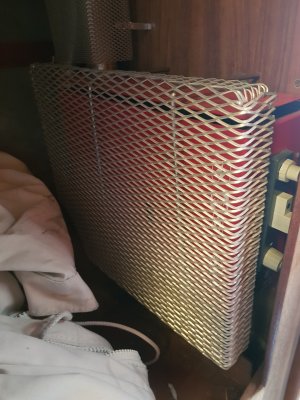
Anyway - the radiators run along the sides of the main cabin benches ... you can see them here in this photo ....

20230713_185145.jpg

I'm sure that if the unit is run properly - I don't have any manual for it and cannot find one online either ... would be warm and cosy. But I'm not so comfortable using it.

I have considered how to modify as OP says - a diesel water heater to feed the radiators ...

I have bought a Diesel Air heater system - was thinking to install ... but its still in box near 2yrs later.
 
I installed an Eberspacher many years ago. Account with photos here Installing warm air heating

I wanted to heat the forecabin in addition to the saloon but did not want to run large diameter ducting the length of the boat. So I terminated the large stuff at the aft end of the saloon beneath the chart table, then via a T ran the smaller ducting forward, hanging it from the tops of the side lockers to avoid losing stowage.
We lived aboard for periods during several cold winters in the Netherlands where the heating performed superbly. Forecabin and heads was plenty warm enough. The ducting was almost unnoticeable.
 
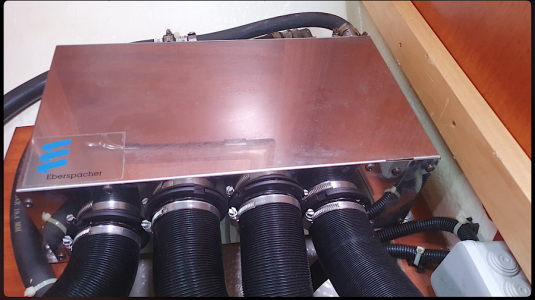
We've a wet system on our boat, 45ft LOA. It's a 10kw Eberspacher diesel heater. It is very effective, producing a more stable temperature than the warm air Eberspacher on my previous boat. It takes ten minutes for noticeably warm air to output from the fan heat exchanger. It's kind of a hybrid system with two large heat exchanger units which are then ducted to multiple warm air outlets. The fans have three speeds, noisy on fast but quiet on slow. It's quite power hungry as it is running the heater plus the heat exchanger fans, about 10A @12v. Immaterial in the marina but quite a draw when anchored out when I only use one heat exchanger. Good system, happy with it. Picture of heat exchanger:

1760892569901.png

Hot water pipes at the rear, hot air ducts at the front.
 
Last edited:
We have a wet heating system comprising of one of these which is rated at 9kw:

MV Hydro 9-S 12V marine diesel heater

and five of these located one in each cabin and two in the saloon area:

Webasto or Eberspacher water 1.7kw Heat Exchanger matrix 24v

We also have a twin coil 120 litre calorifier for domestic hot water

The system is configured such that if the diesel heater is on, it heats the hot water. The heating can then be switched on via a rocker switch at the interior helm which controls a two port motorised valve.

some advice on the heater matrices, the axial fan units are much quieter than the centrifugal fan units. The above units are two speed and we’ve found that the output on the low speed is more than enough

Very happy up to now with this set up.
 
We had a (wet) Webasto ThermoTop C on our 40' Ovni, powering 5 fan matrix radiators around the boat and an additional circuit in the calorifier for domestic hot water. Definitely louder than the blown air heating on my new motor boat as each fan matrix makes quite a din, and draws power. And whilst the pipework is much smaller diameter, there's still quite a lot of it with flow and return lines and all the tee'd off fan matrix units, and every fan matrix takes up a chunk of space in a locker.

Worked beautifully, when on extended anchor stays without running the engine it was great to be able to heat the water for shower/washing. Generally I find it gives a much gentler heat so takes a while to warm things up, you don't get the fairly instant blasts of hot air, but for extended periods was great. If I had a wet system again I'd fit a bypass valve on the calorifier circuit to prevent it heating up the water tank every time first if in some instances my priority is actually just heating the cabins.
 
That’s very helpful thanks. I think I might struggle to install enough radiators to make use of 5kw. If I do stick with blown air I was thinking of going 2kw in order to keep it working hard. 🤔
I started with a 5kw heater on my little 24’ boat. I worried that as I hardly ever ran it above level 2 it might clog up more quickly, so I got an inexpensive 2kw heater expecting it to run harder for the same heat output. it dropped onto the same exhaust, fuel pipe and mounting plate but needed a reversed reducer for the outlet ducting.
The 2kw casing was slightly smaller than the 5kw in all three dimensions, but it was considerably more noisy even at low heat as the air passed through a much smaller volume case. I soon refitted the 5kw, and have kept the 2kw for an emergency spare.
 
Last edited:
Apologies for 'hijacking' OP's thread ...

My 38ft boat has that Propane water based system ... and I am loathe to remove the radiators / woodwork - imagine wjat it looks like behind after 30 - 40 odd years !
I bought a Vevor Diesel Air system - but have had trouble deciding where to install it ... you would think a 38ft boat would be easy !!

Since finding that installation would mean a serious rethink of stowage and where I have my Propane cylinder for cooking etc. - I thought about getting one of the boxed air heaters ... so that could stand in cockpit .... hot air then connect to piping which could be blanked when not in use.
 
With the help of a good friend and experienced plumber I installed a Webasto Thermo-Top hydronic system and three radiators. Well, one long narrow rad under the settee berth and two heated towel rails, one in the heads, one on the end of the galley.

Twenty minutes and it got toasty, forty minutes you were down to tee shirt.

15MM 'speedyfit' tube and connectors were used throughout.

Boat was a GibSea 96 three cabin. Hardest job was boring the iron hard stringers so the pipes would pass through. It needed several new bits-they went blunt very quickly!

We found the fuel pump 'click' annoying. It was mounted near our sleeping cabin. Probably could have soundproofed it, but never got around to it.

The 'wet' heating system with normal rads as opposed to those with fans proved first class. We bought our hardware from a supplier of narrowboat stuff at a very good price for the complete package.

Reccomended.
 
I'm watching this thread with interest as I'm about to install a similar set up as Rotrax.

I've bought a 3kW Wallas water heater, which I intend to use to heat a 30L calorifier and a series of radiators (two aluminium finrads in the saloon, a towel rail in the heads, and small domestic radiators in the forward and aft cabins. I'm linking it all up with 22mm Hep2O barrier pipe from Screwfix, with 15mm barrier pipe spurs for the radiators (no matrix blowers)
I went for a water based system as I don't like the headache-inducing dry air that air heaters tend to generate. I also wanted to be able to heat water without running the engine (I have a single coil calorifier, so am disconnecting the engine cooling loop). The last reason is that I have a long, thin hull (37ft trimaran), and the idea of cutting large openings for air ducts in the structural frames wasn't appealing.
I went for Wallas because the case and exhaust remain relatively cool, which in my situation makes it easier to install. I'm also told that it's much quieter.

Fingers crossed it'll be as successful as Rotrax's, albeit I fully expect it to be a pig trying to balance steel and aluminium radiators.
 
Given the price of the units available now, we are going with both - a hydronic system for hot water (and future radiator upgrade potential) and a blown system for forced air heating. In our case it helps that we are doing a full refit so can design almost from scratch - for example, it gives us the option to reduce the calorifier size and generate hot water in 15-30 mins. The two systems give redundancy, and if we find we want or need it in future, we will put radiators in the heads and wet locker.
We also have plenty of space, both systems will go in the cockpit locker where noise is reduced.
We intend to anchor a lot, and with lithium and solar it will be nice to generate hot water easily with relatively low power, without running the engine.
 
I've had a water based Mikuni Mx60 working for the last 15 years. It's great but the two disadvantages are that the fans use quite a lot of power plus you have to watch for frost when the boats out of the water
 
I've now had time to crawl into the back of my boat and test and inspect the heater that's already installed.
It's an aged Eberspacher D1L. It works, heats up, blows warm air and goes through its cool down cycle, but it smells bad. A hot rubber type smell. A bit of Googling reveals multiple possible causes, but my feeling is the heater unit should be replaced anyway as no parts are available.

The current unit is installed in the area of the boat behind the transom, around the corner from the cockpit locker, if you will.

It looks like the heater is drawing its combustion air through a hose that's clipped up further into the space, which leads to the bottom of the heater. It looks like it's drawing the actual air to heat and circulate from the built in vent in the front of the heater itself.

I've decided on another hot air heater. When I replace the heater with a new one (e.g. Autoterm or similar), it seems I should:
  • Take the combustion air from outside the boat.
    • Is there a type of vent fitting I can use for this that will help prevent water from going into it?
  • Lead the air intake outside the boat.
    • I think you can connect a 60mm tube to the air intake on the heater itself and run that to a hole in the boat / cover it with a grille.
    • Do I have that right?
    • Again is there a kind of grille that gives at least some weatherproofing?
  • I assume those two inlets can be near each other, but not near the exhaust. Am I right?
I know some people prefer to re-circulate air from inside the boat, but the area where the heater is ultimately leads to the engine compartment so I want to be sure there's no scenario where it's drawing in exhaust gases.

Any pointers greatly appreciated! :)
 
Top