Black carbon line around PSS shaft seal.

fredrussell

Well-Known Member
Joined
24 Mar 2015
Messages
4,166
Visit site
There’s a black line on the areas around my PSS shaft seal. Anyone had similar?. I dare say my bellows are old enough to warrant replacement, which I’ll do over winter. Anything else to check whilst I have it all apart?

 
Anything requiring shaft disconnection (which is quite a job in itself), but that depends on the peculiarities of each boat.
One thing definitely worth checking is/are the shaft bearing/s along the thru-hull, behind the seal.
 
Yes, check the stainless steel rotating face for corrosion. Mine pitted, probably during a winter layup. See the PSS section well down this page. Stern glands

I was able to reverse the rotating face, where the opposing side seemed also to be machined flat. Since then, maybe 10 years, I rinse the seal with fresh water after haul out and all has been well.
 
I have a PSS seal where one of the sealing elements is made from carbon and can be such that when the seal is run in it can create some carbon dust that tend to be case off when the rotor drives the prop.

This in indiated by PSS as a Templary measure and one run in will stop
 
As far as I know it is a witness mark to a fine mist mixed with the hard black plastic material of which the base is made. In other words they leak slightly! I have just replaced mine with Tides Marine seals because of this
 
Thanks for replies. I might try moving the rotor away from the gearbox a few mm to increase the pressure on seal face. Seems to be recommended a fair bit on web.

I should have mentioned there’s no (or next to no) water ingress at seal.
 
Urgh, that's 100% bonded to the shaft.
Was it unaffected? :oops:

The stainless steel rotor has 2 rubber O rings and only fived with the grub screws

The normal preload of a PSS is 1 inch from no preload

Mine slackened off due to running allowing water to flow in

I fitted a back uo split rotor and a worm drive to keep the rotor in place
 
Last edited:
Yup, I know there are 2 ORs along the internal part of the rotor, which in fact couldn't hold water without them... ;)
But the set screws in between the ORs are more than enough to grant a shaft/rotor bonding, I reckon!
 
Yup, I know there are 2 ORs along the internal part of the rotor, which in fact couldn't hold water without them... ;)
But the set screws in between the ORs are more than enough to grant a shaft/rotor bonding, I reckon!
I hope you won’t mind me pointing out that the set screws can only be tightened once. In other words, if they are ever slackened or removed they must be replaced with new items. The reason being, that when they are initially tightened their points distort and become blunt. Consequently, should the screws be retightened, particularly if the rotor has been repositioned there is no assurance that their points will dig into the prop shaft as the design intends.
Mike
 
I hope you won’t mind me pointing out that the set screws can only be tightened once. In other words, if they are ever slackened or removed they must be replaced with new items. The reason being, that when they are initially tightened their points distort and become blunt. Consequently, should the screws be retightened, particularly if the rotor has been repositioned there is no assurance that their points will dig into the prop shaft as the design intends.
Mike

The issue with grb screw usd to locate a collar should be dimpled into the shaft as we would do with Plumer block bearings.

Mind did move which so I made a split collar and worm drive clip to lock the rotor in place

The stainless steel grun screws by PSS is a soft metal unlike proper grub screws which are hardened steel that do bite int the stainless steel shaft but would rust
 
We have the same issue. I consulted with various people including the manufacturer of the seal and companies at the Boat Show. If it helps, here's what has been suggested

- Increase the compression by 1/4"
- Clean the interface with a 600 grit sandpaper
- Engine alignment is off
- You have the wrong kind of seal for a bouncy engine like the 1GM10 (not sure what engine you have).

Attached photo shows what ours looked like after about 50 hours.

I haven't tried any of these remedies yet, as it isn't too urgent, so I can't comment on what worked and what not. In any case, all of these problems could cause the black spray and the actual cause on each boat would be different.
 

Attachments

  • 1.jpeg
    1.jpeg
    121.4 KB · Views: 15
Also, remember each of the set screws are doubled, there are two screws on each hole, one behind the other.
My carbon ring gets stuck against the steel ring if the shaft does not rotate during a few months (typically during overwintering), I detach it by hand, once I forgot and it was detached by the engine :D ; the seal has about 4k hours and still going strong, I replaced the bellows but after checking the old one it was not necessary.
I also put a steel clamp ion the shaft, behind the steel ring, just in case.
 
Also, remember each of the set screws are doubled, there are two screws on each hole, one behind the other…

…I also put a steel clamp ion the shaft, behind the steel ring, just in case…
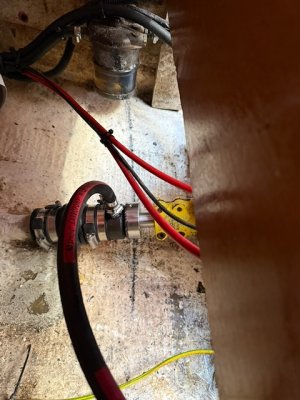
I’ve also put a clamp behind the steel ring Roberto. I’ve just received a new set of the grub screws just to be sure the steel ring is clamped securely. I re-used the current ones when I did cutless bearing a while back - PSS say not to re-use them, so perhaps that’s why I have the black line issue.
 
As mentioned above, the grub screws are designed to deform, and that’s why they are single use. That might well be the problem in your case.
 
Top