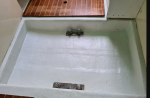
Bilges - Flowcoat or Danboline?

Gadget257

Well-Known Member
Joined
26 Apr 2009
Messages
106
Visit site
I am refurbishing a Halmatic 30 and having cleaned the gunk from the bilges I would like to make the bilges "easy to clean". The two options I see is applying flowcoat or Danboline.

Both applications will require preparation, thorough cleaning, de-greasing and sanding. The main difference is Danboline is easier to apply but flowcoat is more durable.

Does any one have a view of the better coating or tips to painting the bilges?

Thank you
 
Mine were done last year (by previous owner) in grey Danboline. Similar age boat and quite happy with it as have used it on previous boats successfully.
 
If you have paint on already then you would need to go back to bare glass in order to use flowcoat, in that case I would use a bilge paint. Although actually I find a 2 component like PPG sigmadur 550 while more expensive, will far outlast the single part paints.

If its bare glass then I would flow coat, make sure to abrade it well first.
Unless you want to spend hours flatting & sanding you'll get a durable but not showroom finish.

I just did mine, it really needs a second coat, but it looks reasonable.
Capture.PNG
 
Thanks Ceirwan,
Very interesting contribution, thanks. How do you apply it? I’ve googled but there doesn’t seem to be anything on application. For example, over an existing flow coat base, how does one prepare then apply signature 550 and how many coatings would be required.
Thanks again.
 
Thanks Ceirwan,
Very interesting contribution, thanks. How do you apply it? I’ve googled but there doesn’t seem to be anything on application. For example, over an existing flow coat base, how does one prepare then apply signature 550 and how many coatings would be required.
Thanks again.

To apply flow coat, assuming that's what's already there.
Good scrub with soapywater & allow to dry.

Sand back, don't be shy with the grit, 60 is fine for something like flow coat, just don't go so far that you're burning through the glass.
Then hoover, acetone wipe & apply. 2% catalyst, though your tin of flowcoat should have a guide. Brush apply, fairly thick & then tip it off with the brush later to spread it evenly.
Roller can work for flat surfaces, but make sure you've got one that isn't going to melt with solvents. If you mask off, then pull the tape before the gelcoat hardens or it will be hard work to remove.

For the paint, I would actually use Sigmadur 520 as its a semi gloss.
You do need to epoxy prime first, which does increase the price, but this stuff will far outlast danboline, or any other single part paint.

Prep is much the same, clean, sand, acetone. 2 coats of primer.
First coat of colour probably won't cover well & will look terrible, at this stage you're regretting it, but persevere. 2nd coat will start to look good, go for 3 in total. You can leave the masking tape on for all 3 coats.

Personally if its flow coat there now, then renewing it makes sense, rather than painting.
 
The P.O. of my first boat used Danboline. I spent the next twenty years fishing bits of it out of the bilge pump, even after I removed all visible areas of the stuff... Never again!

But don't flow coat on a damp cold day as I found the conditions inhibited cure. Despite heating the inside of the boat, the hull side remained cold and probably even attracted condensation. At least it was easy enough to get off with acetone a week later.
 
I seem to remember reading somewhere that there is benefit in leaving the inside of a hull vapour permeable to let the glass dry out into the cabin thus preventing moisture build up that may cause osmosis.

In furtherance of that position I cannot tell you;

1. Whether that is scientifically sound
2. What constitutes a vapour permeable coating
3. Where that information came from so you could research it yourself.

And therefore I conclude that this post is pretty useless.

Sorry.
 
I seem to remember reading somewhere that there is benefit in leaving the inside of a hull vapour permeable to let the glass dry out into the cabin thus preventing moisture build up that may cause osmosis.

In furtherance of that position I cannot tell you;

1. Whether that is scientifically sound
2. What constitutes a vapour permeable coating
3. Where that information came from so you could research it yourself.

And therefore I conclude that this post is pretty useless.

Sorry.

And yet it has some 'substance' in history. I remember an old chap in his great gaff rigged smack who had removed every inch of paint from the inside. He said this was standard procedure. It was dark in there but not a sign of problems in a 100 year old boat. He lived in a Cuprinol flavoured environment.
 
When I went to Bunnings (Our hardware chain) for paint I was asked what I wanted it for. I said I wanted to paint the fiberglass bilge. She said "you need Rust Guard Epoxy paint. I told her it is Fiberglass! :rolleyes: She responded "If you go over to the Marine Section you'll get the same paint for double the price"

I've used the (white) paint and it seems fine. (Cost was $125 for4L)

rustguard_epoxy_enamel_465x365.png
 
Last edited:
Top