Bilge water sensors (again)

What sort of waterproof relay are you going to use with it?

Haven't decided yet, but it probably won't be waterproof, but rather mounted in a waterproof enclosure. Small IP68 enclosures don't cost very much and allow more flexibility WRT relay board and number of input/output connections. This will be mounted next to each pump, some way up the side of the hull. From this there will be connections to the pump, the sensor, the on/off/auto switch with running indicator, and the on board computer monitoring system. Ideally the board should provide an "on" delay in addition to the "off" delay, but I haven't been able to find one that does this off the shelf (yet).
 
Haven't decided yet, but it probably won't be waterproof, but rather mounted in a waterproof enclosure. Small IP68 enclosures don't cost very much and allow more flexibility WRT relay board and number of input/output connections. This will be mounted next to each pump, some way up the side of the hull. From this there will be connections to the pump, the sensor, the on/off/auto switch with running indicator, and the on board computer monitoring system. Ideally the board should provide an "on" delay in addition to the "off" delay, but I haven't been able to find one that does this off the shelf (yet).

I can't help thinking that you're making rather hard work of this. If you're so distrustful of bilge pump switches, why not just fit 2 in parallel? You can get two Whale BE9006 electronic switches for £60 - they'll directly handle a 20A load, no relay needed, and have a 30 second over-run timer. It would be infinitely cheaper and simpler than the route you've chosen, and just as reliable.
 
I can't help thinking that you're making rather hard work of this. If you're so distrustful of bilge pump switches, why not just fit 2 in parallel? You can get two Whale BE9006 electronic switches for £60 - they'll directly handle a 20A load, no relay needed, and have a 30 second over-run timer. It would be infinitely cheaper and simpler than the route you've chosen, and just as reliable.
+1
I always try to work with the KISS principal. This is way too complicated and provides no more security than a few pumps with their own float switches.
 
Of course. And the diaphragms eventually wear out. The point is though, that I do not think there is any other pump available at reasonable cost/size that is more reliable. If you think I have made the wrong choice I would welcome alternative suggestions.


Yep - see updated post above.

Edit: I might add that the 19mm (3/4") hose I've selected was chosen because that's the free diameter passing through the pump - the Gulper 320 will also accept a 25mm (1") hose, but objects that can fit through this cannot necessarily pass through the pump, which may cause a blockage at the pump inlet barb.

I think you are correct in your choice, i can't think of anything better. If the bilges are kept clean (i'm sure yours will be) the risks are further reduced.
 
For some years I have been using fill switches from automatic washing machines.

Interesing. I have recently used a washing machine fill switch as a bilge switch. Mounted it way above the bilge, over 70cm above, with a 13mm bore hose from the switch down into the bilge sump in the skeg. When the level in the sump increases to 15cm, which is only a few litres of water, it operates. I did not alter the switch settings. It works great but time will tell on reliability in practice, but should be good based on your experience.

Www.solocoastalsailing.co.uk
 
Interesing. I have recently used a washing machine fill switch as a bilge switch. Mounted it way above the bilge, over 70cm above, with a 13mm bore hose from the switch down into the bilge sump in the skeg. When the level in the sump increases to 15cm, which is only a few litres of water, it operates. I did not alter the switch settings. It works great but time will tell on reliability in practice, but should be good based on your experience.

Www.solocoastalsailing.co.uk

This bilge pump switch from Jabsco operates on the same principle.

After having several of the nodding donkey switched fail due to broken wires I replaces these with the jabsco switch and had no further failures.

http://www.go2marine.com/product/112053F/jabsco-hydro-air-bilge-pump-switch-59400-series.html
 
After being disappointed with a few external switches, I finally settled on pumps with internal ones. I am especially happy with Rule pumps, where the switch is solid state (field sensing) and also provides "mopping action" - the pump keeps running few seconds after the lowest level is detected. To my surprise the cheap Seaflo pump is doing a good job too. I have one in the bilge for 2 years now.
The advantage of the integral switch is simple wiring and less chance of the switch being fouled by a foreign object. The field sensing also eliminates the possibility of oil being pumped to the sea in case of leaking engine. Only water triggers it.
Another automatic pump system doesn't have any switch at all. The pump is being periodically switched on for a few seconds. If the system detects load (the pump is actually pumping water), it stays on until the load drops indicating the pump is running free again. The extra energy consumption is minimal and it shouldn't play a big role in your total energy budget. I tested one of these and it worked well. Unfortunately, the pump as such was of poor quality (bearings) and it went tits up after a few months.
 
Last edited:
I haven’t read all the post and perhaps someone has already mentioned but there is a product on the market that not only does the usual auto operation etc...but also will send you a text via SIM card mobile sms to let you know it’s activity.
 
What sort of waterproof relay are you going to use with it?

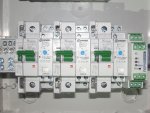
A year later(!) and the bilge pump system is finally being installed. To go along with the three Whale Gulper 320 pumps, and the Flowline LU10 sensors (still looking for one more of these!) I have the following control devices:

bilge_pump_controllers.jpg

From left to right, there's a 25mm2 to 10mm2 distribution block, then three blocks consisting of an auxiliary switch (so the on-board computer can monitor, and notify me, of any tripped fuses) a 10A DC rated MCB and a process control timer*, and finally a DigiRail 4-input Modbus RTU counter, which will allow me to monitor pump activity (one input for each pump sensor, with the fourth one monitoring the aux switches, in series).


*) The "CE" program means the relay will only be energised after a sensor has been "high" for the set time, and will only de-energise once the sensor is "low" and the set time has elapsed again (provided that the sensor does not go "high" again within that time, which would reset the timer). This has two major benefits; the pumps will not "pulse" if water is slushing around, and the pumps will continue running for long enough to fully empty the hoses. I've got them set to 20s as a starting point only - further experimentation will be needed to find the ideal delay. And before anyone points it out: yes, the timer relays are not DC rated. Yes, I understand that this might mean they will wear out due to arcing. But I'm betting that the 16A AC rating means they may cope well with the 5A DC draw of the pumps. Time will tell...
 
Last edited:

Other threads that may be of interest

Top