Bilge level sensor and electrolytic corrosion

plaviator

New Member
Joined
28 Jan 2013
Messages
18
Location
NW Poland
Visit site
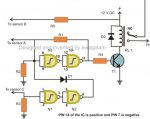
I have built this electronic bilge level sensor to control my bilge pump.
I am now having misgivings about it because of intentionally introducing a voltage into the bilge water.
My boat is GRP but the ballast keel is steel and is bolted to the hull with the studs protruding into the bilge.
Will this be a problem and if so can it be prevented by grounding the keel studs?circuit.jpg
 
Given that the current is only going to flow when water is at height to activate the sensor .... and once water is pumped out - sensor will effectively switch off the pump - I would think its not a problem.

I created a 'bilge warning alarm' by using an old Smoke detector ... by connecting wires to the + and - of the test switch - I created a water activated 'test' and alarm worked.
I wanted to go further and see if the alarm part could actually switch a pump relay ... but I then bought a solid state Bilgemaid switch which was good for a couple of years till it just gave up ... will never buy another !!
 
Many years ago I bought a solid state switch for a leaky wooden boat I use to have.
It didn't last that long and one of the stainless probes had completely dissolved!
 
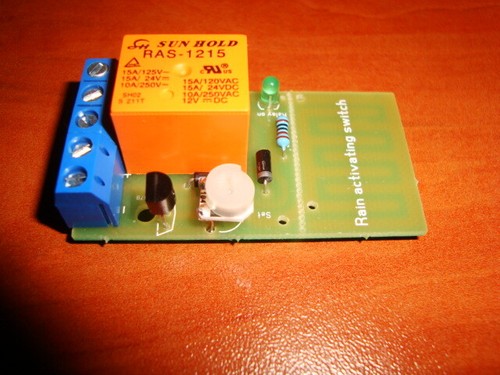
I am looking at this item ....

RAIN DETECTION WATER ACTIVATED SWITCH RELAY SENSOR RELAY KIT 10A 12V | eBay

s-l500.jpg


The sensor part can be detached and connected via a lead - so the actual electronics is well out of the bilge etc. It crosses my mind whether the sensor part can be replaced by a twin lead which is then dangled on a rod into my water tank ... the two wires then when water is being filled - touch water and relay sets of an alarm.
 
A washing machine has a pressure sensor operated by air trapped in a pipe. The sensor stays dry. Would that help?
 
I have built this electronic bilge level sensor to control my bilge pump.
I am now having misgivings about it because of intentionally introducing a voltage into the bilge water.
My boat is GRP but the ballast keel is steel and is bolted to the hull with the studs protruding into the bilge.
Will this be a problem and if so can it be prevented by grounding the keel studs?View attachment 119093
The bilge pump and sensor will have absolutely no impact on your keel and studs and definitely should not be connected in any way to them.

Galvanic action (electrolysis) occurs when two dissimilar metals are in contact in an electrolyte such as seawater. You do not have these conditions. Your keel is unlikely to be steel, more likely to be cast iron and the studs may be mild steel or stainless. Either way they are virtually the same on the galvanic scale so no basis for galvanic action even in seawater. Electric bilge pumps (including submersible) and sensors are commonly used and create no problems.
 
I have built this electronic bilge level sensor to control my bilge pump.
I am now having misgivings about it because of intentionally introducing a voltage into the bilge water.
My boat is GRP but the ballast keel is steel and is bolted to the hull with the studs protruding into the bilge.
Will this be a problem and if so can it be prevented by grounding the keel studs?View attachment 119093
If your sensors are metal electrodes because they are electrically positive relative to "ground" they may tend to corrode due to electrolysis driven by the 12 volt power supply. The rate of corrosion will depend on the current flowing. Presumably that will be quite small. It can be avoided by making the electrodes of a material which will not corrode in this way eg carbon , titanium ??, or by a precious metal coating /plating.
Perhaps Tranona can tell us what material is used as sensors in bilge pumps. I'm afraid I don't know.

The actual rate of corrosion can be calculated if you know the current by applying a tiny bit of chemistry and some simple arithmetic
 
Having standing water in the bilge is a bad idea, I've not encountered a plastic boat with standing water except where there's a problem.

My boat is plastic ... I have standing water as you call it based on condensation that collects ... A COMMON fact on many older boats. The Auto Bilge pump that controls this cannot pump the last bit because the float switch needs a level of water to lift it. Every so often - I lift cabin soleboard and sponge out.
Its actually why I am looking at an electronic activator to bypass the float switch ..... but even then - the pump cannot pump every last bit.
 
My boat is plastic ... I have standing water as you call it based on condensation that collects ... A COMMON fact on many older boats. The Auto Bilge pump that controls this cannot pump the last bit because the float switch needs a level of water to lift it. Every so often - I lift cabin soleboard and sponge out.
Its actually why I am looking at an electronic activator to bypass the float switch ..... but even then - the pump cannot pump every last bit.
As you say, I have worked as an engineer on ships and boats all my life and have yet to find one with a totally dry bilge. Also, no bilge pump will remove every last drop.
With the system I have made, the sensors can be located at whatever level you require so long as the pump can take the level below the lowest one otherwise it will not stop running.
My plan is to screw brass screws into a nylon strip with the sensor cables soldered to them, The strip will then be glued to the hull. I am going to try using a conductive epoxy to cover the head of the screw as an experiment.
 
As you say, I have worked as an engineer on ships and boats all my life and have yet to find one with a totally dry bilge. Also, no bilge pump will remove every last drop.
With the system I have made, the sensors can be located at whatever level you require so long as the pump can take the level below the lowest one otherwise it will not stop running.
My plan is to screw brass screws into a nylon strip with the sensor cables soldered to them, The strip will then be glued to the hull. I am going to try using a conductive epoxy to cover the head of the screw as an experiment.

I would leave the heads plain ... whatever you do - they will get a covering of something from the water and will need occasional wipe or / cleaning. The Bilgemate I had with its stainless contacts was in need of a wipe off about 3 - 4x a year .. at least.

I would also not epoxy it into place ... I would use a silicon or flex base to fix it so you can easily remove / service and put back. Or at least if you do epoxy - maybe devise a way to have the sensor 'clipped' into a mount that is epoxied ?
 
I would leave the heads plain ... whatever you do - they will get a covering of something from the water and will need occasional wipe or / cleaning. The Bilgemate I had with its stainless contacts was in need of a wipe off about 3 - 4x a year .. at least.

I would also not epoxy it into place ... I would use a silicon or flex base to fix it so you can easily remove / service and put back. Or at least if you do epoxy - maybe devise a way to have the sensor 'clipped' into a mount that is epoxied ?
Good idea about the clip-in mounting
 
As you say, I have worked as an engineer on ships and boats all my life and have yet to find one with a totally dry bilge.

My boat is 6 years old. It has been in the water continuously except for about 10 weeks in total out for maintenance. There is still factory dust in the bilges. It was similar with my last boat which I had for 13 years from new. The only water in the bilges in all that time came from a split domestic water hose, easily fixed and a split water tank, not so easily fixed!. I had to replace the electric bilge pump which had seized because of lack of use.
 
Tranona, I am still laughing about the seized bilge pump.
My boat is 51 years old and when I bought her 15 years ago the keel was full of water and had to be scrapped which involved my building a new steel keel and filling it with lead ballast salvaged from an old Polish yacht.
Due to work and other matters she is yet to see the water again except for a brief dip after fitting the new keel to check the trim.
Hopefully she will not leak either when she finally goes in but I am fitting 4 bilge pumps just in case!
 
Well done! I did wonder about the steel keel bit. Hopefully your rebuild will result in a leak free boat so your 4 pumps will have an easy life.

My old boat was used as a charter boat for the first half of its life and I found the seized pump when I was checking it over before taking a long trip across the Med. Obviously had a manual pump as well, which also never got used.
 
What is the hysteresis on it, will it stop the pump as the bilge is empty? They are designed to switch off the fill valve but don't control the pump for emptying.
Interesting idea though
 
What is the hysteresis on it, will it stop the pump as the bilge is empty? They are designed to switch off the fill valve but don't control the pump for emptying.
Interesting idea though
[
No idea about hysteresis, but the diaphragm is not rigid like a piston, so I'd expect a reasonable degree. Easy to check with a U tube of water on the kitchen table before you try on the boat.
 
Top