Bilge alarm- DIY?

Slightly off topic but another useful addition is a light installed in the cabin wired to the pressurised water system pump. Every time the water pump comes on, so does the red light. We were engining along once and didn't know the tank was dry and the pump was running. Resulted in a burnt out pump.

I'm stealing that! I suspended our pump from shock cord and now can't hear the damn think unless everything else is completely quiet. Thanks.
 
Last edited:
Best idea I have seen is a strobe alarm light, fitted to the radar arch & wired into the high level bilge pump.

Useful in a marina where most boats sink
Surely all through hulls have their valves closed when boats unattended? I am more worried about sinking when nobody is around to assist or rescue me
 
I fitted one of these cheap battery operated ones off ebay a few years ago. Its gone off twice, once with a blown calorifier pipe and again when a water tank leaked. Lets you sleep soundly at night, hardly marine grade but what do you expect for under a tenner. I have proper alarmed float switch on the bilge pump but its the cheapy one that I hear above the engine.
 
Surely all through hulls have their valves closed when boats unattended? I am more worried about sinking when nobody is around to assist or rescue me
Many boats have truhulls for cockpit drains if you close them the cabin can fill with rain water...(my friend discovered this the wrong way...)
 
I can hear my auto bilge pump unless the engine is running. Its enough of an alarm for me. The video has motivated me to upgrade my old Henderson MK3 to something less temperamental though so any recommendations for a new manual bilge pump greatly appreciated.
 
I realise the brain doesn't always work well in a crisis but even still that seems a little obvious. He clearly then knows it could have been done earlier but strangely he doesn't mention that he should have done that straight away in the summing up at the end.
The RED MIST affect is interesting. I watched the video and felt that he really, really did not know his boat. It really is simple. Water ingress and you check all the through hulls. He made the mistake of assuming the log would be OK. Still it made for good clickbait.
 
The RED MIST affect is interesting. I watched the video and felt that he really, really did not know his boat. It really is simple. Water ingress and you check all the through hulls. He made the mistake of assuming the log would be OK. Still it made for good clickbait.
He's just changed all the through hulls. He knows the boat. He just didn't consider the log initially. He found it and plugged it and saved the boat. I think you're being a bit harsh.
 
The RED MIST affect is interesting. I watched the video and felt that he really, really did not know his boat. It really is simple. Water ingress and you check all the through hulls. He made the mistake of assuming the log would be OK. Still it made for good clickbait.
He might not have thought of that one because his mind was on all the ones he'd just replaced. Bit of a coincidence the timing that breaking just after changing all the others.

I had a moment with a through hull but thankfully I was in the marina and it came off in my hand so I had no trouble locating it! When I bought the boat I was told they had all been recently replaced and they looked it, except it turned out for one cockpit drain outlet which was buried in a cockpit locker. It looked like a brass thing from a plumbing shop with the red wheel on it and just crumbled in my hand. This happened after I'd sold the boat when I was emptying the locker having sailed it all over and lived in it for over a year. I still shudder at the thought of "what if". I put my foot on it while I phoned someone from inside the locker to come and pass me a bung :LOL:
 
I found this on yo
Just watched a Sailing Zingaro video where he nearly lost his boat on its shakedown. Log impeller failed and the first anybody knew about it was when the floorboards were floating, by which time the electrics had all shorted out. Scary stuff! I was amazed that he managed to pinpoint the cause of the failure so quickly, whilst dealing with such a volume of water.

It's made me think about two ways of tackling this kind of problem- firstly, separate the bilge into watertight compartments (by sealing up limber holes and anywhere that a cable or pipe runs); secondly, fitting a bilge water level alarm.

I know you can buy off the shelf alarm systems, but I'm wondering about putting something together myself using float switches and a buzzer. Maybe refine it with a little panel showing a light for each compartment. Surely not rocket science? Just wondering if anybody else has done something similar and any lessons learned.

This was around a few years ago. Seemed like a good idea. Probably fairly easy to make.
 
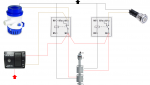
This is my over elaborate effort using a cheap switch off Amazon. Our float switch died ages ago, and this lot cost me about the same as a replacement, so if it doesn't work i'm not at a complete loss. Plus it gave me something to do during lockdown. I have a longer term plan to re-do the bilge pump arrangement in our boat (deep keel Moody Carbineer) so this is more a fun project. Plus we have plenty of redundancy with an engine mounted pump and a manual backup.

Existing parts:
  • Bilge pump
  • Switch panel

Purchased parts:
  • Dual water level sensor
  • Waterproof junction box
  • 2 x relays
  • PVC pipe
  • Buzzer
1616505212068.png
 
I've always found relays to be among the most unreliable things, within throwing distance of the sea.

I've luckily not had the same experience, but either way this has a manual override, I have spares and it's a (type A) fun project at very low cost. As I said, the plan is for a further bilge pump project in the future.

I'm more concerned about the el-cheapo float switch giving up before the relays....
 
Float switches where the reed switch doesn't move are normally quite reliable if not loaded by an inductive load or a large load. A FET buffer works for us. We've been through a lot of bilge pumps and float switches over the years, in RIBs and other open boats where they earn their keep.

On a yacht, I'd want the alarm to sound with or before the bilge pump running if I was on board, the bilge pump(s) should be idle on a GRP yacht except in extreme conditions.
 
Float switches where the reed switch doesn't move are normally quite reliable if not loaded by an inductive load or a large load. A FET buffer works for us. We've been through a lot of bilge pumps and float switches over the years, in RIBs and other open boats where they earn their keep.

On a yacht, I'd want the alarm to sound with or before the bilge pump running if I was on board, the bilge pump(s) should be idle on a GRP yacht except in extreme conditions.
Our anchor chain locker is below the waterline on our boat. It cant self drain. Its super water tight except for the bung that goes in the hawse pipe. It lets in a dribble when we are hard on the wind and we are taking water over the bow. The chain locker drains via a 19mm pipe all the way to the main sump over the keel. Periodically the bilge pump runs to clear this dribble. Its good to know the pump works and also the alarm connected to it. Its a regular test for a safety device?
 
  • Like
Reactions: RJJ
All that video showed me was that a) there's a reason we have plugs lashed to skin fittings, and b) the bilge pump was obviously pretty poorly designed to short out before the sole was even awash. A remote pump like that could quite easily be mounted on a bulkhead. Storing all the batteries in the main bilge, whilst probably helping with stability, seems a fairly dim idea as well.
We have a float switch in the main bilge because it came when we bought the boat, but on a small yacht I'd be worried about over-reliance on alarms that realistically aren't going to be tested very often if at all. It's not a huge amount of effort to cast an eye into the main compartments every so often and that way you know exactly what's going on, and there's one less thing to go wrong.
 
We all install the same skin fittings or speed transducers regardless of size of boat. Failure of these fittings will put the same size hole in a boat regardless of the size of boat. The reality is that hole will sink a small boat far faster than a large boat. I would want to know as soon as there is a problem not when my floorboard start to float
 
I used process float switches from RS, with red LEDs for alarms and yellow for pump operation. I added a truck reversing buzzer on the alarm side which can be muted separately. That was the cheap version. Now the boat is further away it is all monitored with a Victrom Cerbo GX via my phone/ laptop.
Hi Pyrojames

I'm trying to figure out which bilge alarm will work correctly with the Cerbo GX. Would you mind sharing what you're using please? Also any tips on getting it working, or it just a case of connecting it to the correct input connectors on the Cerbo?

Many thanks

Miles
 
Miles, I took the 12v from the power to the pump, off to a DC/DC converter (12v to 5v) to get the digital signal to feed into the Cerbo. Whenever the pump operates the Cerbo records the time and runtime of the pump. With it linked to a 3g/4g router it records the data on the VRM Portal and you can monitor in from anywhere. Drop me a PM with your email and I can send you the full details of the required kit.
 
Top