Beta marine 14 starter panel

Neil Stu

New Member
Joined
1 Nov 2022
Messages
2
Visit site
I have a problem that hopefully someone has some experience with.

I have a Beta marine 14 engine in my Yacht. The problem I have is with the starter panel, it’s a standard panel ABV with a key mechanism control to start the engine.

when I put the key in and turn it to heat I get nothing , where I would normally hear the sound of the buzzer sound indicating pre heating there’s nothing , the lights do not come on and the engine is not preheated before starting . I have changed the buzzer unit for a new one already but that didn’t solve the problem, I’ve also been into the engine bay and unplugged the connector from the panel to the engine and plugged it back in to ensure it has a good connection. When I turn the key over to the start position the engine struggles to start, but does eventually Get going. This time all the lights come on as they should and go out as they should according to the operators manual, when I turn the key to the run position to charge the batteries the light stays out, so I’m assuming the batteries are not being charged. Finally when I try to turn off the engine by the stop button again nothing happens and I have to go into the engine bay to be able to stop the engine, the stop solenoid was changed at the beginning of the year and still moves freely when I’ve checked so I think that’s ok.

Any ideas are welcome.
 
This year my son had a problem with his Beta panel and some, but not all, of the symptoms you describe were present then. His was the type A panel (no meter). He changed the ignition switch (for a Kubota one from Amazon) and that fixed the main issues. There were a couple of remaining problems due to corrosion on the PCB behind the panel but I fixed those separately and I don't think that is relevant in your case.

It may be worth removing the switch as we did and check continuity actual versus expected between the various poles in the different key positions.

Good luck
 
Last edited:
when I turn the key to the run position to charge the batteries the light stays out, so I’m assuming the batteries are not being charged.

Any ideas are welcome.
[/QUOTE]


But surely the light should go out when it is charging?
The lack of preheat is likely to be the ignition switch.
There may be 2 multi plugs on the wiring loom. Lack of stop is usually due to a bad connection on one of these.
 
As I understand it the positive feed from the key switch to the warning lights is fed through the buzzer in passing, so it is a bit surprising when the engine is fired up that the lights are operating as they should while the buzzer is silent. Makes me wonder if the replacement buzzer was wired in correctly.
Have you checked for loose connections at the back of the panel? How they should be is on page 106 in the manual:
OM 221 20031 HE REV30 0322
I agree with Boater Sam's comment concerning the charger warning light.
 
Last edited:
On my Beta A panel the red warning lights go out when she runs and the green charging light stays on - as you would expect .The voltage should show around 14.4 under test if it is charging.
For what it is worth I find that pushing the throttle lever well forward ,as the manual suggests, will produce an instant start every time,whether cold or hot and whatever the battery condition.So putting the lever beyond what you visually think necessary.Leaving the lever closer to vertical may produce a splutter.Can the teleflex 'extend' in use ? Presumably not in this case because the idling speed is perfect.
 
The green light only indicates that there is power at the panel. It will be lit until the engine is shut down, but doesn't say whether the battery is charging or not. The charge warning is one of the red lights. As per Boater Sam above it will go out when the battery is being charged and light up if the charging is not working.
 
Thanks,I see that you are right. I had been guided by the slight delay in the green coming on rather than what it tells me in the manual ,and happy that the red indicators have never remained on.
You have also saved me from erroneous labelling on a new fascia - which i will now change.
 

Attachments

Can anyone tell me if my problems could be with my batteries.

About the time my problems started, one of my batteries died. It wasn’t the one in the give bay if that makes a difference but I had to replace it anyway, I thought I had bought a like for like replacement but on inspection that’s not the case. The failed battery was a Numax CXV XV24MF 86Ah C20 640 EN 900MCA, The one I bought to replace it was a Numax CXV 24MF 80Ah C20 630 EN 780MCA. Could my problems be caused by not replacing it with an exact replacement ?
 
Can anyone tell me if my problems could be with my batteries.

About the time my problems started, one of my batteries died. It wasn’t the one in the give bay if that makes a difference but I had to replace it anyway, I thought I had bought a like for like replacement but on inspection that’s not the case. The failed battery was a Numax CXV XV24MF 86Ah C20 640 EN 900MCA, The one I bought to replace it was a Numax CXV 24MF 80Ah C20 630 EN 780MCA. Could my problems be caused by not replacing it with an exact replacement ?

No
the replacement is only marginally smaller in terms of capacity, CCA and MCA and is in any case more than large enough for an engine of that size. although you seem to be suggesting it was not the engine starter battery which you replaced
( The recommended battery is 70Ah, 450CCA or 45 Ah , 400CCA depending on which version of the manual you read.)

You say the engine struggles to start........... is that because it is not cranking fast enough or is it because the glowplugs are not working ?

My first thoughts were that the key switch could be faulty but that does not fit all the facts, certainly not the non-operation of the stop button

I think the operation of the various panel lights has been explained above in so far as the green light indicates power on and remains illuminated while running and the left hand red light indicates that the alternator is not charging and should therefore go out when running.

I don't think the buzzer will sound during the preheating. It appears to be linked only to the red warning lights

Systematic testing while referring to the wiring schematics is the way forward, but be aware that a digital voltmeter takes so little current it will often give a normal reading through a poor connection. A test lamp that draws a significant current will be more reliable . Voltmeter and lamp in parallel even better.

In particular check that there is power on terminal 19 of the key switch (red wire) when turned to the preheating position and that power is applied to the glowplugs
Also check that there is power to the stop button ( white wire) and to both the white /black wire and the stop solenoid when it is pushed.
 
I don't think the buzzer will sound during the preheating.

I think it might, because the green will be lit as well as the red oil pressure and charging lights.
At least this is the case on my keyless ABVW panel. ABV could be different though...
 
I think it might, because the green will be lit as well as the red oil pressure and charging lights.
At least this is the case on my keyless ABVW panel. ABV could be different though...
Good point . I assumed that if the key was turned anticlockwise to energise the glow plugs the accessories terminal , which powers the lights, buzzer and alternator excitation , would not be energised although perhaps desirable unless the key is turned against a return spring and could not be left in the preheat position.

However, you have forced me to re-read the starting instructions in the manual.
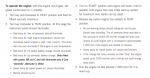
The instructions in the 2015 edition of the manual , for Beta 10 to Beta 25 only, reads

1668372471319.png

Which implies that the lights and buzzer do not operate while preheating. only operating when the key is turned clockwise to the RUN position

The wording of the current edition, which covers all engines from Beta 10 to Beta 115 is different and it is not clear if the buzzer will sound during preheating or not.

Presumably the OP will remember if the buzzer used to sound or not.
 
Can anyone tell me if my problems could be with my batteries.

About the time my problems started, one of my batteries died. It wasn’t the one in the give bay if that makes a difference but I had to replace it anyway, I thought I had bought a like for like replacement but on inspection that’s not the case. The failed battery was a Numax CXV XV24MF 86Ah C20 640 EN 900MCA, The one I bought to replace it was a Numax CXV 24MF 80Ah C20 630 EN 780MCA. Could my problems be caused by not replacing it with an exact replacement ?
Do you not have a dedicated engine start battery? You really do not need a battery of that size to start the engine. I have a 32Ah AGM battery for starting my Beta 30 and on a previous boat with a Nanni 14 (same as your engine) I had a simple 45Ah battery as used on small Citroen diesels. If you only use it for starting then this sort of battery is perfectly adequate.
 
Do you not have a dedicated engine start battery? You really do not need a battery of that size to start the engine. I have a 32Ah AGM battery for starting my Beta 30 and on a previous boat with a Nanni 14 (same as your engine) I had a simple 45Ah battery as used on small Citroen diesels. If you only use it for starting then this sort of battery is perfectly adequate.
Why do Beta recommend 70 Ah minimum?
.
 
Why do Beta recommend 70 Ah minimum?
.
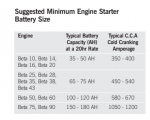
According to the Beta Operator's Maintenance Manual for Beta 10 to 25 they say this:

Screenshot 2022-11-14 093857.png
So for a Beta 14, something in the order of that proposed by Tranona would seem to be consistent with this advice. There do though seem to be different manuals for these engines so maybe elsewhere the advice is different.
 
Can anyone tell me if my problems could be with my batteries.

About the time my problems started, one of my batteries died. It wasn’t the one in the give bay if that makes a difference but I had to replace it anyway, I thought I had bought a like for like replacement but on inspection that’s not the case. The failed battery was a Numax CXV XV24MF 86Ah C20 640 EN 900MCA, The one I bought to replace it was a Numax CXV 24MF 80Ah C20 630 EN 780MCA. Could my problems be caused by not replacing it with an exact replacement ?
Not the batteries themselves. However have you checked that you reconnected everything correctly and that the connections are all good?
 
According to the Beta Operator's Maintenance Manual for Beta 10 to 25 they say this:

View attachment 146075
So for a Beta 14, something in the order of that proposed by Tranona would seem to be consistent with this advice. There do though seem to be different manuals for these engines so maybe elsewhere the advice is different.

Those figures for 'typical' capacity and cranking amperage may line up fairly well for wet, leisure type batteries, but less well for AGMs intended for starting.
Like others, I have used for many years a Red Flash (43 Ah, 500 CCA) without any problems.
I guess that the only downside would be slightly fewer starting attempts 'in store', if there were to be for instance a fuel related problem that required many attempts.
 
According to the Beta Operator's Maintenance Manual for Beta 10 to 25 they say this:

View attachment 146075
So for a Beta 14, something in the order of that proposed by Tranona would seem to be consistent with this advice. There do though seem to be different manuals for these engines so maybe elsewhere the advice is different.
That is an out of date table. The current manual does indeed recommend a minimum 70Ah for engines up to the 38/43st - that is under 1500cc. Really is unnecessary to have that capacity for purely engine start. The 14 is 500cc, the 30 is 1100cc. As I suggested small 1100cc road diesels with well over twice the HP usually have 45-60Ah batteries. It does not say what type of battery, but there are big differences between simple FLAs, AGMs and high power start AGMs. For most people for a dedicated start battery a basic FLA is fine, but AGMs have a potentially longer life (number of cycles) and quicker recharge times. High powered AGMs have the added advantage of being significantly smaller and lighter plus can be mounted in any orientation - and disadvantage of being well over twice the price.

Which you choose as ever depends on how you view the benefits against the costs. I am a fan of high powered AGMs, mainly based on experience. The 28Ah Red Flash in my Morgan is just now fading after 19 years of usage pattern not dissimilar to yachts - short periods of intense activity (when the sun shines) followed by long periods of doing nothing. The Odyssey 32Ah in the boat was fitted because of its size which allowed me to fit 50% more house capacity in the restricted space available.
 
Top