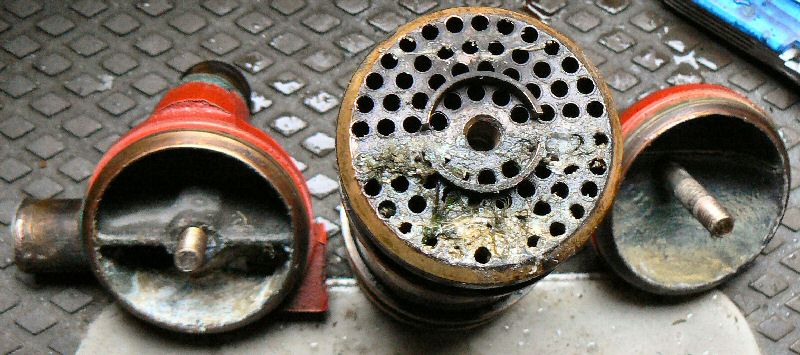
Beta engine heat exchanger.

Mudisox

Well-Known Member
Joined
4 Jan 2004
Messages
1,788
Location
Dartmouth
Visit site
I have a problem with sea water cooling getting into the fresh water stack and out through the radiator cap.

I had dismantled the engine and cleaned up the tubes with vinegar. New O rings and smeared with grease. When replaced in the salt water housing and the engine turned over, water came out through the overflow.

Removed from stack and re assembled. water injected through inlet and exited with no problems or leaks.

Why doesn't it not leak when the stack is inserted?

Many Thanks.
 
Check the exhaust elbow for build up of salt deposits, a restriction here can increase the water pressure in the salt water system and force it past the seals in the heat exchanger. Just had the same problem on a Volvo engine.
 
How much water came out of the overflow? Are you sure it wasn't just the freshwater expanding when heated?

Like most, my engine (also a Beta, but that's by the by) is installed sloping downwards aft. If I fill the freshwater side to the brim, it overflows when heated. If I refill it again it does the same. If I don't refill it, it settles with the top of the freshwater about 1" below the filler and stays just like that all year.
 
Not 100% sure I understand what you are saying here? Are you certain that you got the tube stack back in the correct way round and the rear end cap properly lined up with the crosspiece horizontal. In the photo you can see the crosspiece on the left and the area on the tubestack that it is supposed to mate with in the centre. This was before I cleaned it up:o

P1000835.JPG
 
Beta's also love to blow their coolant out. This is why Beta sell an expansion tank kit. If I'd kept my last boat then I would have fitted one to her.

The heat exchanger is the primary reason I won't buy another Beta. Very poor in my opinion.
 
I have had my share of heat exchanger problems on a Beta 14. Which through the excellent support dept. at Betamarine are now resolved.I wouldn't hesitate from re engineing any future boat with a Beta. They are a lovely forgiving and robust engine, what sets them apart from the competition is the after sales support. Nothing but the highest praise from me and many others.
I suggest you give them a call.
 
... Are you sure it wasn't just the freshwater expanding when heated? ...

Not 100% sure I understand what you are saying here? Are you certain that you got the tube stack back in the correct way round and the rear end cap properly lined up with the crosspiece horizontal. ...

... excellent support dept. at Betamarine ...I suggest you give them a call.

+1 to all that (no connection to Beta except as customer).
 
Top notch customer service, imo. We had an engine with no service records after a visiting Beta (they are not far from us) The workshop manager gave us a detailed how to sort out the problem and as we left a print out of all the relevant details of the engine as we had the engine number with us. The date it was converted, who bought it, date delivered, test bed results. The engine was approx 10 years old when we got it.
 
Why doesn't it not leak when the stack is inserted?

I don't not no-how know for sure, but suspect it's either not aligned properly (cf alahol2's post) or not pulled down fully on the O-rings.
You'll find hydrochloric acid much better than vinegar at dissolving crud.

I've had two Betas and never had a problem with blowing out coolant, unless overfilled, as per LittleSister's post. It's easy enough to rig up a catch bottle so that any fluid expelled doesn't end up in the bilge. Cost about £1 for a bit of hose, a couple of zip-ties and a surplus plastic bottle.
 
...You'll find hydrochloric acid much better than vinegar at dissolving crud. ...

But if you use strong acid cleaning on the stack and take it all back to bare metal, be prepared for the possibility of anode consumption increasing until the surface passivates again. I personally don't find strong acid cleaning necessary, but I do clean it regularly. And of course you do need to ensure that the edges which mate with the O-rings are clean and smooth.
 
Yes, Hydrozoan, that's all worth stating. Besides, I've never found the need to clean the stack annually, as Beta advise, although that may be necessary if the engine is regularly used in weedy or otherwise cruddy water. For canal boats (a significant portion of Beta's business), it may be a must.
 
Yes, Hydrozoan, that's all worth stating. Besides, I've never found the need to clean the stack annually, as Beta advise, although that may be necessary if the engine is regularly used in weedy or otherwise cruddy water. For canal boats (a significant portion of Beta's business), it may be a must.

I suspect you may have hit the nail on the head there

I've never used a heat exchanger on a narrowboat as ours was air cooled but the working boats I crewed and skippered were all raw water cooled and cleaning out the mud box (as the intake "filter" was traditionally known) was a regular chore - daily even on a bad stretch of canal

With an intake screen and two stage filtering, I can't see that much crud getting through to the heat exchanger on a sea going yacht and given the level of use my own feeling is that annual cleaning will do more harm than good. YMMV of course!
 
... I've never found the need to clean the stack annually, as Beta advise, although that may be necessary if the engine is regularly used in weedy or otherwise cruddy water. For canal boats (a significant portion of Beta's business), it may be a must.

... given the level of use my own feeling is that annual cleaning will do more harm than good. YMMV of course!

I take the point about canal boats. I do certainly understand Beta recommend annual cleaning for modern engines, but some 10 years ago I gained the impression from somewhere (perhaps not Beta) that two-yearly cleaning was then recommended for our (then) 10 year old BD622. So I have done it every second annual service, with new O rings and antifreeze, and have never found much crud - though I may have been lucky. But I'm not convinced that annual cleaning will 'do more harm than good', and I'm resolving to do it annually in future. With annual cleaning one should become more adept at it, and there should be less trouble in getting the stack out: it's sometimes been 'sticky' - the result of some scaling on the end pieces and/or a bit of corrosion on the housing surfaces, I assume.
 
Last edited:
My feeling about cleaning the heat exchanger too often is perhaps more geared towards using caustic or acidic cleaners that strip the oxidised layer off the tubes, rather than just a scrub and rinse. "Annually" smacks of being too simplistic anyway. One engine may get 50 hours put on it in a year, another may get 500, yet another 1500. Whilst preventative maintenance is, of course, a good thing it has to be balanced with good old if it ain't broke, don't fix it!

If there ain't much crud after two years, why clean it annually?

But it's a question that is bound to be contentious so I'll go hide behind the sofa!!!
 
My feeling about cleaning the heat exchanger too often is perhaps more geared towards using caustic or acidic cleaners that strip the oxidised layer off the tubes, rather than just a scrub and rinse. "Annually" smacks of being too simplistic anyway. One engine may get 50 hours put on it in a year, another may get 500, yet another 1500. Whilst preventative maintenance is, of course, a good thing it has to be balanced with good old if it ain't broke, don't fix it!

If there ain't much crud after two years, why clean it annually?

But it's a question that is bound to be contentious so I'll go hide behind the sofa!!!
i checked my H/E @ 7 yrs (approx hrs), no sign of over heating. the tubes were clear & no crud anywhere. i might have another decco nxt year 5 yrs after the last time & possibly 1250 hrs.
I have a Blue engine from France
 
My feeling about cleaning the heat exchanger too often is perhaps more geared towards using caustic or acidic cleaners that strip the oxidised layer off the tubes, rather than just a scrub and rinse. "Annually" smacks of being too simplistic anyway. One engine may get 50 hours put on it in a year, another may get 500, yet another 1500. Whilst preventative maintenance is, of course, a good thing it has to be balanced with good old if it ain't broke, don't fix it!

If there ain't much crud after two years, why clean it annually?

But it's a question that is bound to be contentious so I'll go hide behind the sofa!!!

No need for the sofa as far as I'm concerned - I see where you're coming from, and as indicated, I am against unnecessarily aggressive chemical cleaning!

It's just that with two-yearly cleaning - which, as I said, I've always done - I have had some occasional trouble getting the tubestack out, and I do wonder if annual removal might make that easier. I do think that if you leave it for years, you may well find that it's more tricky to get the tubestack out. It's not just a matter of running hours, I think, as scaling/corrosion around the ends may be independent of running time.

I'm able to get reasonable access to both ends, and have found it easier to get the stack out with the aid of my patient assistant at t'other end. But with the passing years, she shows more reluctance to sit around while I'm doing the servicing, and that may be a factor in my good resolution! :) (I suppose I could get a blue engine, but I'm quite happy with the red one.)
 
Top