Best Material for Permanent Dock Lines

Jurgen

Well-Known Member
Joined
17 May 2011
Messages
1,554
Location
Bristol Boat in Mercury
Visit site
Hi All,

1 of the winter jobs this year is to buy some permanent dock lines.

What is considered the best material for this purpose.

Boat is a S37 moored in Brixham on a 12 mtr finger so was thinking 16mm should be robust enough
 
Three strand polyester.

One way eyes tied off on to the cleats on the pontoon and the other way tails tied off to pontoon cleats or eyes to pontoon cleats so that the tails can tension the boat as the ropes stretch.

definitely not these braid on braid ready made docklines
 
Hi All,

1 of the winter jobs this year is to buy some permanent dock lines.

What is considered the best material for this purpose.

Boat is a S37 moored in Brixham on a 12 mtr finger so was thinking 16mm should be robust enough

I vote for 3 strand nylon. Make the loop in 1 end and use them for a while just tied to the pontoon - because nylon shrinks when first exposed to UV - then splice loops in the other end after a few months.
 
another vote for 3 ply nylon - stretchy. I don't trust these braided dock lines - had two fail unexpectedly (came with boat) and you cant easily see what the state of the inside core rope is like.
 
One way eyes tied off on to the cleats on the pontoon

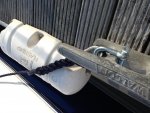
For my permanent lines I've spliced in metal thimbles at the shore end, and attach to the cleats with a big galvanised bow shackle around one leg. This eliminates any chafe (though admittedly there shouldn't be much anyway) and also means that the cleat can still be easily used by a neighbour (our head and stern lines overlap) or by us for the first (temporary) line ashore while berthing.

Pete
 
For my permanent lines I've spliced in metal thimbles at the shore end, and attach to the cleats with a big galvanised bow shackle around one leg. This eliminates any chafe (though admittedly there shouldn't be much anyway) and also means that the cleat can still be easily used by a neighbour (our head and stern lines overlap) or by us for the first (temporary) line ashore while berthing.

Pete

I do likewise with 3 strand rope. a word of caution, ensure the shackle pin is secured with stainless steel wire or tie wraps else the movement of the boat will loosen them to the extent the pin will come out and eventually, the mooring line will come away from the cleat.
 
I find nylon stretches when in use and shrinks when not.

Nylon also goes hard with age.

English braids recommend polyester.
 
If you want strength and plan to have fixed eyes etc, you could do worse than polysteel... not soft on hands, but strong and will give you the three strand flex whilst being very durable against wear & tear...
 
Hi All,

1 of the winter jobs this year is to buy some permanent dock lines.

What is considered the best material for this purpose.

Boat is a S37 moored in Brixham on a 12 mtr finger so was thinking 16mm should be robust enough

Hi Andy

Lazy way of doing it I know but we have a quote from Dolphin Diving to splice the ropes, put a plastic sleeve over the shore side loop and put a pole on the Sea end of the pontoon that we can hook the spring line on as we leave and pick it up as we arrive. 3 strand and £100 all in which I thought was quite a good price.
 
I use 28mm (yes really) triple plait, soft eye at the boat end, bowlined on to the mooring rings at the quay end. Works a treat and nice and easy to handle as well.

Cheers
Jimmy
 
Hi Andy

Lazy way of doing it I know but we have a quote from Dolphin Diving to splice the ropes, put a plastic sleeve over the shore side loop and put a pole on the Sea end of the pontoon that we can hook the spring line on as we leave and pick it up as we arrive. 3 strand and £100 all in which I thought was quite a good price.

Am going to splice the lines myself with a snubber fitted, like the idea of the pole on the end of the finger though!
 
We have seen a couple and as we berth bows in and the finger is almost as long as the boat, we have little margin for error before we "kiss" the pontoon, but we need to get close so we can jump off the back as the freeboard is so high.

So we thought a precisely measured spring (thats why I am not doing it !) would at least get us close when there are just 2 of us.

I'll let you know if it works... sounds good on paper though ....
 
Easy to make them yourself. Just set your lines as you would want them then mark the length with a suitable marker. even if you don't fancy splicing the lines you'll get the same affect with a bowline
 
Does anyone know the best place to buy 3 strand polyester rope for dock lines, also what diameter rope would you recommend for a 40 ft flybridge

cheers
Hope this helps
photo.jpgphoto3.jpg
Diameter

For designated dock lines, the size of your line is determined by its diameter and depends on the size and weight of your boat.
The following is an approximate guide:


• Boats under 20 feet = 3/8"
• Boats 20 to 30 feet = 1/2"
• Boats 30 to 40 feet = 5/8"
• Boats 40 to 60 feet = 3/4"
• Boats over 60 feet = 1"

Length

Dock lines should be about 2/3 of the boat’s length when used on the bow and stern. Spring lines should be equal to your boat’s length.

Have just done mine 25 foot cruiser with 12mm 3 core Nylon trust this helps, I purchased 30M from Foulkes Chandlery on the Hamble (cheaper then Force4 and alike).

regards Ross
 
Last edited:
Only ever use Monel wire for securing a shackle pin

Monel is certainly preferred for stainless shackles, but I've used stainless wire before without any problem. But for galvanised shackles, I'm not even sure whether monel is a good idea. (Not saying it isn't, just that I don't know). On Stavros, the hundreds of galvanised shackles and bottlescrews are moused using the strands from offcuts of galvanised rigging wire.

Pete
 
Does anyone know the best place to buy 3 strand polyester rope for dock lines, also what diameter rope would you recommend for a 40 ft flybridge

cheers

Shawn, I would use 16 or 18 mm line. My Snazi has a mix of 14 and 16, but I am not happy with the 14 mm, so will upgrade. Jimmy Green is usually pretty competitive for warps.
 
Does anyone know the best place to buy 3 strand polyester rope for dock lines, also what diameter rope would you recommend for a 40 ft flybridge
cheers

Hi, if you want safety and strong lines, then the bigger the better especially if you can't get to the boat frequently. Jimmy mentioned 28mm lines. These are great but way over the top unless you're in the Med and stern to. You would not get two of these on most centre cleats if you're pontoon berthing. Your boat would be fine with 16mm 3 ply for working lines and on fixed lines, 18 -20 mm if your preference. Size of cleats and ease of handling heavier ropes should be considered here. Don't use the hard floating type polyester ropes, go for the softer stretchy nylons, reasons below.

I'm not a fan of fixed dock lines at all but I understand why some people like them. Often these things are personal preference. Made wrongly, there are some real negatives which are:

1. They reduce flexibility on which way round you can moor up. If you need to turn the boat round for cleaning or have difficulty in getting back in the usual way round due to wind or tide then you would need to tie up with standard lines.

2. If you select the wrong rope, like braided soft plat they are harder to make without a set of 'fids' than 3 ply which you can splice easily yourself. Soft braid is prone to wear, by the time the outer layer is wearing through, you can be sure the inner is on its last legs too and replacement or shortening to remove damaged part is essential. The use of a Bowline in this case is NOT good, whilst a great knot, the Bowline is not ideal and if you must use one 'coz that's what you like, then be sure to 'lock' the loose end back through the bight as the bowline can and will come undone if put under strain and released repetitively.

3. Nylon is far better than Polyester because it stretches. This stretch will protect your cleats and side decks just below the cleats if longer springs are used. It is the stretch in nylon that will remove the necessity for a rubber snubber in the line. If your new fixed lines are too short they will snap hard on max length and have crushing effect on the side of the boat just below the cleats. You will often see crazing/ spider web marks on boats where people have done this. (you'd be surprised how many) I've even seen a Targa 48 get the tops of its cleats bent downwards by having too shorter lines. Both are strong but polyester is prone to wear more quickly than Nylon. Longer springs are safer for your boat!

4. If you really go for it and make them out of really nice rope and finish them with bright and shiny stainless shackles and thimbles, they are more likely gonna get swiped by some low life. Sounds horrible, I know but this happened to a friend that made some beaut's' :mad:
Just one more point, when selecting your shackle, either Stainless or Galvanised, standard shape is fine but my preference is for the more rounded, 'horseshoe' shape as this is less likely to jam around the vertical post of the pontoon cleat and thereby provide a straighter pull and less shear force on the shackle, pin and thimble. Make sure the thimble is correct size for the selected rope size!

There you go, that's why I don't use 'em anymore. :)
 
Last edited:
Top