Wansworth
Well-Known Member
Aboard a yacht last week and the owner remind stainless steel was not the best for fuel tanks from the condensation point of view,better plastic?


See Vyv's comments above, particularly the word "if2". Having had a weld on a stainless tank fail on our trip back across the Med I would prefer a Tek Tanks custom made. Not so sure about the rotary moulded types although it is often the fitting attachments that give problems not the tank material itself.I’d consider plastic but I’m not sure it’s that much better?

Fine but impossible on most boats - and many who have that from the early days of GRP boat building might not agree with you. Not good to extrapolate from one example.Grp diesel tank built as part of the boat. 500 litres. Perfect after 44 years and lots of miles. A manhole you can climb in to if you want
Yes built in grp fuel tanks obviously seemed a good thing and could occupy an awkward cornerFine but impossible on most boats - and many who have that from the early days of GRP boat building might not agree with you. Not good to extrapolate from one example.


Utter nonsense. A well built boat is a well boat. Not my problem if that's not your experience.Fine but impossible on most boats - and many who have that from the early days of GRP boat building might not agree with you. Not good to extrapolate from one example.
It's great for maximising the size of the tank and adding structural strength to the hull. Our fuel and water tank occupy the space under the saloon floor. They use every spare bit of space and waste nothing. Our water tank is the same and the holding tank. I notice on the utube channel Duracell, they have the same set up using ballast tanks converted to large water tanks. It's not a cheap solution, but done well, it's excellent.Yes built in grp fuel tanks obviously seemed a good thing and could occupy an awkward corner
My limited experience on three French yachts from the 1970s was built in tanks in awkward corners with no access to cleanIt's great for maximising the size of the tank and adding structural strength to the hull. Our fuel and water tank occupy the space under the saloon floor. They use every spare bit of space and waste nothing. Our water tank is the same and the holding tank. I notice on the utube channel Duracell, they have the same set up using ballast tanks converted to large water tanks. It's not a cheap solution, but done well, it's excellent.
This one is the water tank. 800 litres. Two access lids. You can see that you can climb in. The diesel tank is just astern. 500 litres. Only a single access lid on that oneMy limited experience on three French yachts from the 1970s was built in tanks in awkward corners with no access to clean
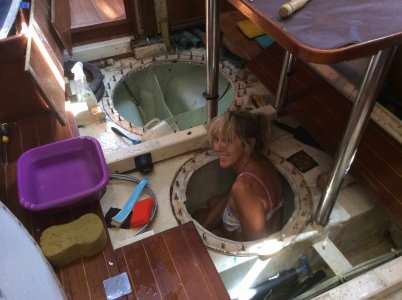
And you keep your galley slave in it too?This one is the water tank. 800 litres. Two access lids. You can see that you can climb in. The diesel tank is just astern. 500 litres. Only a single access lid on that oneView attachment 180160

 ) left the filler cap off and I got sea water in it, it was an easy task to close the tap, remove the hose, unbolt the tank and take it elsewhere to empty and flush it.
Thank you,it was just an interested questionI don't think stainless tanks should be so casually dismissed. As others have mentioned, they need to be properly welded, but I can't imagine they are any worse for condensation that non-stainless steel (which of course suffer rust problems - I'd avoid those), nor significantly worse in that regard than GRP. Moulded plastic might be marginally better for condensation, but condensation really isn't a big issue.
The best tank I've ever had in a boat was a stainless one. Over 40 years old but still shiny inside (and out) so you can see any debris in the tank. Its other advantages were a drain right in the bottom, a straight drop from the filler into the tank (for visibility and facilitating dipping the tank), and being separate from the boat structure and bolted to the hull side, so that when some fool (no names, no pack drill
Of course, if you need an excuse to reject yet another potential boat, it's as good as any other.


