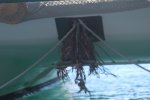
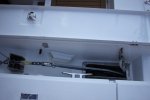
Best chain hook for a catamaran bridle

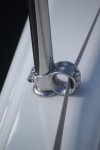
When a Witchard chain hook failed
The Wichard hook is an unfortunate product, their catalogue has mostly very good products, or clearly advertised for their intended use, whereas their chain hook has a lot more unfavourable reviews in non anglosaxon sailing domain (Wichard being French) than UK/US.
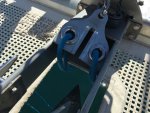
Should anyone need a hook/claw which breaks the chain before deforming itself, there are several, like this for example. 6-7euro a piece a comfortable cushion or the lack of galvanising. This particular piece was used as chain shortening claw, I ground it lightly to let the chain out more easily.
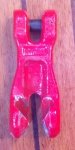
chain claw.jpg
 
We have a small Bunge that slip over the snubber hook and over it self , it keeps the hook in place no matter what , and it's very easy to flick back over to remove the hook .
 
Send an email to Izi Kalvo - izikalvo@gmail.com he will tell you the position. Tell him you have contacted him as a result of a thread on YBW. I do know he is travelling and may not reply till next week. I have also heard comment from members here that courier charges are a bit OTT. See what happens and then let me know - I have a variety of fixes. When you contact Izi tell him your chain size.
I now see you are in Turkey, and I think Izi might be on his way to Greece (and the Bridle Plates were being made in Ukraine) - so maybe courier is not such an issue. So tell Izi where you are located - it might be convenient. I thought he had stock in Belgium and maybe Israel.
Jonathan
Izi replied, thanks. Available online from Belgium but not cheap - without putting in all my details it looks like €160+ including shipping and I'd have to pay Turkish VAT and handling charges to import. I hope you're getting a cut.
 
The Wichard hook is an unfortunate product, their catalogue has mostly very good products, or clearly advertised for their intended use, whereas their chain hook has a lot more unfavourable reviews in non anglosaxon sailing domain (Wichard being French) than UK/US.
Should anyone need a hook/claw which breaks the chain before deforming itself, there are several, like this for example. 6-7euro a piece a comfortable cushion or the lack of galvanising. This particular piece was used as chain shortening claw, I ground it lightly to let the chain out more easily.

View attachment 141592

These are well engineered products - but you devine the issue. They are very precisely made, so hold the chain in the claw very securely. Howqever as I mentioned on another post you need to get the tension off the claw in order to remove the link in the claw or jaw and if you need to release a snubber quickly, for any reason, it can be difficult. They are cheap as chips and easily available (and being so cheap they might be worth while simply buying one to try (with maybe modification as Roberto has done). If you find them useful - they are not galvanised - so buy 2 and when one gets a bit grotty, swap them round, abrade and re-paint - or simply retire.

We had been using one as the ultimate back stop should the bridle fail. It was attached to a strong point on a short dyneema strop. The assembly worked as the fall back at anchor and also secured the anchor on passage. But I found the claw a bit of a faff and we have replaced the claw with a lifting hook, it does the same job, meets the same specification, but is much easier to release. I have our claws and hooks galvanised.

If you buy a hook they can be sourced with a securing pin that locks off the jaw of the hook and stops the link falling out. Like the Witchard hook the pin bends like over cooked spaghetti. I have found if you remove the pin, and the spring, you can replace the pin with a piece cut from a bicycle spoke (which is, I think, hard drawn stainless). It does not bend easily - but you can bend it with some effort and make a little ring at the end. If you then insert the pin back in the hole but cover the pin with Sika and allow to set off, twisting as it sets you finish up with a relatively secure pin. The set off Sika provides a 'sort or' polymer lining to the hole and holds the pin relatively tightly. The Sika does wear with time and usage - simply replace with more Sika. Tie a loop of 1 -2mm cord through the ring you made at the end and its easy to withdraw and seat back home.

To me some form of hook or a slot as in my bridle plate or Viking's snubber hook - are the way to go. They are simple to apply and remove. If made properly, and my bridle plate should be made from a High Tensile steel or Duplex stainless, then they are designed to have the same strength as a Crosby shackle, for a 6mm device they are as strong as a 3/8th" shackle. If they are kept under tension they will not fall off and if you commence your snubber/bridle at the transom then you have a minimum deck length snubber and even in shallow water you have no reason for the device to ever touch the seabed (the most common reason hooks fall off). If you start at the transom you can secure to the horn cleat and with extra rope you can extend your snubber without the need to leave the cockpit (though to extend you would have had need to ensure you have decent lazy loop of chain.

Again read the article on the Med storm (and look for the picture of the bent Wichard hook (as also described by Roberto). If you can release and lengthen your snubber quickly - the extra elasticity will offer more protection from extreme gusts. This is the reason we have 30m snubbers. We use about 15m 'everyday' and have 15m coiled in the sort of bag you use to store sheets - ready. Because we double back our snubber we can release 15m of snubber (bridle) but only need to release (or have available as a lazy loop) 7.5m of chain - which also means you should have that 7.5m astern not 15m - to the next yacht.

Jonathan
 
No I make no money on them.

Jonathan
It wouldn't be my way but I respect your altruistic interest in safety for the benefit of all of us.
Referring to my #13 I've attached below a poor photo of my setup. The only way I can figure to attach a longer snubber bridle is fishing for the chain with a hook over the bow rail. If I could figure a way to attach and release your bridle plate I'd gladly pay the price.GOPR1673_1661503374981.JPG
 
I was more interested in having my ideas accepted than becoming rich from the ideas. I started all of this with the idea that you should be able to buy an anchor rode as a bit of kit in a box. You get everything, maybe including an anchor. You don't need to scratch around finding compatible parts - they are all in the box. But this means selling chain - and it then gets complicated (freight is an issue) and I went the simple route. But Viking asked, they market (which I'm not particularly keen to take on, and we have similar ideas - I like their high tensile steel anchor - it moves anchor production forward a notch - but is a difficult concept to sell.


Our bow roller I don't think is much different to yours - except yours is further aft, ours is at the bow. Our windlass, chain locker are just forward of our mast.

This is a similar view to yours. We have pad eyes, reinforced, at the bow water line which I used to secure one end of our bridle. Each arm of the bridle then passes to the bridle plate and then to a turning block at the bow. You secure the bridle when not in use - in the locker. When you use it you reach through and attach to the chain. When at sea you hold in that 'chain/anchor' locker and simply tighten the bridle, both sides, so that there bridle does not dangle.

As an aside - we are trialling those rubber dog bone things on our bridle. My idea is that on your car you have a multiple of devices to absorb shock loads, tyres, springs, hydraulics and even foam in the upholstery. Shock or snatch loads are produced from different mechanisms, gusting wind, chop, swell - so why not have different devices to manage snatch loads - I have made no conclusions yet.

IMG_5023.jpeg

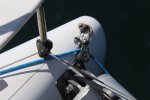
The blue line is the bridle and we installed a turning block, with suitable backing plate. Originally I simply tied the block to that stanchion using nylon tape. You could use the same idea for your 'turning block' but make the tape longer so that the block when under tension extends outside the hull/deck interface. If you use the extend tape idea its like a Barber haul. You can simply tie, until you are comfortable to one of you bow stanchion bases. I've tied our turning blocks using Dyneema - I did not want a stainless shackle rattling around.
IMG_4865.jpeg

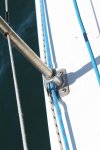
Our bridle then passes through the base of our stanchion, which have a convenient slot. The same blue rope, ignore the other blue rope.
IMG_4863.jpeg

If you do not have appropriate stanchions any chandler will have devices that are used to tidy ropes on the deck, like these
IMG_5057.jpeg

or these.
IMG_5052.jpeg

At the transom you simply attach to the horn cleat. If you instal like this you have a deck length snubber, + 2 times the distance from the bow to the bridle plate - and if you buy extra bridle line - you can simply extend the bridle from the aft horn cleat. The tension are not particularly high, even in strong winds. A teenager could do it (with supervision). The ideas is to have a long bridle, but not much extending from the bow. The bridle is neatly held out of the way, we leave ours permanently deployed, the excess is held in a bag at the transom.

You can see we have a long lazy loop of chain - it could be a bit longer - and you can then extend the bridle from the aft cleat - without the need to go out in the wind and rain (depending on the location of the aft cleat.)

Part of the intention was to make it easy and safe to cope with deteriorating weather - so taking the Med storm scenario and managing the bits that went wrong. Extending the bridle gives you a storm bridle (but shortening it provides an everyday bridle). The plate is high tensile steel - so will not bend, nor fall off. The Low Friction Rings allow the extended bridle to slip through the plate - and its all very simple.

Returning to the bow roller. This is a 6mm bridle plate, below, and the 8mm plate is the same size, bigger slot. We have the same restriction as you - we need to bend down to attach (or retreive) the plate to the chain. The plate simply slots on the chain. We pass the plate through that gap in the trampoline and drop onto the chain. It does not fall off, because you have bridle ropes pulling the plate down and the chain is at the end of the slot. The plate has a hole at the 'front' we use it to secure the plate when we are at sea, simple snap link.


IMG_1763.jpeg

With your installation you need to ensure that you do not drop the bridle plate - it will be a devil to pick up and return to your bow roller - but I bet you know this already!
If any of this is unclear - just ask. I might not have pictures immediately to hand - but I can use different words :) or take some pictures for you.

If you have any issues with your anchor arriving at the bow roller 'upside down' have a look at my Boomerang, that Viking also sell. You may find that much of the cost of the Bridle Plate is in the delivery charges and 2 units might be an idea.

Jonathan
 
I'd try running a permanent messenger line looped under the central "starship", between the two hulls.
Before anchoring, you attach a long line from bow to bow and tie the central part to the messenger, then bring it aft with the messenger. Drop anchor, then retrieve the long line from both/either side, it will catch the chain and you can bring at deck level, so you do not need to go fishing too deep for it.
 
@Neeves Thanks for your response. I regret I'm not as technically minded as you nor as edept at explaining myself in writing. The fixed bridle in the pic I posted is only 2.5/3 metres long and is suitable only for quiet water occasional anchoring. For overnight anchoring and stern-to med mooring I use a snubber bridle deployed over the bow and back through fairleads to the forward or midship cleats. I don't have a trampoline. The deck is solid and it's 1.6M from the bow back to the "bow" roller so impossible to reach the chain by lying down and leaning over the bow. First priority is to get the anchor set so by the time I'm ready to deploy the bridle the chain is already submerged and under tension. I use a long boat hook to help me grab the chain with the bridle chain hook. It's not easy and on occasions I've had to get in the water to attach it directly by hand [please don't ask how many times it has dropped off before I'm back on the boat to fully tension it].
 
I'd try running a permanent messenger line looped under the central "starship", between the two hulls.
Before anchoring, you attach a long line from bow to bow and tie the central part to the messenger, then bring it aft with the messenger. Drop anchor, then retrieve the long line from both/either side, it will catch the chain and you can bring at deck level, so you do not need to go fishing too deep for it.
Thanks. I understand your suggestion but as I've explained above the chain is already under tension at that stage and not easy to raise it sufficiently to attach to chain hook and virtually impossible single handling, I'd imagine.
 
@Neeves Thanks for your response. I regret I'm not as technically minded as you nor as edept at explaining myself in writing. The fixed bridle in the pic I posted is only 2.5/3 metres long and is suitable only for quiet water occasional anchoring. For overnight anchoring and stern-to med mooring I use a snubber bridle deployed over the bow and back through fairleads to the forward or midship cleats. I don't have a trampoline. The deck is solid and it's 1.6M from the bow back to the "bow" roller so impossible to reach the chain by lying down and leaning over the bow. First priority is to get the anchor set so by the time I'm ready to deploy the bridle the chain is already submerged and under tension. I use a long boat hook to help me grab the chain with the bridle chain hook. It's not easy and on occasions I've had to get in the water to attach it directly by hand [please don't ask how many times it has dropped off before I'm back on the boat to fully tension it].

Pictures are worth 1,000 words.

Can you not access the chain at the windlass? My guess is you have a locker with a big hole in the front and the hole houses the actual bow roller. When you retreive the anchor comes in through the hole and the shank is pulled back toward the windlass. The anchor is 'stopped' by some form of restrction, the edge of the hole. The hole must be big enough for the anchor shank to enter and swing through 90 degrees - so the shank comes in vertically and then the windlass rotates the shank so that it becomes horizontal.

The sort of bow roller and locker assembly is not uncommon for multihulls - and sensibly house all the weight amidships.

Can you not lie on the deck deploy anchor and chain and then insert your hand through the hole from which the anchor and chain exits. If you cannot do this - and I fail to see how the boat designer thought you would attach the supplied bridle other wise. Its not difficult to hold the bridle plate, put hand (with bridle plate) through the hole and simply insert the slot over the chain - basically this is how we do it (though we do not need to lie on deck but simply kneel.)

With your arrangement I have seen cats with a second bow roller at the bow and the chain exiting the locker amidships and the chain run under the bridge deck to the second roller.

This sort of arrangement is quite common on a cat. There is a big locker as part of the bridge deck that houses all sorts of stuff - but including chain and windlass. At the forward end of the locker is a bow roller and the chain is run from the locker bow roller to another bow roller secured at the bow and under the bridge deck. I have seen the chain in a channel, a bit like ours, a chain in a tunnel (which I'm not so keen on) and the chain exposed under the bridge deck - its simply supported by the 2 bow rollers.

But I have also seen lockers with the single bow roller located as yours, well back from the forward part of the bridge deck, and any bridle need be attached at this aft based locker. Attaching a bridle to the arrangement below will need long arms - its a really big cat! You will note - they too have bridle arms that offer no snubbing (and the pent house appartment to offer maximum windage).


IMG_4921.jpeg

Normally the single bow roller in the big bridge deck locker are located quite high up, just below the deck - as then the windlass is also 'high up' and in line with the bow roller and the. chain has maximum fall allowing lots of chain to be carried.

I am the first to admit some of these bridge deck lockers can be pretty massive - but the simple geometry of windlass being located as close under deck as possible to allow max fall and max chain storage is common.

Your picture in post 26 seems to show a pretty massive hole at the front of the locker and if you can access the hole it certainly looks big enough to accept a hand holding a bridle plate. I cannot tell the size of the locker - but if its really big - maybe you are meant to get in the locker to attach the supplied bridle. If that is the case, no different attaching the supplied bridle to attaching a 'real snubber/bridle'. :)

Oddly - many single snubbers on mono hulls are attached to the chain using a rolling hitch - accepting your arrangement - a rolling hitch would be impossible.

I do agree that fishing around with a boat hook to pull chain up at the bow to attach a hook (or worse a hitch) is not the answer. If nothing else - chain is heavy!

Either you need to access the bow roller, as is, by getting into the locker - and making it easy and safe to get in there

Or

You need to add a second bow roller at the forward edge of your solid bridge deck. Sourcing a bow roller is not difficult - but you would need some reinforcing - a stainless plate to match the holes on the 'new' bow roller comes to mind. I would not have a bow roller like the one in my pic in this post - it offers too much of a 'lever' if you are caught side on to the wind with no bridle attached. I'd want a bow roller a bit more flush to the underside of the deck. You may find reinforcement has been built in - for just this application.

I favour - look at the locker - see how you might make it more used friendly - send a pic or 2. Even if you don't go the bridle plate route - solving how to attach the existing bridle would be of immense value to you.

Jonathan
 
Irish Rover,

These are some pretty rubbish pictures but maybe help Illustrate.

I include this one only to illustrate to anyone interested that swivels are a waste of time - and don't remove twists in the chain. Its a big Lagoon. You can see the swivel badly attached to the anchor - and the rather large number of twists in the chain. They obviously have never read Vyv's remedy on how to attach a swivel :( . This was a crewed charter cat in the Med, Santorini.
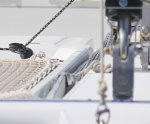
IMG_8695.jpeg

I think this was one of the recent Bav cats. They have 'extended the bridle adding a single snubber. They have taken the snubber into the bridge deck locker and I assume can attach the snubber without too much of a problem to the chain rode. Adding a single snubber to a bridle seems to negate some of the value of a bridle - I would have simply retired the original bridle (and kept it as a spare) and bought some new cordage of a sensible length such that both arms of the bridle reach inside the locker.
IMG_1399.jpeg

A really rubbish picture, which I only took to illustrate any anchor can be clogged with weed (if you anchor in weed). But again they have long enough bridle to take the whole bridle into the bridge deck locker where, again I assume, they are able to disengage the bridle or re-attach.
IMG_7571.jpeg

Its amazing how common it is to see incorrectly attached swivels. This cat is using a dangerous Witchard, easy to bend, hook (neatly attached to the locker wall). The locker is well equiped with a chain lock. Again they obviously attach the hook from inside the locker - and the Wichard hook is no different to attaching a bridle plate. The hole through which the anchor enters the locker looks similar in size to yours?

IMG_9743.jpeg
 
Top