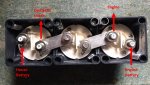
BEP Horizontal Battery Distribution Cluster with VSR

You’ve already convinced me to buy the victron one ?. If I’m not going to use it for engine start as I will have a battery connecting switch can I use cables just to take the amps of the starter motor?
You should get beer tokens for all the advice you give..

I never use the start assist feature, because i always fit the third switch. The third switch not only provides emergency starting, but it allows the circuits to be paralleled and one bank to be isolated, allowing all circuits to be powered by one bank, in case of failure of a battery.

Use 10mm cable from the relay to the battery positives and 1.5mm cable for the negative. Fit a fuse, max rating of 120a (midi fuses work well here) in one of the positive cables. If it's possible for the other positive cable to short, fuse that too.
 
Use 10mm cable from the relay to the battery positives and 1.5mm cable for the negative. Fit a fuse, max rating of 120a (midi fuses work well here) in one of the positive cables. If it's possible for the other positive cable to short, fuse that too.

Sorry to ask this and please don't think I'm questioning your advice, I just want to clarify something in my head.

I understand 10mm2 cable has a 70amp rating but you recommend a 120amp fuse. Is this to do with nominal and peak output? Sorry if this is the wrong terms.
 
Sorry to ask this and please don't think I'm questioning your advice, I just want to clarify something in my head.

I understand 10mm2 cable has a 70amp rating but you recommend a 120amp fuse. Is this to do with nominal and peak output? Sorry if this is the wrong terms.

I used 16mm2 cable and 80a fuses on mine.
 
Sorry to ask this and please don't think I'm questioning your advice, I just want to clarify something in my head.

I understand 10mm2 cable has a 70amp rating but you recommend a 120amp fuse. Is this to do with nominal and peak output? Sorry if this is the wrong terms.

10mm cable should be large enough, providing your charging systems don't exceed 70 amps and there isn't too much voltage drop. The 120a fuse is the max permissible rating, to protect the relay.
 
10mm cable should be large enough, providing your charging systems don't exceed 70 amps and there isn't too much voltage drop. The 120a fuse is the max permissible rating, to protect the relay.

My 1GM10 alternator is the original so only 35 amps I believe.
I still feel I'm missing something as I understood the fuse is to protect the cable. I know I've misunderstood something along my learning journey and will retrace my steps.

Dave
 
My 1GM10 alternator is the original so only 35 amps I believe.
I still feel I'm missing something as I understood the fuse is to protect the cable. I know I've misunderstood something along my learning journey and will retrace my steps.

Dave

In many cases the fuse is there to solely protect the cable. In some cases it protects the equipment too, such as electric motors. In this case, the fuse has to protect the cable and the relay. The relay is rated at 120a, so the max fuse must be 120a in order to protect the relay, but it can be less than 120a to protect the cables too.

So, if the cables need to be protected by a fuse you can fit a fuse that is rated anywhere between the maximum amperage of your charging systems and the maximum current rating of the cable, with a maximum of 120a (to protect the relay) , in your case, 35a to 70a. You may as well fit the 70a one.
 
Why did you use 110a cables and a 80a fuse ? How long are the cables ? What charging systems do you have ?

Cos 16mm2 was what I had available

As for the fuse size, it appears to fit within your accepted fusing in the posts that followed, so not sure I understand why you are questioning it. It is higher than my max charging current and lower than the cable rating

I'm guessing around 30cm

60A alternator, 30A battery charger
 
Cos 16mm2 was what I had available

As for the fuse size, it appears to fit within your accepted fusing in the posts that followed, so not sure I understand why you are questioning it. It is higher than my max charging current and lower than the cable rating

I'm guessing around 30cm

60A alternator, 30A battery charger

Questioning out of curiosity :)

Nothing technically wrong with what you have, just wondered why you chose 16mm cable, 10mm would have been fine, but if you had it kicking around it makes sense to use it.
 
So I bought the three BEP switches in the end but not the one with the VSR built in. I have a couple of questions (obviously :unsure: )
I'm planning to take the advice on here and wire it up not following the BEP instructions so I can isolate a battery if needs be.

Presentation1.jpg

Questions are,
Is there a downside to linking it up this way and is there anything I should be aware of?
I believe my Victron VSR should be mounted as close to the engine battery as possible but I've seen lots of installations with the VSR is wired into the switch. Does it matter where the VSR is wired in practice?

Thanks guys.
 
Questions are,
Is there a downside to linking it up this way and is there anything I should be aware of?
I believe my Victron VSR should be mounted as close to the engine battery as possible but I've seen lots of installations with the VSR is wired into the switch. Does it matter where the VSR is wired in practice?

No downside.

Doesn't matter where you put the VSR, although if you mount it close to the switches it will minimise the extra cable needed.
 
Questions are,
Is there a downside to linking it up this way and is there anything I should be aware of?
I believe my Victron VSR should be mounted as close to the engine battery as possible but I've seen lots of installations with the VSR is wired into the switch. Does it matter where the VSR is wired in practice?

Thanks guys.
As pvb says there are no downsides to altering the switching.
But
Once you add the vsr you are back to a situation where you could be linking a bad battery, which you thought you'd isolated, back to the good one again. The solution is to incorporate a switch in the negative connection to the vsr. Opening the switch will disable the vsr.
 
Once you add the vsr you are back to a situation where you could be linking a bad battery, which you thought you'd isolated, back to the good one again. The solution is to incorporate a switch in the negative connection to the vsr. Opening the switch will disable the vsr.

Ah ha, I was thinking that but was wondering if I'm overthinking again.
Being honest, is having a bad battery a common issue? Could I just disconnect the battery? Mine are pretty accessible.
Is it good practice to put a switch in?
 
Being honest, is having a bad battery a common issue? Could I just disconnect the battery? Mine are pretty accessible.

I reckon it's fairly rare. It's happened to me once, in 40+ years of boating. If you can easily disconnect it, I wouldn't bother with a switch - and you'll need to disconnect it anyway to replace it.
 
Would anyone have a wiring diagram for converting a 1;2;both switch to a peb type system??

You get one in the box if you buy a set of BEP switches, but if not the picture Gixer posted is pretty good.

Connections A-B are the house bank switch. C-D are the engine start switch and the middle unlabelled switch the combiner for when the engine won't start and you have flattened the battery. Or, if its a really simple design and there is no charging other than the alternator then close the middle switch so the alternator charges both engine and house bank, not forgetting to open the switch when you stop so you don't drain the engine start battery using the house electrics.

Pete
 
Ah ha, I was thinking that but was wondering if I'm overthinking again.
Being honest, is having a bad battery a common issue? Could I just disconnect the battery? Mine are pretty accessible.
Is it good practice to put a switch in?
I reckon it's fairly rare. It's happened to me once, in 40+ years of boating. If you can easily disconnect it, I wouldn't bother with a switch - and you'll need to disconnect it anyway to replace it.

True. You can simply disconnect a dud battery

Therefore there's no point in reconfiguring the switch cluster either.
 
Top