Beneteau Oceanis 31 - Seacock Corrosion

CaptainA1

New Member
Joined
2 Mar 2017
Messages
1
Visit site
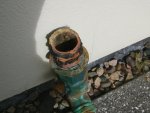
The raw water inlet to my Yanmar 3YM20 is badly corroded and needs to be replaced.
Boat is now 6 years old and all the other seacocks look OK.
The only difference I can see is that there is a strainer on the outside which may be setting up some kind of sacrificial current.
Any ideas on the spec & supplier for a replacement? (UK)
See photos:
Sea_Water_Inlet_Ball_valve.jpg

Sea_Water_Inlet_Strainer.jpg
 
You don't need one with a strainer - although skin fittings with one are still available. Replace it with a DZR skin fitting and ball valve. Think it is a 3/4". available from any decent chandlers or mail order from suppliers like ASAP supplies. Alternative is Tru Design composite non metallic valves from Lee Sanitation.
 
+1 for ASAP. You really need a supplier who will commit to a particular spec (e.g. CW602N which is DZR or CC491K which is a suitable bronze). Other terms are too vague so hard to take them to task if it turns out to not be what you think it is.

It is possible that there may be some stray current causing that particular skin fitting to corrode, but the thing is that Beneteau only had to supply fittings that would last five years. You could argue it is a weakness in the RCD - certainly forumites have had hours of fun arguing that topic in the past.

Your other fittings may also be quite heavily corroded. The only way to find out is to replace one. Here's a photo of a so-called bronze fitting removed after 6 years. One reason I want the supplier to quote a spec.

SkinFitting.jpg
 
Last edited:
The raw water inlet to my Yanmar 3YM20 is badly corroded and needs to be replaced.
Boat is now 6 years old and all the other seacocks look OK.
The only difference I can see is that there is a strainer on the outside which may be setting up some kind of sacrificial current.
Any ideas on the spec & supplier for a replacement? (UK)
See photos:
Sea_Water_Inlet_Ball_valve.jpg

Sea_Water_Inlet_Strainer.jpg

+1 for ASAP

Might be one difference between the raw water inlet and other skin-fittings and valves. The hose between engine and skin fitting might be reinforced by wire and it could be making a circuit if the wire protrudes at either end.

Just a possibility and could be worth checking. I'm pretty certain that Beneteau use plastic "wire" reinforcement in most of these hoses but think I've seen metal reinforcing in the raw water inlet hose. Metal would only be a problem on raw water hose as it connects to the engine and other skin-fittings usually connect to well insulated plastic bits on heads and basins.

This popped into my head when I asked myself "What's different about the engine raw water inlet and other skin fittings?" A few things came to mind but this seemed most likely to be capable of accelerating dezincification significantly in certain circumstances.
 
Last edited:
The thirteen year old seacocks on our oceanis 331 are all being replaced this winter, the first one snapped clean off as when we tried to take the hose off, we're not taking any chances with the rest. We bought ours via network yacht handlers.

It's crazy that such a vital part has such a limited life to save a few pounds,. But that's been said many times before. By the way, all ours looked ok, until it snapped.
 
Hello Captain and welcome.

As the others have said this has been well aired and was the subject of a campaign by Yachting Monthly, see here:

http://www.yachtingmonthly.com/archive/essential-seacock-checks-4692

Don't know if it had any effect or brass plumbing fittings are still being used, I suspect the latter. Someone will know.

Sadly YM were very half hearted, certainly not a "campaign". I suggested they should put their editorial where there words were and publish the seacock composition in each and every new boat test - but they said they "couldn't do this, as they wouldn't know what type they were"!!! So how a new boat buyer could find out, if YM couldn't (or more likely couldnt be bothered) when they are dealing directly with the manufacturer to arrange the test.
Sadly a case of YM failing to act on their own artcicles. Interesting to see if they can be bothered to do so now - or is the colour of the upholstery more important for new boat tests
 
I am replacing all seacocks and throughulls of my Beneteau 361 even though after cutting all to remove them looked relatively OK. I am going for all bronze ones.
 
Sadly YM were very half hearted, certainly not a "campaign". I suggested they should put their editorial where there words were and publish the seacock composition in each and every new boat test - but they said they "couldn't do this, as they wouldn't know what type they were"!!! So how a new boat buyer could find out, if YM couldn't (or more likely couldnt be bothered) when they are dealing directly with the manufacturer to arrange the test.
Sadly a case of YM failing to act on their own artcicles. Interesting to see if they can be bothered to do so now - or is the colour of the upholstery more important for new boat tests

First, the majority of new boats are still fitted with brass valves - as they were for many years long before the rCD came in. Nothing has changed.

Suspect that they are not pursuing the issue because there is simply not enough credible evidence that there is a significant problem - that is no evidence of boats sinking from dezincified fittings. you can imagine how quickly our press would pick up on such a sinking - particularly if it was a Bavaria.

So plenty of evidence that brass fittings randomly dezincify, but no evidence to support any idea of of numbers or timescale, nor any evidence of real adverse consequences.

The standard is under discussion for revision within the RCD, but inevitably progress on any change is slow.
 
Removed four today, all showing some signs of pinkness in places. The engine inlet was one of the worst,like the OP's, (apart from the heads inlet which snapped), and bonded to the anode, as was the stern gland inlet. Not sure why they are bonded but I will restore the connections tomorrow when I hope to put the new DZR ones in.

Removal pretty straight forward, with the aid of a stilson and dremel. The only problem is the sink outlet, where I will need a 32mm box spanner to get at the nut which Beneteau have cleverly recessed so the stilson won't touch it.
 
+1 for ASAP

Might be one difference between the raw water inlet and other skin-fittings and valves. The hose between engine and skin fitting might be reinforced by wire and it could be making a circuit if the wire protrudes at either end.

I can confirm this having cut that hose yesterday. Will this make a difference to the bonding requirement?
 
Tranona's views on this topic differ from mine. Plenty of boats sink for a variety of reasons, some in their berths or on moorings, but because the sinking is never investigated properly we don't know whether failed seacocks caused them. What I do know is that many people tell me that their seacocks broke off when they leaned on the hoses attached to them. There are pictures of such on my website. I also know from discussions with surveyors, particularly Paul Stevens who started the YM campaign, that the method they use, a sharp tap on the fittings with a small hammer and drift, often reveals extreme brittleness in the fitting. A photo by Paul is on the website.

I think criticism of YM is unjustified. No other magazine has done as much for boat construction on this issue, if anything. As a result of the campaign certain builders changed the material of the seacocks they fitted. When the problem arose it was not possible to buy all-bronze ball valves nor DZR skin fittings and hose tails. The fact that they are now in general production is a direct consequence of the campaign.
 
However, little of this is documented systematically. Insurance companies do not see it as an issue, nor have there been any significant MAIB investigation to sinkings from this cause. While it may be true that dezincified skin fittings may fail if whacked with a hammer, they do not seem to fail structurally while still attached to the boat. Hence the limited (unquantifiable?) number of sinkings from failure.

While some builders may have changed and it is now possible to buy better products, the major builders (nor the RCD recommendation) have changed so there are still vast numbers of plain brass fittings in use and thousands more being added every year.

I was not criticising YM, just observing that in the absence of systemic evidence of a problem it is difficult to know what they can do. Launching their own investigation to collect reliable evidence is way beyond tem or the resources they could allocate. Despite my 25 years or so of designing research projects of this type, I don't think I would take it as a commission!
 
However, little of this is documented systematically. Insurance companies do not see it as an issue, nor have there been any significant MAIB investigation to sinkings from this cause. While it may be true that dezincified skin fittings may fail if whacked with a hammer, they do not seem to fail structurally while still attached to the boat.

Couple of points.

Insurers do see it as an issue as they require owners to demonstrate "due diligence" in inspecting things likely to go wrong. Some policies specifically exclude claims caused by something an owner should have spotted during routine inspection.

Secondly, I know personally of a Beneteau which suffered a hose tail failure at sea which, had the skipper not been on the ball, would have sunk the boat. When he hauled out and checked the rest, another one failed without much persuasion.
 
Couple of points.

Insurers do see it as an issue as they require owners to demonstrate "due diligence" in inspecting things likely to go wrong. Some policies specifically exclude claims caused by something an owner should have spotted during routine inspection.

Secondly, I know personally of a Beneteau which suffered a hose tail failure at sea which, had the skipper not been on the ball, would have sunk the boat. When he hauled out and checked the rest, another one failed without much persuasion.

Once again one offs. Owners' diligence is expected in respect of the whole boat.

Would be more convinced insurers had any real interest if they refused insurance or loaded premiums for boats fitted with plain brass fittings. Guess that would affect the majority of their clients!

No, seacocks are just included in the general risks along with all the other things we know can fail and possibly lead to loss - rigs, rudders falling off, portlights failing, fire, gas and electrical systems etc. Indeed re-read the YM series on sinking boats and recall both how difficult it is to actually sink a modern yacht and how rare such failures are. Insurers publish data on reasons for damage/loss claims regularly and none of those things even make the list.

As i said trying to isolate and record failures of seacocks and fittings while in the water is a monumental task. Common sense suggests the number is tiny and the population huge so even finding any in a reasonably representative sample is a challenge. Given there are so many variables, even defining the parameters for a sample is problematic.
 
No, seacocks are just included in the general risks along with all the other things we know can fail and possibly lead to loss - rigs, rudders falling off, portlights failing, fire, gas and electrical systems etc.

But surely that is the whole point. The diligent owner takes steps to avoid these well-publicised problems, by carrying out regular checks/replacement of rigging fittings, keel bolts, rudder bearings and stocks, etc., etc. Replacing potentially problematic seacocks is just one of these, avoiding failure down the line. I am certain that mast loss due to rigging failure is far more common than boat loss due to seacock failure but insurance companies do not load the premiums of boats with masts as far as I know.
 
Top