belay trailer down slipway?

The simplistic steady load will not be much, but I have experience of launching heavier boats (about 1 ton) on ropes. Even with a fairly good slipway, the load is jerky.
300kg stopping suddenly is as many kg as you like.
I don't think the fig 8 will allow the boat to start moving? I would be wary of it having to go completely slack for the weight to overcome the friction, then it might tangle?

A big ratchet block might be better?
We use a proper dockside bollard, but we always have one person on the rope and helpers to guide and start the boat down the slip.
Obviously your boat is very light, so will be easier, but you still can't be in two places at once.
Maybe if you take the rope from the boat, around the towball or ratchet block, then back to the trailer, you can ease away from the trailer while steering it?
Get a decent bit of polyester rope. And industrial gloves.
Get some chocks. 2 for the car and two for the trailer.
I'd ask a friend to help at least the first couple of times.
Hope that helps?
 
Hi guys,
I realise that my post is significantly after the initial discussion, but I wanted to thank the forum. I've now successfully launched my trailer sailer down a wooden slipway using a rope on the Norfolk Broads.
Initially I couldn't work out how to do it and this forum came up during my research.

I took the time to film my experience.
It wasn't perfect, but I'm sharing it here because I think it can help others who stumble across this forum like I did.


Locals had told me I had to use a rope and I wasn't allowed to drive on the wooden slipway. There was a sign saying as much and I was tempted to ignore it.
I'm really pleased I didn't ignore the sign though because whilst launching a man told me he'd seen cars slide down the slipway when they ignored that sign!

Hope my video helps others.
Keep boating :)
Danny
 
Nice video. Looks like a lovely location for cruising. (envy) Not envious the obvious low temperature with you all rugged up. I am guessing my own little boat is similar to yours 21ft on a similar trailer. I use a concrete ramp fairly steep so can leave trailer attached. Doesn't seem to be a concern re car slipping in. I have seen people make a draw bar extension. ie a ball near one end and a hitch the other end. With some way to hold the trailer end aft of the ball to make it rigid. While this must be limited to a sensible length it does mean you can push the boat and trailer down the ramp if necessary. Certainly have control of decent.
Anyway using rope is fine. I would chock the trailer and drive the car forward about one or more boat length then tie a rope fixed each end to the trailer. Now drive the car forward to allow removal of chocks then reverse the car with hopefully the trailer going in slowly. Then with boat off pull trailer out.
As you found be careful of a step at the bottom of the ramp.
Pulling out can be similar on a rope. I would always have mask and snorkel ready to allow me to see the boat on the trailer under water. But then no cold water here.
My experience here has been with friend's fin keel boats which are much trickier to get onto the trailer.
Just a little story of the first time I took my new to me boat to a ramp. I disconnected the attachment at the bow (winch wire) intending to jump on the brakes at the bottom so boat launches itself. Unfortunately I touched the brakes in the way down. The bed of rollers and steepness of ramp saw the boat launch itself onto the concrete. Didn't harm the boat much but banged up the outboard. Now I just back the trailer into the water so back rollers of trailer are under water. Remove the safety chain lift the paul on the winch and the boat slowly slides off unwinding the winch wire as it goes. Leaving wire unwound ready for retrieval. Just a bit tricky to climb down the trailer to disconnect winch wire hook. Usually accompanied by much grinning as it is the start of a new sailing season. (I keep it on a swing mooring all summer.) Sadly it is nearly time to drag it home again. Have a great season ol'will
 
I fitted a tow bar to the front of my 4 x 4 to make it easy to launch my mobo. I also have a 12volt winch that I can fit to the front of my car so if I cannot bet near the water I can lower the trailers down the ramp with the winch. It also makes recovery easy.

We also have a concrete ramp that is used to winch out my 24 ton steel boat for anti fouling and the clubs specially designed dolly.
 
I fitted a tow bar to the front of my 4 x 4 to make it easy to launch my mobo. I also have a 12volt winch that I can fit to the front of my car so if I cannot bet near the water I can lower the trailers down the ramp with the winch. It also makes recovery easy.

We also have a concrete ramp that is used to winch out my 24 ton steel boat for anti fouling and the clubs specially designed dolly.
All very well, but the OP has a 1.2litre VW Polo. I don't think it would be cosmetically improved by the kind of adaptations that would not look out of place on a large 4x4. :)
 
Oh aye?

Descenders are generally intended to take the load of 1 person - with a factor of safety again, generally, 5:1. Some late 70's designs were overbuilt purely for heat absorption, but never intended for much bigger loads as you say.
Because of the factor of safety, and because of the loads being mitigated by the slip, then it would be ok for the OP's purpose.
The loading on the rope in this case would be very much less than the weight of one person, even if the slipway was more steeply inclined than the average. Can any one work it out mathematically, it's been a long time since I did 'O'-Level Applied Maths?
 
Hi guys,
I realise that my post is significantly after the initial discussion, but I wanted to thank the forum. I've now successfully launched my trailer sailer down a wooden slipway using a rope on the Norfolk Broads.
Initially I couldn't work out how to do it and this forum came up during my research.

I took the time to film my experience.
It wasn't perfect, but I'm sharing it here because I think it can help others who stumble across this forum like I did.


Locals had told me I had to use a rope and I wasn't allowed to drive on the wooden slipway. There was a sign saying as much and I was tempted to ignore it.
I'm really pleased I didn't ignore the sign though because whilst launching a man told me he'd seen cars slide down the slipway when they ignored that sign!

Hope my video helps others.
Keep boating :)
Danny
Re your comment about your not holding the rope correctly, yes, sailing schools always teach, on the very first on-the-water session, that the correct way to hold a loaded line, such as when easing a jib-sheet, is to hold it with your little finger and the edge of your palm towards the winch, and your thumb and forefinger on the side facing away from it. It's said to be easier to let go if the force overcomes your strength and your hand gets pulled towards danger.
Also, it's easier to get by without a little finger than without a thumb and forefinger :).
 
All very well, but the OP has a 1.2litre VW Polo. I don't think it would be cosmetically improved by the kind of adaptations that would not look out of place on a large 4x4. :)

The main reason I fitted a tow hitch to the front is it makes it very easy to see where the boat/ trailer is going and when you get older its much harder to turn you head round to see what's going behind you.
 
AFAIK, the force required to pull the boat+trailer up the incline or stop it going down is its mass multiplied by the sine of the angle of incline.
Suppose the boat weighs 150 kg and the angle of the slip is 30deg. The sine of 30deg= 0.5, therefore the apparent weight of the trailer is 75kg, the weight of a moderately sized man. I think that a climbing descendeur, or even a couple of turns of rope around the tow-hitch could control that easily. As for pulling the boat up the slip, a 4:1 purchase would make easy work of it.
 
Coincidentally, yesterday my son in law was describing a gadget he had seen for launching his RIB.
A light two wheeled trolley with a tow ball and tow hitch either end and a trailer winch on top.
Used like a gun limber and versatile for various uses. Could be made light enough to store in the boot or bolted to the trailer.
I think he was hoping I'd make him one. Perhaps a project for my spare time.
 
Spirit (of Glénans) thread #48,
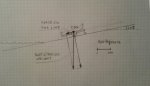
Here is the math, graphically solved.
I supposed a 20% slope (one in five) as a likely figure. It can be changed to suit the case.
 

Attachments

  • 20210402_220404.jpg
    20210402_220404.jpg
    246.1 KB · Views: 12
Spirit (of Glénans) thread #48,
Here is the math, graphically solved.
I supposed a 20% slope (one in five) as a likely figure. It can be changed to suit the case.

Glenans did it the mathematical was and you did it the graphical way (force vectors)

Both are valid and would get the correct answer.
 
SYH used to have a length of steel wire around a cheek block, so the vehicle stayed on the level, have they done away with this?
possibly, in the intervening 9 years.

I don't see how that would help him steer the trailer. Anyway, seems he took a swinging mooring in 2014.
 
Nice video. Looks like a lovely location for cruising. (envy) Not envious the obvious low temperature with you all rugged up. I am guessing my own little boat is similar to yours 21ft on a similar trailer. I use a concrete ramp fairly steep so can leave trailer attached. Doesn't seem to be a concern re car slipping in. I have seen people make a draw bar extension. ie a ball near one end and a hitch the other end. With some way to hold the trailer end aft of the ball to make it rigid. While this must be limited to a sensible length it does mean you can push the boat and trailer down the ramp if necessary. Certainly have control of decent.
Anyway using rope is fine. I would chock the trailer and drive the car forward about one or more boat length then tie a rope fixed each end to the trailer. Now drive the car forward to allow removal of chocks then reverse the car with hopefully the trailer going in slowly. Then with boat off pull trailer out.
As you found be careful of a step at the bottom of the ramp.
Pulling out can be similar on a rope. I would always have mask and snorkel ready to allow me to see the boat on the trailer under water. But then no cold water here.
My experience here has been with friend's fin keel boats which are much trickier to get onto the trailer.
Just a little story of the first time I took my new to me boat to a ramp. I disconnected the attachment at the bow (winch wire) intending to jump on the brakes at the bottom so boat launches itself. Unfortunately I touched the brakes in the way down. The bed of rollers and steepness of ramp saw the boat launch itself onto the concrete. Didn't harm the boat much but banged up the outboard. Now I just back the trailer into the water so back rollers of trailer are under water. Remove the safety chain lift the paul on the winch and the boat slowly slides off unwinding the winch wire as it goes. Leaving wire unwound ready for retrieval. Just a bit tricky to climb down the trailer to disconnect winch wire hook. Usually accompanied by much grinning as it is the start of a new sailing season. (I keep it on a swing mooring all summer.) Sadly it is nearly time to drag it home again. Have a great season ol'will

Thanks William :-)

I love the idea of separating the trailer from the car with a length of rope and then using the vehicle to do all the heavy work, but unbelievably at that particular location there's a tree in the way so the car can't really go further forward than it is in the video!
 
Top