
Being towed at speed

Roberto

Well-Known Member
Joined
20 Jul 2001
Messages
5,849
Location
Lorient/Paris
sybrancaleone.blogspot.com
Suppose this situation: a deep draft sailboat has to be towed along the coast at nearly the maximum hull displacement speed, say 7kt for a 40', by a tug with a fixed speed, once underway the tug cannot decrease its speed to make things gentler, sea state calm or smooth, duration longer than one day.
The tow line will be under a considerable load, though mostly static.
The sailboat has a much greater draft than the tug, so there is the additional need to be able to release very quickly the tow line in case the sailboat keel collides with the sea bottom: this means someone on "tow watch" that triggers some immediate release device as the bang occurs. The tug has no depth sounder, or can't be relied upon to slow down or give any warnings of decreasing depth, they basically keep going.

How would you proceed ?
I thought about spreading the load by some kind of tow harness attached to several strong points: aft winches, mast (?), cleats, etc, the whole harness should converge to a single attachment point to the towing line from the tug. Seems sensible ?
What to rig to quickly release the tow line by someone sitting in the aft cockpit ? Something foolproof and about 100% sure of being effective, if the tow line does not release it might mean the loss of the boat, drawn at high speed on rocks or shelving sea bottom.
Long/short tow line? With calm sea state, must consideration be given to proper snubbing anyway?
Any thoughts?
thanks
 
Not sure I get the intention of asking this question.
Do you envisage being in this situation? I certainly would not take a tow based on this information unless it was an emergency situation to get me away from danger. No quick release would be quick enough, given that you have already hit the bottom be it rocks or otherwise. The damage would already be done.
 
Are you planning to lasso a passing ship? ;)

I have been in an in some ways related situation. Towed by a lifeboat for some miles along the coast, we had to ask them to slow down, as we were at or above our 'hull speed' and the stern was squatting down alarmingly, and with everything seeming under considerable strain. That was, fortunately, in pretty benign conditions, it would have been far, far worse (and it was bad as it was) in a rough sea.

Once we knew the lifeboat was on its way, we spent the time rigging a bridle for the tow, taking numerous lines round the two stout wooden keel stepped masts and every other 'solid' point. I can't remember now how we connected the line to/from the lifeboat to the bridle, so i can't advise on that, but I do remember I had to go forward at some point while we under tow to sort out some problem, and was very nervous that if the tow parted I'd likely be badly injured by the backlash. Mainly we stayed in the cockpit and kept our heads down.

I suspect a long tow line is generally best, both for max stretch in the line, and avoiding the two boats colliding. From towing dinghies it seems a minor adjustment is sometimes helpful, so that you are generally at the same point on the waves/swell to minimise snatching. In our situation there wasn't any snubbing, and as far as I recall we were moving so (relatively) fast, and in pretty calm conditions, that we were under continual tension, and didn't suffer snatching except when first moving off, which I seem to remember as pretty alarming.

I have read that a chain tow line (or part of the tow line) is beneficial, as the catenary absorbs a good deal of the likely snatching.
 
What you've described seems fairly typical of most RNLI towing if some of the video's and web comments are to be believed. The advice I was given (by the RNLI) was to have a towing harness available (this could simply be a suitable length of stretchy rope or a full blown spliced hard eye made to measure job) and to have worked out beforehand how to deploy it. The trick was to spread the load across as many points as possible. This usually means ending up at the main winches via a round turn or two on as many cleats as possible along the way I think (the RNLI agreed with me :p) but it's worth trying it first to make sure you know how to get a good portion of the load on the cleats but don't end up with one bow cleat taking all the load.

One of the crew at Poole did share the fact that they don't like hanging around while the rescuee faffs around trying to sort things out - you're liable to find a crewman aboard who just attaches the RNLI's towrope to the mast apparently. I don't know about the boats but one of the AWB crew at Poole some years back reckoned that a 4 or 5 knot tow was "never gonna happen".
 
Recollecting from 60 years in the past of towing old wooden fishing boats. The best way of reducing the snatch was to have a car tyre or two tied into the middle of the tow. The energy required to lozenge the tyre absorbed the shock of the snatch and prevented the tow parting.
As for the 'tug', if it has a minimum speed and cavalier attitude to the draft required, it may be worth looking for alternatives. Being towed at an 'excesive speed' raises the dangers exponentially.
 
Hang your anchor off the front of the towline so that it acts as a brake before your keel strikes bottom. You'll need to work out at what angle the anchor chain will hang at towing speed to ensure that it hits bottom before your keel does.
 
Over and above the dangers already stated there is a possibility that as engine water inlets on sailing boats are recommended to be fitted to maximise the scoop effect that you can end up with a flooded engine if the water finds its way past the seawater pump.
Should the seacock be turned off?
 
Having been told by a friend how he was towed at excessive speed, and with too short a tow line, in quite heavy weather, on a dark night, by an RNLI lifeboat, I have given some thought about rigging a very long towing bridle, should it ever be required. Basically, it's a long nylon line, with its middle way out past the bow, with the ends made fast to the aft mooring cleats, a single turn round the midship mooring cleats, and again a single turn round the forward cleats. It would be either wrapped or tubed where it passed through the forward fairleads. I do have a suitable line aboard, which is sometimes used as a second anchor rode.

I hope never to need a tow, but things happen..... When my friend was being towed, the towline parted either once or twice, but still the lifeboat wouldn't go slower. He said it was a terrible experience.

I do have experience of towing professionally, with boats and barges, and the single most important point, is to have the towline as long as possible. As "gus" says, using a tyre or two in the line can help, but length so that the line never leaves the water is the ideal.
 
Thank you all for your thoughts and experiences!

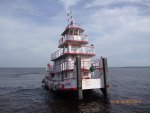
An unusual situation of course, some mental gym, a friend was towed by one of those pusher-tugs (?), I do not know the technical name, basically those very short rectangular vessels with very big engines that push huge barges, found a sample picture, the two vertical beams get in contact with the engineless barge, the sailboat was attached behind, to the stern of the tug:
14484602578_d59f701c18_b.jpg
they follow their commercial speed, not much consideration for the tiny sailboat towed behind.
This guy has a 13-14m boat, they were towing at about 9kt and he said his boat made a huge wave, the tow line like a guitar string. The biggest problem he had, sometimes the pusher-tug stopped and made a strong burst in rear gear to clean the propeller of all grass, weed, debris etc, during one of those bursts his boat kept going and collided against the tug, he could avoid the worst anyway. He also had some tree trunks coming against the hull, some flowed around the boat, a couple were stuck in front and he had to cut the line.

So from your answers: the longest tow line the better, a double section with tyres working in compression in the middle, line preferably of big diameter in order to have some additional elongation in case of hitting something and give the tow watch a few seconds more to react before the whole deck is ripped away :D

What kind of device for quick release? Maybe a cascading sequence of loops with a snap shackle at the end?
Also check what happens with the engine and other water inlets.

thanks again :)
 
I was towed from around the Nab tower to Gosport by Bembridge Lifeboat, many years ago. The RNLI guy on board tried to rig the tow around the mast. I wouldn't allow that.They set off at 10 knots. I radioed them to stop. We then rigged a brace from the stern cleats to the main cleat on the foredeck. Also we had two bridles, one from the bow cleat (the strongest on the boat) and the other from the stern cleats. I then bound the two bridles together at the bow and we set off at a slower speed. Sometimes you have the work with what you have and do the best you can.
 
The loads on a tow line can be enormous if the towing vessel goes too fast. The larger the towing vessel the less they will notice the huge load so be inclined to want to travel at cruise speed. I think the situation could arise where you will be safer not being towed. If they won't slow down tell em to leave you to your own devices.
I would think the case where the towing boat goes over shallow banks that are too shallow for your keel are hopefully unlikely. If they do that then they are pretty miserable seamen. You should be doing navigation to make sure anyway.
regarding emergency release of the tow line. A stout knife might be one way or might be slow. A hook devised liek a pelican hook or snap shackle that can release under load would be the ideal device. But we don't all expect to be towed very often.
Regarding rope around the mast, not a good idea for deck stepped mast. Mine has a mere 1/4 inch bolt that would take all the load in the forward direction so not good at all. Use bow rail mounts plus bridle back to main winches if you don't have strong bow cleat.
In training our club rescue boat drivers I always emphasise that the skipper of the boat in distress must dictate how the tow or pull off a bank is conducted including direction of pull etc. The towing boat skipper is responsible for the safety of his boat but should not try to dictate to the towee. So regarding speed, the towee should dictate speed. If the tower is not willing to go slow then he is failing badly as a rescuer and if at all possible sent on his way. (with no glory)
ol'will
 
Last edited:
One of the local lifeboat crew is still recovering from broken ribs following a towline parting, chafed through at the casualty end. There was a short wire strop for the casualty end spliced up by a crew member but the powers that be discarded it.
For a release I suggest multiple bridle attachment. Say, the tow end is a shackle or eye. Make an end onto the mast, pass the line through the towline eye and round the mast several times, then the end back to the cockpit, several turns on a suitable strongpoint. On release the whole lot should pull out........of course it will jam if it can.
 
One of the local lifeboat crew is still recovering from broken ribs following a towline parting, chafed through at the casualty end. There was a short wire strop for the casualty end spliced up by a crew member but the powers that be discarded it.
For a release I suggest multiple bridle attachment. Say, the tow end is a shackle or eye. Make an end onto the mast, pass the line through the towline eye and round the mast several times, then the end back to the cockpit, several turns on a suitable strongpoint. On release the whole lot should pull out........of course it will jam if it can.

This idea of towing from the mast may have been alright when all masts were keel-stepped, and passed through substantial mast partners at deck level. Nowadays many, if not most, yacht masts are deck-stepped, on a mast step which is definitely not designed for a forward force.
 
This idea of towing from the mast may have been alright when all masts were keel-stepped, and passed through substantial mast partners at deck level. Nowadays many, if not most, yacht masts are deck-stepped, on a mast step which is definitely not designed for a forward force.

yes, substitute any strong point, once you have multiple turns you can even hold onto the end, or make it off so it can be released. There used to be a method involving a beam across under a deck hatch. Of course, when you let fly the eye/shackle will snag the forestay and bring the mast down, hauling you along broadside on your beam ends.
 
The RNLI certainly seem to tow at quite immoderate/inapropriate speeds and that's an understatement, just look on youtube.

Pianowire-rigid towlines are potentially dangerous if they snap so anyone stationed at the bow with a breadknife is likely to have his head taken off if it goes before he can cut it. Car tyres on the tow might moderate the whiplash but who carries them around, just in case?

Surely the answer is to conduct a tow at a seamanlike speed.
 
Top