
Being seen whilst on night passages.

12 Year Plan B-)

Well-Known Member
Joined
25 Sep 2013
Messages
98
Location
UK Waters
Visit site
It occurred to me that aiming a small, powerful white light at the top of (usually white) sails whilst underway might get the attention of watchkeepers on other vessels. This would surely be more noticeable than a single 12v (filtered red) light e.g. if they are to Port of you forward of the beam. I understand that sails 'lit' in this way could 'overpower' the red Nav light, however: once seen others would of course monitor relative bearing to their own vessel and seeing sails, they wouldn't even need to tax their brain about which lights mean what!
All comments welcome...
 
On the delivery of my boat from NL to the UK, the previous owner reported shining a torch on the sails because a ship apparently hadn't seen us, but was asleep at the time and never questioned how close we were, how long he did it for or why he didn't just change course.
 
It all depends on the circumstances.

If you are keeping a proper watch and see a large, fast moving, commercial vessel that looks to endanger you then it is very prudent to assume they have not seen you and may never see you - and you should take evasive action. If you are keeping that proper watch you will have plenty of time to take evasive action as a large commercial vessel with be well lit.

I'd say it is safe to assume a large commercial vessel should have a person on watch and he (or she) will have access to a variety of radar devices, AIS and eye sight, with good binoculars. If they have not seen you given all of these devices you are better out of the way - this assumption also assumes the person on watch is fast asleep.

If they change course and still endanger you - this is the time to use the parachute flare - aimed at bridge height but not at the bridge.

I have used a spot light on the sails to prove to an enquiring vessel that even though we were averaging 10 knots we were in fact, as stated, a sailing vessel.

Spotting a bow located nav light of a small sailing vessel might be very difficult to see, being small, low powered and almost at sea level - much better a mast located light assembly. We have deck lights for 'inshore' passage making and mast head lights for open waters - two independent circuits.

However I would sacrifice night vision, it does return, unless there are a convoy of large commercial vessels :) and use a spot light on the sails and then played squarely at the still distant approaching vessel, cycled back to the sails etc. My major action would be to get out of the way!
As current events clearly demonstrate 'might is right' (and/or bullies rule) or has been for the last 100 days or so), whatever the rules, convention and etiquette might be.

Jonathan
 
Now that you've ruined your night vision, how are you going to see the vessel comming at you.

If you close one eye or cover it with one hand, you keep night vision in that eye.

I would definitely do this if necessary. It's one of many tools available; use them judiciously.

It's not just for big ships. Maybe it's a fishing boat or another short-handed sailing boat, maybe without AIS/radar where a lone watch-keeper may have been temporarily distracted by other tasks and missed those little reds and greens; lighting up the sails might be just what they need.
 
I suspect that the OP has not much experience of sailing at night. If he had, he would long ago have worked out for himself that there are two golden rules to collision avoidance (forget ColRegs - they are an interesting, academic and often pedantic exercise for the unworldly, that are only of relevance to the small-boat sailor when in close-quarters situations).

1 When other traffic is bigger or faster than you (which for sailing yachts means virtually everything, always) - stay out of its way long before any situation arises where you even have to consider ColRegs implications.

2 If you believe that commercial ships these days (down to and including fishermen) have a watch-keeper who is able and prepared look out of the window, make sure your will, and funeral wishes are up-to-date. Shining lights on sails, you're having a laugh. If it ain't on radar or AIS, then it don't exist. (Now cue seven pages of anecdotes. "Well in 1984, when I was on my day-skipper night sail, there was this............."
 
It occurred to me that aiming a small, powerful white light at the top of (usually white) sails whilst underway might get the attention of watchkeepers on other vessels. This would surely be more noticeable than a single 12v (filtered red) light e.g. if they are to Port of you forward of the beam. I understand that sails 'lit' in this way could 'overpower' the red Nav light, however: once seen others would of course monitor relative bearing to their own vessel and seeing sails, they wouldn't even need to tax their brain about which lights mean what!
All comments welcome...
Follow the COLREGS and keep out of their way. In my experience big vessels are on top of their game and I am cautious around fishing vessels.
 
I suspect that the OP has not much experience of sailing at night. If he had, he would long ago have worked out for himself that there are two golden rules to collision avoidance (forget ColRegs - they are an interesting, academic and often pedantic exercise for the unworldly, that are only of relevance to the small-boat sailor when in close-quarters situations).

1 When other traffic is bigger or faster than you (which for sailing yachts means virtually everything, always) - stay out of its way long before any situation arises where you even have to consider ColRegs implications.

2 If you believe that commercial ships these days (down to and including fishermen) have a watch-keeper who is able and prepared look out of the window, make sure your will, and funeral wishes are up-to-date. Shining lights on sails, you're having a laugh. If it ain't on radar or AIS, then it don't exist. (Now cue seven pages of anecdotes. "Well in 1984, when I was on my day-skipper night sail, there was this............."
This is dangerously inaccurate on several counts.

I agree that big ship watchkeepers primary sources of information about other vessels are radar and AIS but they do look out of the window sometimes too. (Usually/often to visually identify what they’ve seen on the radar…)

To suggest IRPCS should be ignored and you should ‘just keep well clear of big ships’ makes no sense at all. As you make some wild alterations because a ship has come into sight and for some reason you think it might get close to you, it leads watchkeepers on big ships wondering what in earth that yacht is going to do next. IRPCS are not optional extras for you to ignore. By all means don’t get into close quarters and dangerous situations, but if you’re the stand on vessel then you should stand on until (as the rules say) you realise the other vessel isn’t taking action and you take the appropriate action (in accordance with the rules) yourself.
FWIW we have good lights, AIS class B with transponder and Radar fitted on our boat.
One of the really good things about AIS is that it’s become obvious to yachts that most every ship does actually see you and does obey IRPCS and alter to avoid collision.
And the above from time on the bridge of various ships from Channel ferries to tankers to warships.
In the Med it can be a different story, but that’s another topic.
 
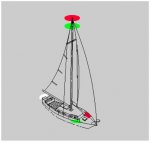
In the attachment shown, I cannot help wondering about the practicality of mounting the the green light such that it will be seen around the mast & sail for the full 360 degree radius
View attachment 137842
I did read somewhere that the ideal separation would be 1 metre. I cannot imagine this being practical on most yachts. What would most forumites consider an ideal distance? Bearing in mind that if a yacht is heeled the apparent separation becomes considerably less when viewed from a distance. Then how would one mount the green light.
Would a vertical red/white/green stack of LED lights be possible so one had the option of the anchor & steaming light in the middle for under power. That would then only require a port & stbd bow light for when motoring with the white light- which would double at anchor.
 
Last edited:
In the attachment shown, I cannot help wondering about the practicality of mounting the the green light such that it will be seen around the mast & sail for the full 360 degree radius
View attachment 137842
I did read somewhere that the ideal separation would be 1 metre. I cannot imagine this being practical on most yachts. What would most forumites consider an ideal distance? Bearing in mind that if a yacht is heeled the aparent separation becomes considerably less when viewed from a distance.
I like the idea of it but can't see how most of us could fit such lights, unless we fitted a 1m extension to the top of the mast.

Although prepared for such a situation at night, with torches and white flares to hand, I have never needed to make myself visible beyond my usual nav lights. As JM says, most ships are on top of the situation and don't want to mess around with yachts.
 
In the attachment shown, I cannot help wondering about the practicality of mounting the the green light such that it will be seen around the mast & sail for the full 360 degree radius
View attachment 137842
I did read somewhere that the ideal separation would be 1 metre. I cannot imagine this being practical on most yachts. What would most forumites consider an ideal distance? Bearing in mind that if a yacht is heeled the apparent separation becomes considerably less when viewed from a distance. Then how would one mount the green light.
This is an interesting option that I confess never occurred to me.

Looking at it on another forum one poster fitted a masthead all round red light, and fitted 4 separate green lights a meter down from the masthead.
 
A (main) sail diffuses white light quite well. It does not need a very powerful lamp to illuminate it. Five flashes towards the main is a good way to send the “your intentions are unclear” signal. With a little forethought, blinding night vision for those on deck can easily be avoided.
 
Top