Beaching Legs Fitting Location?

View attachment 87977
As the OP of this thread I did eventually fit the legs and here she is in Brittany. Not long keel but semi long.

It’s a shame Yacht Leg Company has stopped them as they’re very good quality. I was fortunate to get a 2nd hand pair.
Didnt realise that was your boat. Found that picture on Google whilst searching for info on beaching legs. It gave me confidence to try mine out due to the size of your boat. I was concerned that when most talk about legs and drying out, they are usually for 'smaller' boats and I have not seen any bigger (40ft plus) on legs. Whats the boats size and weight if you dont mind?
 
Any ideas why Yacht Legs Company stopped making them? Seems quite a few people still want them.

Last time I spoke to the YL Co, I was told that the cost of manufacturing was becoming un-economical, and that they were also having difficulty in getting some parts made.
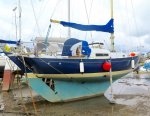
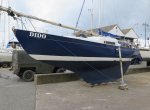
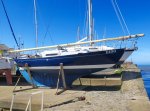
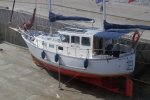
I had a boat with YL for over 20 years, she was moored fore and aft in a drying harbour, sometimes she would sit balanced on her keel with neither leg touching the ground, most times she would be gently resting on one of the legs to the extent that if you leaned on the hull you could rock her side to side, very occasionally she would lay heavily on one leg. I agree that the legs need to be about 6" above the keel depth as that helps the boat to ground keel first rather than the legs hitting the ground first.
For the first 4 years of ownership I used the legs on the hard over the winter, but after a rather nasty storm, which she survived without a problem, I bought a cradle.
I did winter her on the legs the last year I owned her as I wanted her in a position on the hard that she could be easily accessed by a crane, if she sold, and the new owner wanted to transport her or launch her earlier than our club lift-in.
I have attached photo's which show her on her fore and aft mooring, ashore with legs (the legs are chocked to hold her steady, and also a shot of her in the cradle.
I am looking through my files to see if I still have the full info on the leg fittings, but I may have let these go with the boat when I sold her.
 

Attachments

  • YL 1.jpg
    YL 1.jpg
    906.4 KB · Views: 33
  • YL 2.jpg
    YL 2.jpg
    948 KB · Views: 37
  • YL3.jpg
    YL3.jpg
    918.3 KB · Views: 35
  • YL4.jpg
    YL4.jpg
    882.9 KB · Views: 35
If the idea is to use them on the hard then it may be worth checking this with your insurance company. Last year a club close to ours had a tragic death when a boat fell while on the hard killing the skipper when he was antifouling. Most clubs now insist on a suitable cradle. However, I guess if it is kept on your own private area there is no problem

The poor deceased had moved one acroprop to antifoul under it. The boat piroeted around as the load shifted and displaced the other prop on that side so whole lot fell on him. Yacht legs are mounted centrally and firmly attached to hull, not just resting on it. Boats dry out in local yards in cornwall just with yacht legs
 
Didnt realise that was your boat. Found that picture on Google whilst searching for info on beaching legs. It gave me confidence to try mine out due to the size of your boat. I was concerned that when most talk about legs and drying out, they are usually for 'smaller' boats and I have not seen any bigger (40ft plus) on legs. Whats the boats size and weight if you dont mind?

43ft & 17 Tonnes

However before fitting the legs I did ask the crane driver to lower the boat onto the concrete and gently let the slings go slack. I was curious if my boat would sit on its keel evenly without pitching forward. Not only did it not pitch forward but it actually stood on its own entirely. The base of my keel is about 10 inches wide and flat.

This gave me the confidence that the legs would in fact not be taking much weight at all. I was reassuringly told this beforehand but seeing the boat stood up alone with no legs just gave me adding piece of mind.
 
43ft & 17 Tonnes

However before fitting the legs I did ask the crane driver to lower the boat onto the concrete and gently let the slings go slack. I was curious if my boat would sit on its keel evenly without pitching forward. Not only did it not pitch forward but it actually stood on its own entirely. The base of my keel is about 10 inches wide and flat.

This gave me the confidence that the legs would in fact not be taking much weight at all. I was reassuringly told this beforehand but seeing the boat stood up alone with no legs just gave me adding piece of mind.

I did exactly the same as you this year when she came out. The legs saved me the cost of the cradle hire too.

How much space do you leave below the leg foot plate and beach before the keel touch down? Seems most advise 6 inch?

Thanks for the boat specs and photo - gives me a warmer feeling that it will all be fine when I use them in anger on the beach
 
Last time I spoke to the YL Co, I was told that the cost of manufacturing was becoming un-economical, and that they were also having difficulty in getting some parts made.
I had a boat with YL for over 20 years, she was moored fore and aft in a drying harbour, sometimes she would sit balanced on her keel with neither leg touching the ground, most times she would be gently resting on one of the legs to the extent that if you leaned on the hull you could rock her side to side, very occasionally she would lay heavily on one leg. I agree that the legs need to be about 6" above the keel depth as that helps the boat to ground keel first rather than the legs hitting the ground first.
For the first 4 years of ownership I used the legs on the hard over the winter, but after a rather nasty storm, which she survived without a problem, I bought a cradle.
I did winter her on the legs the last year I owned her as I wanted her in a position on the hard that she could be easily accessed by a crane, if she sold, and the new owner wanted to transport her or launch her earlier than our club lift-in.
I have attached photo's which show her on her fore and aft mooring, ashore with legs (the legs are chocked to hold her steady, and also a shot of her in the cradle.
I am looking through my files to see if I still have the full info on the leg fittings, but I may have let these go with the boat when I sold her.
Just spotted your legs are adjustable. Why did you opt for wodden chocks and not just wind the legs down and let the foot sit on the floor? Reason for asking is Ive just wound my legs down to the gravel floor with no chocks etc. Am I doing that wrong? She sat through 40 odd knot winds twice and didnt move.
 
"Thanks for the boat specs and photo - gives me a warmer feeling that it will all be fine when I use them in anger on the beach "

The thing to avoid is any cross current, this can be a problem even if you have a good stern anchor out.
The key advice I would offer, is to get into a shallow area, that you know is suitable, with minimal flow.
Dry somewhere towards the top of the tide so that you are dry before any current picks up. At mid tide things happen very quickly which you want to avoid.

Which is three different ways of saying - you really do want still water.
 
"Thanks for the boat specs and photo - gives me a warmer feeling that it will all be fine when I use them in anger on the beach "

The thing to avoid is any cross current, this can be a problem even if you have a good stern anchor out.
The key advice I would offer, is to get into a shallow area, that you know is suitable, with minimal flow.
Dry somewhere towards the top of the tide so that you are dry before any current picks up. At mid tide things happen very quickly which you want to avoid.

Which is three different ways of saying - you really do want still water.
Cheers Doug (y)
 
Last Time I was in Dublin I went to a bakers in Portmarnock ,you chose tour bread and then put it into a machine which sliced and wrapped it...clever these Irish....
Just spotted your legs are adjustable. Why did you opt for wodden chocks and not just wind the legs down and let the foot sit on the floor? Reason for asking is Ive just wound my legs down to the gravel floor with no chocks etc. Am I doing that wrong? She sat through 40 odd knot winds twice and didnt move.

it's an optical illusion, the legs had the adjustable wheel but they were not the adjustable version, it's just that they were easier to lift with a fixed wheel fitting, otherwise I would have just wound them down.
 
How much space do you leave below the leg foot plate and beach before the keel touch down? Seems most advise 6 inch?

Well Mine are adjustable so I have them raised by about 6-10 inches and then when I feel the boat has touched, I wind them down.

I’ve also only used them When I’ve been on board so for every touch down and refloat I make sure I’m around / awake. Using a tide table curve you can predict to the nearest 10 minutes exactly when that’ll will be.
 
Hmmm seeing Northcave's boat sitting on its legs is making me think. We have a set of adjustable legs on the Deb, and plan to include them when we sell her... but if there was a way of moving them across to the Moody... I had concluded that the new boat was too big for them... decisions, decisions!
 
Hmmm seeing Northcave's boat sitting on its legs is making me think. We have a set of adjustable legs on the Deb, and plan to include them when we sell her... but if there was a way of moving them across to the Moody... I had concluded that the new boat was too big for them... decisions, decisions!

I believe Yacht Legs will still sell you the hull fittings if you do keep them.
 
43ft & 17 Tonnes

However before fitting the legs I did ask the crane driver to lower the boat onto the concrete and gently let the slings go slack. I was curious if my boat would sit on its keel evenly without pitching forward. Not only did it not pitch forward but it actually stood on its own entirely. The base of my keel is about 10 inches wide and flat.

This gave me the confidence that the legs would in fact not be taking much weight at all. I was reassuringly told this beforehand but seeing the boat stood up alone with no legs just gave me adding piece of mind.
I designed and built a set of legs for our CW 32, 8.5 tons. I went through all the neurotic calculations in the process ie, boat listing 20 degr., storm force load on the rig, hull and superstructure, local football team visiting and all standing on one side, tanks full, one side only and all at once ... you get the picture.
Then I saw a pic of a Breton MFV of well over a 150 tons with what looked like a couple of 4x4s holding it up and told myself to get a grip.
I used 2.5" heavy wall (6mm) Alum tubing for the 7' long legs and made a bayonet style attachment from solid aluminum stock with a SS pin. The fitting is held in place by 4 M10 bolts through a 3/4", 30x30cm backing set in epoxy.
As others have said the legs need to be 2-3" shorter than the depth of keel.
Subsequently, I divided the legs and sleeved them so I can store them in the bilge and added rungs for climbing to one side.
The actual load, when fully upright, is less than the weight of two adults, as when moving from side to side you can make the boat tip from leg to leg.
We have used them extensively, especially in Brittany. I try to make a point of surveying a potential drying site prior to.
I would not use them in soft mud; it would not be, in our case be needed, I think and chance are that it could cause damage if a leg gave way.

In the Glenans we dried out on soft sand in calm conditions; by the time we finally refloated, the boat had developed an impressive list, enough to cause concern, as one of the legs and the keel had begun to sink in. This can be avoided by drying the boat as perpendicular to the beach as possible.

Off Gorey, Jersey, we anchored over hard sand on the beach, just off the harbour. The sea was dead flat. When we refloated in the night, there was a very slight swell that caused the boat to develop a bit of a roll just as we were coming off the seabed. The result was a mad, jarring hippo dance that, apart from being very unpleasant, puts high stress loads on all the attachment points.
In such a case it is necessary to be able to remove, swing up or raise the legs instantly.

All in all, we enjoy drying out and it allows us to explore areas closed to many other yachts. Nothing is as gratifying, as to be able to walk up to the full glory that is your boat after an excursion ashore and pat her big, fat rump.
Drying harbours are often a lot cheaper as well. The old drying port at Roscoff was 5 Euros a night, whereas the new shiny and soullessly unattractive yacht basin around the corner at Bloscon is five times as much and further away from the attractions of the town to boot.

legs.jpg
The 20 euro "haulout" at Bas Sablons, St. Malo.
 
Thanks everyvody for the interesting answers. I've been investigating a bit here and there, and wanted to know your opinion about fitting the legs with the already existing shround's chainplates ? Here : Atom Voyages - Giving Your Boat Some Legs
The actual load on the legs is relatively low and attaching them to the chainplates should be entirely feasible. The necessity to remove the shroud prior might be a PIA and it would be easier to have an additional attachment point added to the chainplate.
 
The actual load on the legs is relatively low and attaching them to the chainplates should be entirely feasible. The necessity to remove the shroud prior might be a PIA and it would be easier to have an additional attachment point added to the chainplate.
Definitely not a method I would use. Disconnecting the aft lowers on each side, then retensioning afterwards, must be one of the most clumsy ways of attaching legs that anyone could come up with. The system used by Yacht Legs Co. is extremely elegant and functional. It would surely not be very expensive to have a pair made, or even not all that difficult to make them yourself. They will (would not long ago) sell you a pair for £150.

Several people have attached legs to chainplates, even using rope in a couple of cases, so it will work.
 
Definitely not a method I would use. Disconnecting the aft lowers on each side, then retensioning afterwards, must be one of the most clumsy ways of attaching legs that anyone could come up with. The system used by Yacht Legs Co. is extremely elegant and functional. It would surely not be very expensive to have a pair made, or even not all that difficult to make them yourself. They will (would not long ago) sell you a pair for £150.

Several people have attached legs to chainplates, even using rope in a couple of cases, so it will work.
When I was looking at Yacht Legs Co.'s offerings the prices were not at 150.-, as far as I remember, but in the several hundreds category and their adjustable offerings were considerably more than that even.
This was the reason I decided to make my own, using a similar bayonet style fitting.
 
I know many of you on here have or have fitted beaching legs in the past, most from Yacht Legs Company. I'm currently putting the fittings on my boat for the FA4 version which is the biggest adjustable version. My boat is semi long keel, 17t. It actually sits entirely on its own on the yard since the keel is long flat and about 25cm wide on the bottom.

Anyway... There is very little access to the hull among all my cabinets and an accessible location is beneath one the port lights. You can see below where i have cut out a panel to give access.

I plan to put the fitting there. It uses 20mm bolts, 66mm apart using a 300x150 hardwood backing plate. I then plan to bond and glass around the hardwood block.

Question: Given the legs are not designed to take much load, and only keep the boat balanced, do you think it is ok to put the fitting here given that it is directly below the port light?

16105771_10154838512608162_1660112395028343321_n.jpg
Don't forget the fore and aft lines from each foot.
 
Top