Battery voltage related to charge percentage

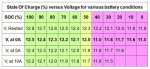
Can someone please give me the chart again. Sorry search seemed just too hard.
regards and thanks olewill

This is the relationship I use. I doubt if you'll easily find it online now. ... you will now because Google will find this thread

wp834ca5fb.png


Otherwise i take 12.7 ( rested for 24 hours) as effectively fully charged and 11.7 as effectively fully discharged. Conveniently 1 volt apart and therefore easy to interpolate if you assume a linear relationship between SOC and rested volts.
 
Last edited:
Can I add a related question? What might explain the fact that after fully charging my batteries the resten voltage for the start battery is 12.8 and for the service batteries 12.4? Happens both when charging through the alternator + Sterling booster and using the battery charger
 
Can I add a related question? What might explain the fact that after fully charging my batteries the resten voltage for the start battery is 12.8 and for the service batteries 12.4? Happens both when charging through the alternator + Sterling booster and using the battery charger


Duff cell on one or more of your service batteries or they are coming to the end of there life. Check each cell and if thats not it load test your service bank.

John
 
I find the whole voltage / percentage charge thing a can of worms, originally a thousand years ago I knew the sums but now I go by instinct on my boat and my guages - I'd take it a lot more seriously if a blue water sailor !

My NASA BM-1 battery monitor seems to feel the same way as me, and just gives a ' 13.5 volts going in from the solar panel = good knews - or less than 12 volts = watch out we may be screwed !

The ' capacity remaining ' display has never really worked and I think it requires quite some serious kit to sort out a true display - but the BM-1 ( and an old Smiths car ' Battery guage ' from a Ford Escort 1300E as faithful backup ) seem to give me enough clues for Solent and Channel holiday sailing.

Maybe I'm happy to please though as when we started we had no charger, had to take the battery to garages to be charged, and only knew state of charge when it all went dim...
 
Last edited:

That is pretty much my understanding used for many years ( I think I made a similar spreadsheet from data published in Nigel calder's books). We cruise less extensively these days but I always usedto set a lower rested voltage limit of 12.3 before we took serious action to replenish the charge. We had solar and wind back then and two alternators/smart regulators, now just smart regulator on a 150A alternator or with 110vac shorepower or if running the little Honda 2kw genset we have 12v up to 40A available.
 

I put that one up some years ago (or rather, NigelMercier kindly did for me, as I was struggling to post a spreadsheet extract!). Do note that the figure of 11.0 at 0A, 40% should in fact be 11.9 - obvious really if you look at the run of numbers, but my apologies for it nonetheless.

EDIT I suppose I ought to add the usual rider about it and anything like it being just a very rough guide.
 
Last edited:
I put that one up some years ago (or rather, NigelMercier kindly did for me, as I was struggling to post a spreadsheet extract!). Do note that the figure of 11.0 at 0A, 40% should in fact be 11.9 - obvious really if you look at the run of numbers, but my apologies for it nonetheless.

EDIT I suppose I ought to add the usual rider about it and anything like it being just a very rough guide.

I've been using this a a guide for years - never noticed the error- but it been a very valuable chart. Especially when my battery monitor system went haywire....I mostly use the 5a chart as that is approximately the draw of my fridge (4.5A ish)
 
What is the difference between zero amps current draw and "rested"? And why the drop in value if there is no current draw??
 
Thanks - it’s nice to know that others, too, find it a handy little table. I regret that I could not find the web source of the data I used when I looked for it again (as a scientist I’m normally punctilious about references!), but it was the only one I had found with SOC/V data for different current draws. One of the battery experts here said the figures were reasonable for ‘plain vanilla’ lead acid batteries, but of course emphasized its rough and ready nature. I too use the 5A row as a guide when the fridge is on.

I take the rested voltage to be that after a period of many hours with no load (or no charge, of course, either). The difference between 0A and rested reflects the fact that the potential takes time to recover after being subject to any load.

But I didn’t think it was as long as Vic’s 24 hours – though perhaps that’s ideal. Having said that, if you want accuracy, measurements of Specific Gravity are very much better anyway.

EDIT I’ve just done a search and I think I may have derived the table (I have not checked the numbers) from data in graphs here:

http://electronics.stackexchange.co...ulate-the-self-discharge-rate-of-a-lead-acid-

or its original source here:

http://www.scubaengineer.com/documents/lead_acid_battery_charging_graphs.pdf
 
Last edited:
The problem with the chart posted is there is no reference to the Ah capacity of the battery in question.

In the graphs in both articles posted used a proportion of the Ah capacity which has more sense i.e capacity(Ah) / 100 or some other discharge rate.

It also stated that "Resting" means when no current is entering or leaving the battery cell without and time specified so by there definition 0 Amps and "Resting" are the same by show quite different values on the posted chart
 
The problem with the chart posted is there is no reference to the Ah capacity of the battery in question.

In the graphs in both articles posted used a proportion of the Ah capacity which has more sense i.e capacity(Ah) / 100 or some other discharge rate.

It also stated that "Resting" means when no current is entering or leaving the battery cell without and time specified so by there definition 0 Amps and "Resting" are the same by show quite different values on the posted chart

Yes, you are right about the battery capacity and my table is for about 100Ah as one of the experts pointed out - I apologize for having forgotten to add that. As I said, I have not checked the two links in detail, so if they both refer to current in terms of % of battery capacity then it is likely that my table data came from elsewhere.
 
Last edited:
Yes, you are right about the battery capacity and my table is for about 100Ah as one of the experts pointed out - I apologize for having forgotten to add that. As I said, I have not checked the two links in detail, so if they both refer to % of battery capacity then it is likely that my table data came from elsewhere.

It would be nice if there was a chart that allowed for different Ah battery capacity and I have over 12 thind the capacity that this chart refers too and I was/am looking for a chart the SWMBO could use as she gets paranoid over battery voltage, which to a point is good think.
 
Top
