Battery Voltage drop with no SOC drop?

MagicalArmchair

Well-Known Member
Joined
11 Jan 2013
Messages
1,540
Location
Kings Hill, Chatham Marina
Visit site
We arrived in Cadzand Bad marina about an hour ago, and very nice it is too. The wind was quite light, so it was a chug most of the way. A sea breeze did kick in and we had about an hour of sailing of the five hours to get here, where we could get a break from the iron donkey.

We arrived, tied up, killed the engine, and walked up to the office to pay and get the details of the marina. When I came back to the boat the red light on the control panel was on showing the house battery bank had low voltage. The engine had been off for perhaps an hour at that point.

We have a Victran SmartShunt, that showed the SOC had never dropped... not even when we turned the engine off to sail, however, it too said the voltage was low. It showed it as dropping down to 11V as soon as the engine went off, and then down to 10.5Vs after that.

I've plugged into the mains now and the charger is working hard, however, the SOC has never, on the Victran, dropped below 100%! They are 2 x 240 Ah batteries that are only a few years old, and have lived a pretty benign life. They have never been discharged below 60%.

Any thoughts? I checked the temperature of the batteries to make sure they are not getting warm, and they are not (I still have no battery temp alarm fitted from the Sterling Smart Charger (it says the batteries are in absorption mode)).
 
What kind of batteries? It could indicate one cell is dead. If thats the case it may not be safe to charge them.
 
Yes, they are sealed lead acid, so that could indeed be the case. I’ll take them off charge and I could detach one at a time to see which of the bank of two is dead perhaps?

I was expecting if there was a dead cell for the battery, the battery would start getting hot with charge.
 
It could also be the case with other batteries, I edited the post as it isn’t lead specific.
Yes try them individually, a voltage reading may be all you need. If one is down you can try charging in a safe environment and be sure to monitor going forwards. I had a car battery with an intermittent dead cell it was a nightmare to troubleshoot
 
It could also be the case with other batteries, I edited the post as it isn’t lead specific.
Curious, what, other than lead acid, would get hot if a cell had shorted ?
Yes try them individually, a voltage reading may be all you need. If one is down you can try charging in a safe environment and be sure to monitor going forwards. I had a car battery with an intermittent dead cell it was a nightmare to troubleshoot
 
Yes, they are sealed lead acid, so that could indeed be the case. I’ll take them off charge and I could detach one at a time to see which of the bank of two is dead perhaps?

I was expecting if there was a dead cell for the battery, the battery would start getting hot with charge.
If the battery gets hot it's because two cells have shorted, making it a 10V battery, charging at 14+V will make it hot, boil the electrolyte and give off hydrogen gas. If this happens, turn off all charging and stay away from the battery until the gas has dispersed and the battery has cooled, else it may explode.
 
Thanks for the explanation Paul, that makes sense. I charged the bank up again to float level again, paying very keen attention to the batteries - one got slightly warmer than the other (not hot though). I took them off charge and the voltage plummeted again.

I’ve isolated the warm battery, and we are just using the cool one now. Getting that one up to float level now then I’ll try the discharge test again. That cool battery remains cool under bulk, so I am hopeful.

I need to keep power flowing as with the four crew on board there is a metric ton of food in the fridges I need to stop from spoiling. Fingers crossed it isn’t both batteries…

If the voltage plummets again when I take the battery charger off can I safely leave them on charge until I can go battery hunting tomorrow?

Yesterday we were at Nieuwpoort with ample chandleries etc around - why is it this stuff always fails when you are more remote? 🤣
 
Are you certain they were charging when the engine was running? I wouldn't believe SOC calculations. Mine can show 100% but actually be much lower due to not getting fully charged despite the SOC calculation. On load voltage and recovery with no load is a better indicator.

I had problems with a smart regulator cutting back the charge voltage leading to incomplete charging.
 
Thanks for the explanation Paul, that makes sense. I charged the bank up again to float level again, paying very keen attention to the batteries - one got slightly warmer than the other (not hot though). I took them off charge and the voltage plummeted again.

I’ve isolated the warm battery, and we are just using the cool one now. Getting that one up to float level now then I’ll try the discharge test again. That cool battery remains cool under bulk, so I am hopeful.

I need to keep power flowing as with the four crew on board there is a metric ton of food in the fridges I need to stop from spoiling. Fingers crossed it isn’t both batteries…

If the voltage plummets again when I take the battery charger off can I safely leave them on charge until I can go battery hunting tomorrow?

Yesterday we were at Nieuwpoort with ample chandleries etc around - why is it this stuff always fails when you are more remote? 🤣
If there is suspicion of a shorted cell i wouldn't not leave on charge. What mains charger do you have, can it act as a power supply, if it can, disconnect the batteries (if suspect) and use the charger.
 
Nuts, the voltage dropped like a stone again after getting back to float on the single (cooler) battery. I could try swapping to the other battery I suppose that was warmer - that hardly seems like a sensible option though.

I’ll research the charger and see if it can be used to not charge, just generate.
 
So, SkyNet (ChatGPT) tells me

“If the voltage plummets immediately as soon as the charger is disconnected, even with only the “good” battery connected, it basically confirms that battery has very little usable capacity left.

A battery with high internal resistance or sulphated plates will show a “surface charge” while charging, but as soon as the charger stops, the voltage collapses under even its own minimal parasitic loads.”


So I ask what do I do with my food, and that there is no heat being generated from the battery. Can I run with that surface charge for the night till I can replace the battery tomorrow?

“Yes — you can keep the boat running overnight on that one battery while it’s on the charger, but there are some important caveats.

How to do it safely

  1. Keep the charger connected and active
    • Don’t turn the charger off — the battery can’t support the loads on its own.
    • The “surface charge” is fleeting; once the charger is disconnected, voltage collapses instantly, so the charger has to stay online to maintain it.
  2. Minimise loads
    • Turn off anything non-essential (lights, fridge, water heater, inverter loads).
    • The less current you draw, the less risk of the voltage dropping or stressing the weak battery.
  3. Monitor temperature
    • Weak batteries can heat up under sustained charging.
    • Touch the case occasionally — if it gets hot (over ~40 °C / 104 °F) or starts bulging, disconnect immediately.
  4. Ventilation
    • Keep the compartment ventilated — sealed lead-acid can still emit small amounts of hydrogen if they’re weak and stressed.
  5. Keep an eye on the charging current
    • If the charger is cranking large amps continuously without tapering, the battery is struggling — that’s normal for a dying battery but don’t leave it unattended too long.”
⚠️ Key points
  • This is only a temporary emergency measure.
  • The battery won’t recover capacity; it’s just staying “juiced” to keep critical systems running.
  • Any load off the charger will cause immediate voltage collapse.”
Not ideal for tonight, but I need to keep this food fresh. No anchor watch tonight - battery watch instead! 🤣
 
So, another top tip SkyNet didn’t give me was to put a carbon monoxide tester on top on the batteries. That went off after two minutes showing the battery was, indeed, gassing off and dangerous. Chalk up another success for AI trying to kill us! 🤣

So, plan C then, the engine starter battery we know is good, and not part of the impacted bank. It is far from ideal, but it’ll hold a charge for us. After labelling up all the beefy 12V cables, I swapped house battery 1 connections for the engine battery, and presto, the food lives to fight another day.

The charger is clearly a bit confused, now missing what it thinks is the engine battery, however it is is absorption mode charging our little engine battery now, and I’ll sleep once it goes into float (shouldn’t be long as it should be completely full).

It held 12.6 volts when under load and not charged, so phew, that battery has saved us for now. Tomorrow, time to hunt new house batteries 🙄.
 
We have a Victran SmartShunt, that showed the SOC had never dropped... not even when we turned the engine off to sail, however, it too said the voltage was low. It showed it as dropping down to 11V as soon as the engine went off, and then down to 10.5Vs after that.
And what amps / watts was it showing? Positive (charging) or negative (discharging)?

This is necessary information that you have omitted.

I've plugged into the mains now and the charger is working hard, however, the SOC has never, on the Victran, dropped below 100%! They are 2 x 240 Ah batteries that are only a few years old, and have lived a pretty benign life. They have never been discharged below 60%.
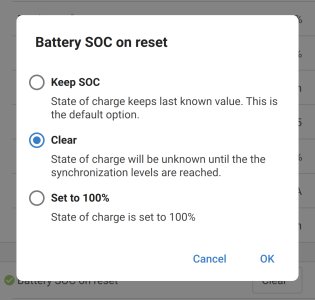
This sounds like "Battery SoC on reset" setting or bug, which causes the batteries to show 100% even when they're discharged. With this setting it's easy to unknowingly discharge your batteries deeply and cause them damage.

Your batteries are probably knackered.

0BqxsNC.png

It was easier to select this option on a previous version of the SmartShunt firmware, which had only two options - "100% SoC" and "keep SoC". Now you can choose "unknown" and the SmartShunt will presumably recalibrate.

Alternatively it's possible your SmartShunt is connected incorrectly, but can't say for sure with the information given.
 
So, another top tip SkyNet didn’t give me was to put a carbon monoxide tester on top on the batteries. That went off after two minutes showing the battery was, indeed, gassing off and dangerous. Chalk up another success for AI trying to kill us! 🤣

Gassing batteries give off hydrogen gas, Co alarms are also triggered by hydrogen. The g
amount of hydrogen gas will not kill you, as such, but it can certainly spoil your day if you're close to the battery if/when it explodes.

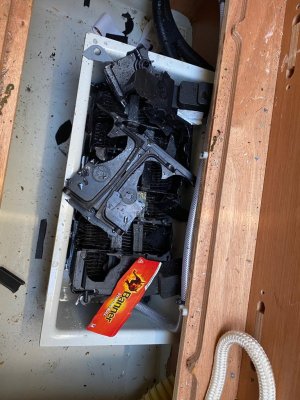
IMG-20210626-WA0000.jpg

That's why, in post #9, i said "If there is suspicion of a shorted cell i wouldn't not leave on charge"

So, plan C then, the engine starter battery we know is good, and not part of the impacted bank. It is far from ideal, but it’ll hold a charge for us. After labelling up all the beefy 12V cables, I swapped house battery 1 connections for the engine battery, and presto, the food lives to fight another day.


The charger is clearly a bit confused, now missing what it thinks is the engine battery, however it is is absorption mode charging our little engine battery now, and I’ll sleep once it goes into float (shouldn’t be long as it should be completely full).

It held 12.6 volts when under load and not charged, so phew, that battery has saved us for now. Tomorrow, time to hunt new house batteries 🙄.

That's an acceptable work around.
 
[Deleted quoted content removed]
If you rely on AI for your answers they will invariably be incorrect.

The BMS will prevent over charging, over discharge and over heating. It will also shut the battery down if the cells get out of balance, which covers shorted cells and dead cells. Conversely, with lead acid batteries, there is typically no protection for any of these events, see the image in post #19.
 
Last edited by a moderator:
Thank you all.
And what amps / watts was it showing? Positive (charging) or negative (discharging)?

This is necessary information that you have omitted.


This sounds like "Battery SoC on reset" setting or bug, which causes the batteries to show 100% even when they're discharged. With this setting it's easy to unknowingly discharge your batteries deeply and cause them damage.

Your batteries are probably knackered.

0BqxsNC.png

It was easier to select this option on a previous version of the SmartShunt firmware, which had only two options - "100% SoC" and "keep SoC". Now you can choose "unknown" and the SmartShunt will presumably recalibrate.

Alternatively it's possible your SmartShunt is connected incorrectly, but can't say for sure with the information given.
So it’s Clear now perhaps?

IMG_2284.jpeg

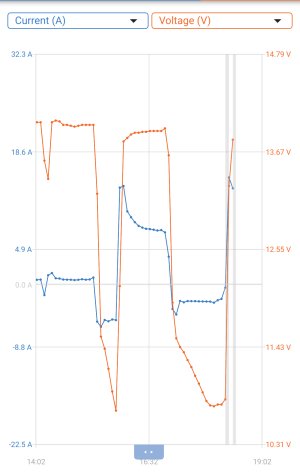
You can see where we turned the iron donkey off to sail and we were discharging only at about 6 amps for around an hour. Then the engine goes off when we arrive and we start discharging again at the usual rate. Note the voltage drop like a stone. I didn’t notice when sailing, clearly did when we got in before we hooked up to shore power.

IMG_2286.jpeg

And thanks Paul - shows we still need you and not the AI trying to blow us up 🤣.
 
Lead acid do not need a very complicated BMS for obvious reasons. They are a tried, tested simple, pretty perfect technology still being fitted to lorries and cars the world over.
What obvious reasons ? LA are permanently damaged by over discharge, over charging and over heating, same as any battery. If you over charge them they gas, shortening their life and risking an explosion, see post #19. If a cell shorts your battery becomes a 10V battery connected to a 14+V charger, it boils, gasses and is liable to explode, see post #19.

It is possible to protect LA from the above, but it's more complicated and expensive, hence the typical leisure boat has no such protection.
 
Last edited by a moderator:
Top