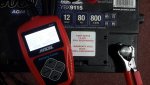
Battery Testers

GHA is entitled to his beliefs. I'm not expert enough to explain why they are superb or a waste of time.
What i can say is I've read enough Web sites and watched enough videos on various testers and battery related science, how they work and gone more far more technical than I can understand to conclude it's only a small minority that think they are a waste of time .
I've tested hundreds of batteries and mine has been spot on .
These testers will tell you the current state of life by ohms.

Seems unlikey, still more than happy to be wrong, but you need to link to some data for that really.. just saying "mine is spot on" means absolutely nothing without 20H controlled capacity tests to demonstrate the accuracy.

From a *very* quick google...
>>
Electrochemical Impedance Spectroscopy and Determination of the Internal Resistance as a Way to Estimate Lead-Acid Batteries Condition
"Attempts have been made to find the best procedure for the detection of premature battery capacity loss (the so called “PCL”) in AGM-VRLA 48 V batteries operating in telecommunication systems. However, recorded changes in internal resistance and potential did not give clear indications of the beginning of the PCL effect. The obtained correlation between internal resistance and potential derived from used batteries does not show the expected trend in measured parameters. It seems that the application of Electrochemical Impedance Spectroscopy (EIS), which is a faster and non-destructive method, may solve this problem. "

Electrochemical Impedance Spectroscopy (EIS) - PalmSens.
"
Electrochemical Impedance Spectroscopy (EIS) is an electrochemical techniques to measure the impedance of a system in dependence of the AC potentials frequency.
Electrochemical Impedance Spectroscopy (EIS) is one of the most complex techniques in electrochemical research. On this page the basics of EIS are explained, i.e. the excitation and the signal as well as the recorded values. The visualization and analysis of the EIS data is explained in the following chapters.
"

For 40 quid?? Seems unlikely... just saying it's good isn't any good - bring on the data!!!! :)
 
16180659563441728136298.jpg
This was just a very quick test rather than inputting all the battery details.
It's 2.49mohms. 100 % health as that's what you would expect for a new battery.
This figure increases with age and when it gets to around 6 or 7 milliohms you know it needs replacing.
 
View attachment 113251
This was just a very quick test rather than inputting all the battery details.
It's 2.49mohms. 100 % health as that's what you would expect for a new battery.
This figure increases with age and when it gets to around 6 or 7 milliohms you know it needs replacing.
So no data at all then, just 2 data points, one of which you guess is end the far of the scale of health - not exactly much accuracy there is there :)

Boat batteries actually have 3 states of health - "new", "seems OK so ignore it", and "oh bish, it's dead" :)
 
Do you have a general dislike to electronic battery testers or just cheap ones ? :D
There is a reason I ask this which I will get to .
 
Last edited:
Do you have a general dislike to electronic battery testers or just cheap ones ? :D
There is a reason I ask this which I will get to .
I would dearly love an accurate electronic ah capacity test that didn't cost an arm and and a leg. Been after some sort of easy way to get reliable figures for years. :) Just doesn't seem to be any evidence that such a thing exists. :( When batts go they tend to fall off a cliff, how do you know the increase in resistance is linear with loss of capacity? Other than conformation bias.. ;)
 
Yuasa use an electronic tester for battery warranty claims.
Yuasa state they will Only accept testing carried out by a specific yuasa or bosh electronic battery tester! These retail at just over £500.
Surely then if yuasa and fluke make these things they have to work?
 
Yuasa use an electronic tester for battery warranty claims.
Yuasa state they will Only accept testing carried out by a specific yuasa or bosh electronic battery tester! These retail at just over £500.
Surely then if yuasa and fluke make these things they have to work?
500 quid ain't cheap. 40 quid is.
Still no evidence that a 40 quid tester is in any way accurate to test aH capacity. Pity, would be pure gold dust for cruisers.
What are the yusua & fluke models?
 
The fluke models are around 2.5 to 4.4k so that would make £500 cheap !
A 3.99 multimeter can be as accurate as a £300 one
A £1.99 watch can be more accurate than a 10k one so why can't a £40 meter be as accurate as a £500 one?
I've searched the specific yuasa but you will have to look for the bosh if you really want to know.
Yuasa MDX617 Battery Tester & Analyser
There are cheaper yuasa ones and would assume equally good, just less features
 
Conductance technology can be used to detect defective cells, short circuits and normal ageing , so state Yuasa.
Can't therefore see any reason why a £40 or even a £5.99 tester could not give reasonably accurate results .
 
The fluke models are around 2.5 to 4.4k so that would make £500 cheap !
A 3.99 multimeter can be as accurate as a £300 one
A £1.99 watch can be more accurate than a 10k one so why can't a £40 meter be as accurate as a £500 one?
I've searched the specific yuasa but you will have to look for the bosh if you really want to know.
Yuasa MDX617 Battery Tester & Analyser
There are cheaper yuasa ones and would assume equally good, just less features

If a £40 tester is as accurate as a £500 one, why would anyone pay £500 ?
 
Conductance technology can be used to detect defective cells, short circuits and normal ageing , so state Yuasa.
Can't therefore see any reason why a £40 or even a £5.99 tester could not give reasonably accurate results .
If there was anything to show in the real world a 40 quid meter could give accurate aH readings over the lifespan of a lead acid then it would be like xmas every day..... .... nothing at all so far though, won't get the tinsel out just yet...

from the yasua manual, don 't get much for 500 quid, do you? So no use on a cruising boat where you want to know how long before it says replace. -
knmzqzP.png
 
Conductance technology can be used to detect defective cells, short circuits and normal ageing , so state Yuasa.
Can't therefore see any reason why a £40 or even a £5.99 tester could not give reasonably accurate results .

Defective cells and short circuits are easy to diagnose with a multimeter.

Normal ageing isn't entirely helpful. As boat owners we want to know two things regarding ageing:

1) Will the engine battery start the engine ? Not just start it on a warm day, but start it at sea after changing a filter, or bleed the engine after a service etc. That's easy to test, put a big load on it, like an Olde Worlde drop tester, or crank the engine for a few 30 second bursts with the stop pulled out (let the starter have a rest between bursts, to stop it getting hot).

2) Will the domestic bank hold enough charge for what we need them to do ? This needs a controlled discharge test with a known load to get any kind of reliable data. Various methods here, 20hr rate or others and various load options. But the end procedure is the same, apply a know load for a given time, note the changes in voltage or SG and calculate the capacity of the battery.

I've used testers that cost considerably more than £40 and none of them are any good for point 2. I know of marinas/boatyards that have testers and many, many times owners have asked me to look at their batteries, after the yard has tested them and pronounced them good, but then they go flat after a few hours use. Carry out a controlled test and they show up as useless.

A common mode of test failure gores like this, fully charge the batteries and allow to rest. Take a voltage reading and put them under a known load. Periodically note the voltage. For a while it drops very slowly, then suddenly it fall off of a cliff. I've seen batteries sit at what appears to be a fully charged voltage for days. put them under load and check hourly, the slowly drop as one would expect with the applied load. Next time you check, down to single figure volts, usually as low as 6-9v.

If you want to know how well your batteries hold a charge and their capacity, a controlled discharge test is the only way to go.
 
If a £40 tester is as accurate as a £500 one, why would anyone pay £500 ?
A £1.99 quartz watch can be more accurate than a 10k one. Why would anyone therefore pay 10k for a watch ?
A £10 drill from lidls drills holes just like a £300 makita does so why would anyone pay £300?
I could go on...
The £500 does a lot more including having a built in printer.
Your 40 v 500 is not really a valid argument.
 
If a £40 tester is as accurate as a £500 one, why would anyone pay £500 ?
Good question when a $60 gives exactly the same results as a branded $500+ One ?
There is also a very cheap v very expensive snap on and guess what the results are ?
Thank God for youtube to support my side of this debate ..
 
Wedge an 18mm spanner between the batt terminals - if it can melt the spanner in less than 3 seconds and still start your engine it's good to go.
Those with a more inquisitive mind can use a range of different size spanners and plot the results on a graph.
 
A £1.99 quartz watch can be more accurate than a 10k one. Why would anyone therefore pay 10k for a watch ?
A £10 drill from lidls drills holes just like a £300 makita does so why would anyone pay £300?
I could go on...
The £500 does a lot more including having a built in printer.
Your 40 v 500 is not really a valid argument.

I'm not arguing, i'm giving you some real World data, do with it as you choose.

I've been testing batteries in the real World for over 40 years, i'm not really interested in You Tube videos. I can make a You Tube video proclaiming any old rubbish, same as most of the other drivel on there. Just because it's on YouTube doesn't mean it's true.

FYI, A £10 Lidl drill doesn't even come close to a decent one. I have a £50 Screwfix one on the boat and yes, it drill holes and is just the job for the occasional use it gets, an expensive one would be a waste of money, but the one i use for work is an entirely different animal. Try cutting 60mm holes in GRP/Ply laminate up to 60mm thick with your Lidl drill!
 
I had been sharing the same, but since i dont posess the same expert knowldege as i know you have im using what Yuasa state who
probably know more about batteries than us lot put together and am pretty sure they wouldnt publish misleading information ?
I was just trying to show contrary to what some suggest, a small handheld device is what yuasa, fluke , snap on and many other believe in.
The video was to show, like many other things ,cheap chinese stuff can give just as accurate results as professional very expensive stuff.
:D The original question was are these testers any good? Hopefully there are now more than enough contributions gained from credible sources for the op to make an informed decision.

Incidently, lidls have just come out with a purple range of drills.. recharged via usb.perfect for the boat. £20 gets you a twin speed 300/1000 rpm and this little thing really has some power behind it.. im making a comparison compared to all the makita kit i have..
 
Last edited:
Good question when a $60 gives exactly the same results as a branded $500+ One ?
There is also a very cheap v very expensive snap on and guess what the results are ?
Thank God for youtube to support my side of this debate ..
Does that tell you anything useful other than it will most likely start an engine?
 
Does that tell you anything useful other than it will most likely start an engine?
Of course it does.. it tells me you dont have to spend a lot of money on some rather expensive items when a cheap item gives the same results ;)
 
Of course it does.. it tells me you dont have to spend a lot of money on some rather expensive items when a cheap item gives the same results ;)

But, for testing the batteries on your boat, very reliably, you need two things. the starter motor to test the engine battery and a headlamp bulb on a piece of wire to test the domestics.

Your tester won't tell you as much as a £5 headlamp bulb when it comes to testing your domestic batteries.
 
Top