Battery switch advice

Yealm

Well-Known Member
Joined
13 Apr 2017
Messages
5,351
Visit site
I’ve got a battery switch panel which is vertical with 3 separate on/off switches.

Whereas I think from looking at Google most modern boats have single rotary switch with 4 positions- off, on 1, on 2 and on both.
Could I ask advice as to how mine is likely to be wired, and which ones I should turn to achieve each of the 4 options ?

(currently I just turn all 3 switches on regardless of what I’m using electricity for. I’ve 3 batteries- 2 domestic and one engine, all lead acid).

Many thanks!

ps is it standard for charging via solar/engine to always be to all 3 batteries, irrespective of switch position?
 
Impossible to say, boats are not like a mass produced Volvo car with a handbook, they are usually one offs. Trace where all the wires go to from the switches. How thick are the wires, the copper, not the insulation? What happens or doesn't happen if you just put one on at a time?
 
Impossible to say, boats are not like a mass produced Volvo car with a handbook, they are usually one offs. Trace where all the wires go to from the switches. How thick are the wires, the copper, not the insulation? What happens or doesn't happen if you just put one on at a time?
 
Yes I understand that, but I assume the 3 switch config I have used to be common, and they’d be a common way to wire them. ie how did they achieve the 4 options with 3 on/off knobs.

It’s a general sense of how this configuration worked, rather than specific info about my boat, I’m seeking :)
 
I’ve got a battery switch panel which is vertical with 3 separate on/off switches.

Whereas I think from looking at Google most modern boats have single rotary switch with 4 positions- off, on 1, on 2 and on both.
Could I ask advice as to how mine is likely to be wired, and which ones I should turn to achieve each of the 4 options ?

(currently I just turn all 3 switches on regardless of what I’m using electricity for. I’ve 3 batteries- 2 domestic and one engine, all lead acid).

Many thanks!

ps is it standard for charging via solar/engine to always be to all 3 batteries, irrespective of switch position?
The three switches are the more modern approach.

One will be for the engine battery, one for the domestics and the other an emergency link. Turn them on and off one at a time to tell which is which. DO NOT routinely leave the emergency link switch on (usually the middle one), it's what it says on the tin, emergency use only (flat engine battery for instance)
 
Many on here advocate the separate switch setup ... each bank having its own switch and then the third as a 'bridging switch' in event one bank goes down ..

I would be inclined to have a meter and try just one switch ... start engine / switch on domestic gear ... see which comes on ... then switch off - try next switch - see what works ..... then try the third switch - likely all will work then !! as its emergency couple banks together ...

Dare say you will find a relay or VSR somewhere that cuts in to charge other bank when primary bank is charged etc.

The 1 - Both - 2 - Off switch is old gear and rarely fitted to later boats .... I like it - but I'm an old hand ! Its on my 25ft'r.

My 38ft'r has two separate switches .. one for engine start - other for domestics .... in the battery bay is a relay to get charge to both from engine ...

EDIT : Typing / posting as Paul posted !!
 
That’s fab thanks!

And do boats generally have charging going to all batteries regardless of whether the switch is on1, on2, on both or off?
 
That’s fab thanks!

And do boats generally have charging going to all batteries regardless of whether the switch is on1, on2, on both or off?
Traditionally no, more recently yes in some cases.

The 1-2-B switch is old hat, what you have is much better. Learn which switch does what and leave the emergency switch off unless you need it.
 
As said one switch for engine battery one switch for domestic battery and one switch to link the 2 batteries for emergency start. However as aid there may be a VSR or relay to connect engine to domestic battery when the engine is running (charging).
With engine off try the various switches one at a time to identify engine batt on and domestic batt on. (label them) So use a volt meter to check batteries with engine charging. Should be around 14v on engine batt. Check for 14v on domestic batteries. If you do get charge on domestic with that remaining switch off then youb have embedded a VSR or similar relay that is linking the batteries for charge when engine is charging. If you don't get charge (14v) on domestic battery then operate the last switch which should give you charge.
The operation then will be that link switch always off unless you need a jump start for engine battery. However if there is no charge to domestic battery then you must operate that link switch each time engine is charging to charge domestic battery then turn off when engine is stopped.
Do not start the engine with link switch operated. Yes it will give you an enthusiastic start but may hide the fact that one battery is not capable of starting alone. ie cream crakered. Start occasionally on domestic alone to confirm you have am alternative start battery. ol'will
 
Yealm .... do you have Solar or wind charger on board ?

Quite often the Solar is charging the domestic bank .... basically because you want charge to that bank as it is your cabin lights / nav gear etc ... and only charged by engine when VSR / Relay cuts in ...

So when checking with meter ... as Will_H suggests ... also look at the Solar controller ... many have a small display or LED's telling you what its doing.

Contrary to many today - I actually like my old 1-B-2-Off switch on my 25ft'r ... simple and I've never had problem with it ... I start on one batt ... switch to both to charge .... once engine stopped and I'm sailing - I switch to other battery .... that way I always have a full charged to start engine.

My 38ft'r with the later style - separate switches ... actually annoys me !! My Domestic bank is at end of life and nav gear keeps shutting down unless I start engine and get charge into the bank via the relay ... (I am going to change the batterys next few days) .... but my annoyance is that unlike the 1-B-2-Off switch - I cannot power the nav gear with engine start battery ...
I'm seriously thinking to copy what previous owner had .... a spare battery under the nav seat ! Why ? Because the fridge runs of the Domestic bank and I would like to have that working !!
 
The three switches are the more modern approach.

One will be for the engine battery, one for the domestics and the other an emergency link. Turn them on and off one at a time to tell which is which. DO NOT routinely leave the emergency link switch on (usually the middle one), it's what it says on the tin, emergency use only (flat engine battery for instance)
I do agree with Paul that this is likely, but it’s not the only way three switches have been used. Some French boats had two for positive and one for negative or something like that and so worked a little differently. You’ll need to work out which you have. If Paul’s explanation fits, the middle switch will just connect to the outer switches so easy to spot.
 
I’ve got a battery switch panel which is vertical with 3 separate on/off switches.

Whereas I think from looking at Google most modern boats have single rotary switch with 4 positions- off, on 1, on 2 and on both.
Could I ask advice as to how mine is likely to be wired, and which ones I should turn to achieve each of the 4 options ?

(currently I just turn all 3 switches on regardless of what I’m using electricity for. I’ve 3 batteries- 2 domestic and one engine, all lead acid).

Many thanks!

ps is it standard for charging via solar/engine to always be to all 3 batteries, irrespective of switch position?
What boat do you have ?
 
Yealm .... do you have Solar or wind charger on board ?

Quite often the Solar is charging the domestic bank .... basically because you want charge to that bank as it is your cabin lights / nav gear etc ... and only charged by engine when VSR / Relay cuts in ...

So when checking with meter ... as Will_H suggests ... also look at the Solar controller ... many have a small display or LED's telling you what its doing.

Contrary to many today - I actually like my old 1-B-2-Off switch on my 25ft'r ... simple and I've never had problem with it ... I start on one batt ... switch to both to charge .... once engine stopped and I'm sailing - I switch to other battery .... that way I always have a full charged to start engine.
Until something goes wrong when you are motoring and the batteries, all in parallel, get discharged. You stop the engine and everything goes off, no nav gear, no VHF, no nothing.
My 38ft'r with the later style - separate switches ... actually annoys me !! My Domestic bank is at end of life and nav gear keeps shutting down unless I start engine and get charge into the bank via the relay ... (I am going to change the batterys next few days) .... but my annoyance is that unlike the 1-B-2-Off switch - I cannot power the nav gear with engine start battery ...
I'm seriously thinking to copy what previous owner had .... a spare battery under the nav seat ! Why ? Because the fridge runs of the Domestic bank and I would like to have that working !!
This is because your system is poorly designed. There should be an emergency parallel switch. You then have all the benefits of a 1-2-B switch and separate switches, with non of the pitfalls.
 
What boat do you have ?
Contessa. Engine wouldn’t start so had to have all batteries replaced (shot after 7 years). Got me thinking whether I’ve been using the switches correctly (everything’s been fine up to now).

Ideally I’d like solar and engine charging to all batteries in the background, regardless of switch position - sounds like that may or may not be the case…
 
Last edited:
Contessa. Engine wouldn’t start so had to have all batteries replaced (shot after 7 years). Got me thinking whether I’ve been using the switches correctly (everything’s been fine up to now).
The Contessa would have been originally fitted with a 1-2-B switch, yours has been upgraded to the better, more modern system. Shame they didn't label the switches. Just identify the switches as in post #5.

Will raises a good point in post #9 regarding charging, which i'd overlooked in post #5. So double check both batteries get charged when the emergency switch is off.

By the way, 7 years from a set of lead acid batteries isn't bad at all.
 
Until something goes wrong when you are motoring and the batteries, all in parallel, get discharged. You stop the engine and everything goes off, no nav gear, no VHF, no nothing.
[/QUOTE]

As you know I have a number of boats and those with multiple batterys have all had one battery go down before other ... that has never compromised the abilty to start engine ... even the 170HP VP in the mobo. The scenario you picture is extremely rare and to kill both batterys would have to be a really serious event.
This is because your system is poorly designed. There should be an emergency parallel switch. You then have all the benefits of a 1-2-B switch and separate switches, with non of the pitfalls.

Agreed - but was never installed by me ... boat was bought with it already installed.
Its annoying - but TBH - I considered having an emergency bridging switch - but thern decided that it was better to have the engine start battery not capable of running the domestics ... to know I can start engine ... which in turn would 'light up' domestics once running anyway ...
 
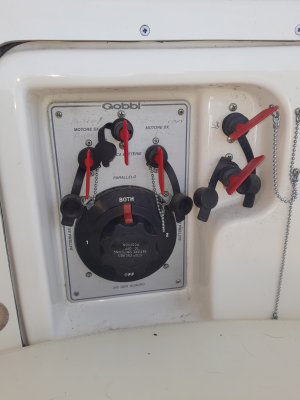
To bring more confusion , i have both type of switches and do not fully understand my setup .

the 1,2 ,both , off rotary switch is self explanatory , the both switches on the right of the picture switches off the EDC , but for what do i have separate switches above it ??? . i do not know beyond the middle top one - it switches the bow thruster . Newer saw such a setup before . Has anybody an idea ?
20250615_193116.jpg
 
To bring more confusion , i have both type of switches and do not fully understand my setup .

the 1,2 ,both , off rotary switch is self explanatory , the both switches on the right of the picture switches off the EDC , but for what do i have separate switches above it ??? . i do not know beyond the middle top one - it switches the bow thruster . Newer saw such a setup before . Has anybody an idea ?
View attachment 195246
The 1-2-B switches is for port battery, starboard battery or both batteries. Te 3 at the top are for port engine, bow thruster and starboard engine.
 
The 1-2-B switches is for port battery, starboard battery or both batteries. Te 3 at the top are for port engine, bow thruster and starboard engine.

Ok , but whatkind of engine electrics does the "engine" switch actually control ? Like said previously there are even separate EDC switches for both engines ...
 
I would undo the screws and see where the cables are connected ....

Looking at the labelling ... the 1-B-2-Off switch has SX and DX labels - as do the switches above it ... giving impression that the extra switches are providing power to something else of high demand.
The switches to the right .. have hand marked SX .. DX ... as well ... so again something extra of high power deemand added ??

Looks like a bit of switch off all .. operate each swoitch in turn - see what they do ... likely that just the rotary switch gives general running on its own ..
 
Top