Battery Replacement

xcw

Well-Known Member
Joined
14 Jun 2002
Messages
594
Visit site
My Bavaria is now 12 years old and still on the original batteries. I have always kept them on charge via shore power and they have never let me down.
Question: is there a simple way of checking their performance or should I think about changing them (particularly the starter battery)? - I don't want to be caught out and the starter battery lets me down.

Thanks
 
My Bavaria is now 12 years old and still on the original batteries. I have always kept them on charge via shore power and they have never let me down.
Question: is there a simple way of checking their performance or should I think about changing them (particularly the starter battery)? - I don't want to be caught out and the starter battery lets me down.

Thanks

Fully charge it then disconnect it. After 30 minutes or so, take a voltage reading, which will tell you if you have any cells down. Then you need to do a discharge test, perhaps driving a car headlamp bulb which at 60W is around five Amps. Divide the time it lasts into the original Ah rating to get your approximate answer. Measure the discharge current if you are not sure what the load is.
 
Fully charge it then disconnect it. After 30 minutes or so, take a voltage reading, which will tell you if you have any cells down. Then you need to do a discharge test, perhaps driving a car headlamp bulb which at 60W is around five Amps. Divide the time it lasts into the original Ah rating to get your approximate answer. Measure the discharge current if you are not sure what the load is.
The problem with this method is you'll discharge the battery below 50% which is not good for a standard LA.

Use a toaster style battery tester to measure CCA (cold cranking amps) and a multimeter to check battery volts when the battery has not been connected to anything for several hours (30 mins not really long enough).

battery.png
 
My Bavaria is now 12 years old and still on the original batteries. I have always kept them on charge via shore power and they have never let me down.
Question: is there a simple way of checking their performance or should I think about changing them (particularly the starter battery)? - I don't want to be caught out and the starter battery lets me down.

Thanks
I'd a similar dilemma a few months back with my batteries of that age. Ostensibly all seemed well, but, "Was I still going to be confident in September with them?". They were 70aH Halfords leisure batteries, they owed me nothing, I didn't want to be caught out either, so I bought a couple of 90aH Tayna batteries as replacements, (which were very cheap IIRC, but can't find the exact price), a little bit over £100 which is cheap for peace of mind I reckon.
 
My Bavaria is now 12 years old and still on the original batteries. I have always kept them on charge via shore power and they have never let me down.
Question: is there a simple way of checking their performance or should I think about changing them (particularly the starter battery)? - I don't want to be caught out and the starter battery lets me down.

Thanks
Expect the batteries are Exide HK950 AGMs. (they were in my 2015 Bavaria). They are stop start batteries usually used on Range Rover and Jaguar V6 diesels so are very lightly stressed for starting a little Volvo a couple of hundred times a year. A drop test on the start battery would be sensible. I had that done on my bow thruster battery (not in the Bavaria) and showed a big drop in CCA so I changed it. Leisure boat duty cycles for start batteries are not too different from cars like my Morgan - long periods of doing nothing, but left on a trickle charge following by short periods of intense activity. The original AGM lasted 19 years.

Service batteries are different and measured by discharge cycles. Typically AGMs like the Exides would give somewhere between 6-800 cycles down to 50%. As a rule of thumb if you use your boat 60 days a year you might expect 10 years+ If you have a battery monitor you should have a good idea of how much you are taking out of your service bank (3*95Ah?) on a daily basis. On my Bavaria I rarely went below 60%SOC because I only sailed in the daytime and being on my own my overnight consumption at anchor was low. I sold the boat at 6 years and the batteries were fine. However 12 years is a good life so depending on your estimate of how much you have used in previous years replacement might be worth considering.
 
Fully charge it then disconnect it. After 30 minutes or so, take a voltage reading, which will tell you if you have any cells down. Then you need to do a discharge test, perhaps driving a car headlamp bulb which at 60W is around five Amps. Divide the time it lasts into the original Ah rating to get your approximate answer. Measure the discharge current if you are not sure what the load is.
I must be missing something here.

So if it's a 100Ah battery and it takes 10 hours to go flat, 100/10 =10. 10 what ?
 
For domestic batteries a real World type test is the best, albeit a little time consuming.

1 Fully charge the battery, leave for 30 mins and note the voltage, using a multimeter.
2 Connect a known load to the battery, the headlamp bulb in post 2 is a good solution, but it would be quicker to use two.
3 After one hour disconnect the bulb, leave for 15 mins and note the voltage again.
4 Reconnect the bulb and leave for an hour, disconnect, leave for 15 mins, note voltage.

Repeat step 4 until the rested voltage is 12V (50% ish). Multiply the hours on load by the load Amps. So say it took 5 hours with a 10A load, that means your battery has a usable 50Ah.

Each battery needs doing separately, but if you're onboard it isn't that tedious, just set an alarm for the hour so you don't forget.
 
A battery monitor which lets you look at charge and discharge history is useful. And a Smart charger should charge the batteries, float and then leave them until the voltage drops to trigger more charging. For me that is weeks when parked in the marina with the batteries sat at 12.8V (and no load).

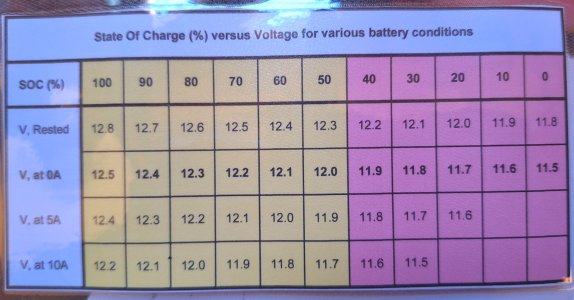
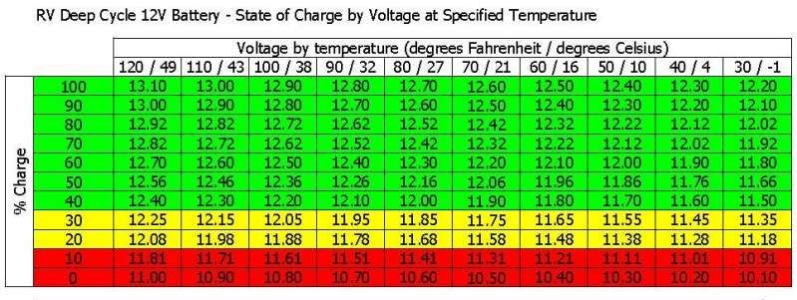
Under load (5-10 amps) will see the voltage drop to around 12.2-12.4 after 30 mins+. This will be slightly lower at lower states of charge. I use this chart on board to guide my understanding of whats going on.
20240330_072653.jpg
My starter battery failed 5 years ago and did it suddenly (after nearly 20 years).

No problem starting off the house bank. I have only knowingly dropped below 80% once or twice in 7 years on normal SLA leisure batteries (360 Ah).
 
I must be missing something here.

So if it's a 100Ah battery and it takes 10 hours to go flat, 100/10 =10. 10 what ?

Seems he forgot to reverse it !! Amps x time to see what battery gave !!

But anyway a paltry 5A is no test of the battery as others saying CCA shows ... bad batterys can often supply 5A all day long ... but turn the start key and demand CCA and another side of the bad battery becomes evident !!
 
Seems he forgot to reverse it !! Amps x time to see what battery gave !!

But anyway a paltry 5A is no test of the battery as others saying CCA shows ... bad batterys can often supply 5A all day long ... but turn the start key and demand CCA and another side of the bad battery becomes evident !!
True, but a domestic bank should never have to provide anywhere near the cranking current. OTOH, starting a cold engine from them will certainly show if they're knackered.

Turning on the fridge would provide a fairly realistic drain, then see how quickly the battery drops from a resting 12.7V - fully charged - to 12V - about 50%. If it drops fast enough to make the OP think he would struggle to last as long as he expects at anchor, then it's time for a change
 
Seems he forgot to reverse it !! Amps x time to see what battery gave !!

But anyway a paltry 5A is no test of the battery as others saying CCA shows ... bad batterys can often supply 5A all day long ... but turn the start key and demand CCA and another side of the bad battery becomes evident !!
My suggestion for testing was for the domestic batteries, not the engine battery.
 
True, but a domestic bank should never have to provide anywhere near the cranking current. OTOH, starting a cold engine from them will certainly show if they're knackered.

Turning on the fridge would provide a fairly realistic drain, then see how quickly the battery drops from a resting 12.7V - fully charged - to 12V - about 50%. If it drops fast enough to make the OP think he would struggle to last as long as he expects at anchor, then it's time for a change
The fridge isn't a good test, it draws above 3-4A, but how long is it actually running for ? 30%-50% of the time is typical, so you don't actually know the usable capacity.
 
Top