
Battery question

CJ1

Active Member
Joined
23 Dec 2018
Messages
65
Visit site
I’ve removed my batteries for the winter, intending to charge them.
The first ordinary car battery which is the dedicated starter battery charged no problem after about 13 hours.
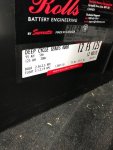
But the much larger domestic battery (there are two) was still charging after 48 hours. Could anyone interpret the attached photo of the label on the battery ? Other than its 12 volts I don’t know what it means.
Throughout the summer the on board battery monitor consistently showed the domestic batteries to be anywhere from 80-100 % capacity.
Any idea how to tell if they need replacing ?
Advice appreciated. BE7949D3-8E09-444C-A5C4-1B52B92AC6A2.jpeg
 
Thank you for your reply.

So (to see if I understand this) the capacity measured in amp-hours increases the lower the load in amps ?

Given that the battery charger I have says “maximum battery capacity 120 Ah” does it mean my battery charger is inadequate for this battery ?

How can I tell if the battery is still OK ?
 
Yes, the higher the current drawn, the lower the usable capacity.

120AH charger should be ok, just take a bit longer. It really needs a three stage charge, bulk, absorption and float stages.

If you have a multimeter, let the battery rest off charge for at least 1/2 hr and measure the voltage. Above 12.6v it is fully charged, 11.9v it is discharged, and pro rata.
 
Just to add to the above.

If you ran a lamp with a bulb 25 watts stamped on it , and you left it on for an hour,
you would suck 2 of your battery amps per hour.

12v/25w = 2 amps approx.

Bear in mind that you can only use about half of the total amps stated on the battery.
i.e. If the battery is labelled at 100ah you can only use 50ah.
 
Thank you for your reply.

So (to see if I understand this) the capacity measured in amp-hours increases the lower the load in amps ?

Given that the battery charger I have says “maximum battery capacity 120 Ah” does it mean my battery charger is inadequate for this battery ?

How can I tell if the battery is still OK ?


What is relevant is the maximum current output. Even the little 3.8amp chargers from Aldi and Lidl are claimed to be suitable for batteries up to 120 Ah ,,,, but they will take far too long to charge a 120 Ah battery from any significant depth of discharge.
Realistically a charger with a max output to 10 or 12 amps will be capable of recharging such a battery in a reasonable time. There would be no point in going much higher , above say 15 amps , because the battery will not accept a much higher current .

I would recharge the battery with a good automatic battery charger with an adequate output until I could get a voltage reading after resting for 12 hours ( 1/2 hour suggested above is too short) of around 12.6 to 12.7 volts
Then monitor the volts, without any load or further charging over several days , preferably a couple of weeks or more. A good battery should take several weeks to fall below about 12 .5.

If you cannot get above 12 .6 to begin with it is not too good. If it falls to quickly it is not holding its charge.

A professional load test would be the next advisable thing to do on the starter battery if it "passes" the above tests
 
Just to throw a spanner in the works..... they are only for your domestic supply so no need to get too technical with absolute voltages, amps etc. As you said they kept you going all last year, I assume without issues. Nice to change them in an ideal world but bearing in mind the cost, hassle, environmental impact etc. is it really necessary? My second hand deep cycle has been keeping the chart plotter running happily with anything down to the low 11's. I'm still sailing and the last time I looked it was 11.3volts. Seem to remember it cuts out around 8 volts!! ......... below 10volts they tumble away quickly.
 
Just to throw a spanner in the works..... they are only for your domestic supply so no need to get too technical with absolute voltages, amps etc. As you said they kept you going all last year, I assume without issues. Nice to change them in an ideal world but bearing in mind the cost, hassle, environmental impact etc. is it really necessary? My second hand deep cycle has been keeping the chart plotter running happily with anything down to the low 11's. I'm still sailing and the last time I looked it was 11.3volts. Seem to remember it cuts out around 8 volts!! ......... below 10volts they tumble away quickly.

Good way to destroy batteries.
 
Errrrr they were second hand and being thrown away anyway because someone was being too fussy so don't really understand your point!!
 
The label at first appears confusing ... but the Version number to right clears up most of it.

The ref to 90 and 125 A/Hr is a generic label .. the battery is in fact a 125 A/hr ...

The voltages are the charged and 'float' levels per cell .... (multiply by 6 to get total battery voltage ...)

The SG is the fully charged density of the acid solution. Acidity and density increases with charge amount. Many people used to use a Hydrometer (some call it a Densitometer - which actually is the electronic version - I own Petrochem Labs) to check each cell charge.

During use you saw 80 - 100% .... I would like to see 90 - 100 but for me I think its ok.

Charging now ? I would keep charging and just note what amp rate is going in ... as battery gets nearer to full - it should drop of to very low - if it doesn't - then suspect a fault.
One bit of info you do not give us - what charger are you using and what is its setting ?

A low rate charger is going to take a long time to charge such battery ....
 
The label at first appears confusing ... but the Version number to right clears up most of it.

The ref to 90 and 125 A/Hr is a generic label .. the battery is in fact a 125 A/hr ...

The label is neither generic or confusing.

It's 90ah at the 5hr rate and 125ah at the 20hr rate.
 
Errrrr they were second hand and being thrown away anyway because someone was being too fussy so don't really understand your point!!

Low 11 volts is a flat battery, 11.5 ish volts is 90% discharged. Short of smashing the battery up with a hammer, there aren't too many ways to kill a battery quicker, no matter what it cost. You really don't want to discharge it below about 12.1-12.2, at the lowest.

The OPs Rolls batteries cost about £400 for the pair, so he might not want to take your advice. If these batteries were subjected to a 40% depth of discharge they would survive around 1600 cycles, with a 90% DoD, they would last around 600 cycles, so i guess that's my point.

Those Rolls batteries are very good batteries, lesser batteries will suffer even more with high levels of discharge, some cheap starter batteries, for instance, might be dead in as few as 3 of your 11 volt cycles.
 
Last edited:
Sorry, but it doesn't. It shows It's 90ah at the 5hr rate and 125ah at the 20hr rate.

At lower rates of discharge, it will have higher ah ratings.

Lets stop this right now .... you know full well that the reason for a lower figure at the higher rate is down to chemistry. The higher the rate - the less you will get out due to constraints on the chemical processes. It does not change the fact the battery is at MAX CAPACITY a 125 A/Hr ..... clearly stated in its model ID : 12 FS 125

With your statement ... the implication is that at 40 hrs it would be ~200 A/Hr ....

Good bye.
 
Lets stop this right now .... you know full well that the reason for a lower figure at the higher rate is down to chemistry. The higher the rate - the less you will get out due to constraints on the chemical processes. It does not change the fact the battery is at MAX CAPACITY a 125 A/Hr .....

Good bye.

The battery does not have a max ah rating of 125ah, it has a 125ah rating at the 20hr discharge rate. If you discharge it slower, the ah rate is greater.

For instance, if you discharge at a 50hr rate, the capacity, in ah, increases to 149ah

Now might be a good time stop digging. ;)
 
Top