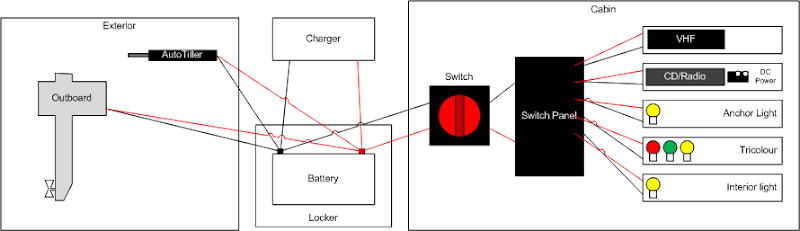
Battery isolation

lustyd

Well-Known Member
Joined
27 Jul 2010
Messages
14,309
Visit site
Hi all, I need to add a way to isolate my battery completely. Unfortunately for various reasons, there are some items which bypass the isolator that a previous owner fitted which is in the main cabin. Ideally I'd like to have a cable from one battery post go to an isolator switch and then have something identical to the battery post to connect the existing wires. I doubt this exists so what are my options? There's a diagram below to show what is there. Please don't suggest wiring everything through the switch panel - I'm not going to do that. I also don't feel the need for another whole switch panel and bus bar in the locker :)

wiring.png
 
Can you take the cables from the outboard and tiller pilot to the other side of the switch?

Unfortunately not. I'm going to need another switch one way or another, the problem is connecting the existing wiring to that switch since there will be 4 wires. I guess I could just put a bolt through them and have a crimped eye going to the switch which would effectively be the same as the battery post?
 
I believe that you can get an isolator that sits on your battery post and creates another one (that is part of the switch).
Obviously you reattach everything to the battery post after the isolator.
I'll try and find one and post it.
 
Now I feel like a muppet, having googled battery isolator switch to get a better picture it looks like the normal boat switches have bolt connections anyway. Thanks for your input everyone, sorry I didn't do my research first!
 
As Vyv suggests

or if you do not want to run the wires to the existing switch

Obtain a suitable battery isolating switch . (Presumably your engine is not electric stating so a real battery isolator that would withstand starter loads is not necessary)

disconnect the four wires from battery + and connect the switch in their place.
connect the wires feeding the panel and the autopilot to the other side of the switch ( put a fuse in the autopilot connection, if not both)

Reconnect the charger and the engine to the battery or the battery side of the new switch. Fuse them both.

The charger can then be used with the switch off.

The engine cannot be accidentally disconnected while running

The autopilot (or anything else) cannot be used directly from the engine ( I blew my autopilot doing that)


Id prefer to shift the autopilot connection to the switch on the main panel.
 
Well the instructions for my VHF make quite a meal of saying it should be a direct connection, maybe a coding requirement?
It is not essential, although coding does require a separate direct supply. There are many ways of doing this varying from an "always on" connection such as you might use for an aoutomatic bilge pump, to entirely separate battery to sophisticated systems such as I had on my boat with an automatic changeover to a separate battery if the main one failed. This sort of thing also requires a means of charging the emergency battery. All OTT for most installations - I now have all my navigation through a switched fused supply from the main switch panel.
 
Well the instructions for my VHF make quite a meal of saying it should be a direct connection, maybe a coding requirement?

Or simply that they don't trust the average electro-muppet's spaghetti panel to supply the relatively high current needed for transmitting, and they get fewer support requests by telling people to bypass it.

Pete
 
Well the instructions for my VHF make quite a meal of saying it should be a direct connection, maybe a coding requirement?

Something to do with it being the last thing to stop working when the cabin fills with water I suspect.
Or maybe in the event of an electrical fire on might want to throw the isolator but have the VHF working?
A VHF on transmit is going to be drawing something around 8 amps at a guess.
So cabling of byzantine complexity is a bad idea, but a decent distribution system should pose no problems.
A few racing boats I have been on have a sealed 12V battery of 4Ah or so as an emergency VHF supply. I don't know if this used to be a requirement for JOG or similar?
It seems a good idea, but these days we have EPIRBS and handhelds VHF's that are much better than of old.

I think the main thing is to understand the system you have.
 
It is not essential, although coding does require a separate direct supply.

I'm not aware of this requirement. Below is an extract from the SCV Code.
Is there an update or MGN that I'm not aware of?

16. Radio Equipment
16.1 General Requirements
16.1.1 Radio equipment carried by a vessel shall be capable of fulfilling the following functional
requirements with respect to distress and safety communications when the vessel is at sea:-
77
ONLY TO BE USED IN CONJUNCTION WITH MGN 280
.1 Provide for the safety of the vessel by:-
i) transmitting ship-to-shore distress alerting;
ii) transmitting ship-to-ship distress alerting;
iii) transmitting and receiving on-scene communications, including appropriate search
and rescue co-ordinating communications; and
iv) transmitting locating signals.
2. Assist other vessels in distress by:-
i) receiving shore-to-ship distress alerting; and
ii) receiving ship-to-ship distress alerting.
3. Receive navigational and meteorological warnings and urgent safety information
(Maritime Safety Information).
16.1.2 The Global Maritime Distress and Safety System (GMDSS) was implemented on 1 February
1999. The implementation of the GMDSS has involved the adoption of Digital Selective
Calling (DSC) for distress alerting in maritime radio frequency bands, e.g. VHF.
Whilst the UK Coastguard will continue coverage of VHF channel 16 for the foreseeable
future, the Coastguard watch on channel 16 is now a dedicated headset watch or a
loudspeaker watch. Ships are currently obliged to keep a listening watch on channel 16 only
where practicable.
For vessels where a fixed VHF is required, it is strongly recommended that vessels are
equipped with VHF DSC with its significant benefits in distress situations.
Other than vessels operating in Category 6, all new vessels and all those replacing VHF
radios, must have installed VHF DSC by February 2005. Where GMDSS equipment is
installed, it should be provided with automatic position updating information from the
onboard navigational receiver, or procedures put in place to ensure positional information is
manually updated at intervals not exceeding 4 hours.
16.2 Radio Installation
16.2.1 Table 16.1 lists the minimum and recommended radio equipment for the Code area of
operation categories, which fulfil the functional requirements specified in Section 16.1.
16.2.2 VHF transmission and reception ranges are reliable only within the line of sight ranges (see
the MCA’s Marine Guidance Note MGN 22 - Proper use of VHF channels at sea).
16.2.3 Aerials should be mounted as high as is practicable to maximise performance. When the
main aerial is fitted to a mast, which is equipped to carry sails, an emergency aerial should
be provided.
16.2.4 Skippers, owners and managing agents should be aware of VHF coverage in the intended
area of operation. Where the certainty of good VHF coverage in the UK coastal area is in
doubt, skippers owners and managing agents should seek advice from the MCA on whether
Medium Frequency (MF) or other equipment with long range transmission capability should
be carried (i.e. Inmarsat Ship Earth Station, EPIRB etc).
78
ONLY TO BE USED IN CONJUNCTION WITH MGN 280
16.2.5 When batteries are used for the electrical supply to radio equipment, the batteries, when
fully charged, should provide sufficient hours of operation to ensure effective use of the
GMDSS installation bearing in mind the distance from shore that the vessel can operate.
Appropriate charging facilities or a duplicate battery of capacity sufficient for the voyage
shall be provided.
The battery electrical supply (reference should be made to Section 8) to the radio equipment
should be protected against flooding/swamping as far as practicable and arranged so that
radio communications are not interrupted in adverse conditions.
16.2.6 A fixed radio installation should be clearly marked with the vessel’s call sign, any other
codes applicable to the use of the radio, and MMSI number where applicable. Acard or cards
giving a clear summary of the radio distress, urgency and safety procedures should be
displayed in full view of the radio operating position(s).10 Brief and clear operating
instructions should also be provided for the hand-held VHF (which is part of the vessels Life
Saving Appliances) as required by Table 16.1.
10
 
Top