
Battery drop tester..

Yuasa Batteries Web site -

Discharge Testers
  1. Apply a current-load equal to half the SAE CCA cold cranking Amps for 15 seconds. For example, discharge a 600A battery at 300A. Observe the voltage during this time and record the voltage after 15 seconds. You will find the CCA in the Battery Specifications section of the Catalogue or on the label. Use an approved, calibrated tester.
  2. If the voltage after 15 seconds is stable and above 9.60V, the battery is in a satisfactory condition with no faults.
  3. If the voltage is below 9.60V after 15 seconds and it is unstable, normally falling quickly, the battery should be replaced.
‘Drop Testers’
  1. ‘Drop testers’ have 2 spikes that are pressed into the tops of the battery terminals and a simple voltmeter to check the discharge voltage.
  2. We do not recommend the use of these testers as:
  • They are potentially unsafe to use as most types produce a spark when the spikes are first pressed into the terminals.
  • The discharge rate is similar for all sizes of battery, and so they do not give a good indication of battery-condition.
  • They give misleading results on discharged batteries.
Electronic Testers Using ConductanceTechnology
  1. The latest generation of testers is digital. Examples are Midtronics and Bosch testers. These will give an immediate decision on about 80 per cent of batteries in service, including flat ones. In the remaining 20 per cent of cases, the batteries need recharging before testing.
  2. These testers show whether the battery is in a good, charged condition, whether it is discharged or whether it needs replacing.
  3. Note. This is the preferred method of checking batteries as it does not take any charge out of the battery. It is also easier, quicker and safer.
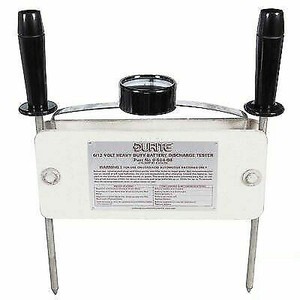
 
Yes, it will do the job, it looks to be just the modern version of the device with two battery prods connected together with a low resistance high current bar and a voltmeter, held with wooden handles.
s-l300.jpg
That appears to be a copy of the type which we used at our garage in the 1960's when we were testing batteries. Reliable and accurate.
But be careful when you use one. I had a truck with starting problems and I called an Auto-Electrician to find the fault.
With trucks batteries are mounted underneath the truck floor.
I had fully charged the batteries (2) when the Auto-Electrician turned up he got one of these Discharge Testers out and was going to use it.
I warned him. "They are fully charged" He gave me the sort of distainful look he reserved for ignorant farmers who know nothing.
When he pushed the spikes on the top of the battery, the fumes from being charged exploded the battery, covering him and his overauls in battery acid.
So if you get one be careful you only use it in a well ventilated place.
 
Many thanks @MikeCC and @LadyInBed The C rating doesn't appear to be widely published, at least for my Numax batteries. Using a single 55w bulb is closer to C20 than using two, albeit plotting the data from the link, there shouldn't be a huge difference in capacity.


Think on it .... a Deep Cycle battery is not designed for high discharge rates ... therefore it is not so unreasonable for manufacturer to expect you to be using it on low discharge rate setups. Even running a moderate sized bilge pump when battery is already on demand 'could' max out some batteries ...

My personal view ... is that discharge check should be at rate expected on board as average and see how long it goes ..... there are various meters that can help in this ... one that is from my 'other hobby' .... the Wattmeter. We use these to test motor draw .. Watts / Volts / Amps .....
My Wattmeter can display up to 100A ..... up to 6S voltage (LiPo terms thats 25,2V) ... time on ..... and if you have possibility to have connections to each cell - the individual cell voltage during check ...

HbmGf7Pm.jpg


No doubt someone will come on and say ... poo poo - no way ... but they would be wrong.

It does not 'load' the battery to discharge it ... it sits in series displaying the numbers of your setup ... setup with sensible parameters - you can gain literally all the info you need. BUT you will need to monitor the voltage level to avoid overdischarge of the battery.

It could even be wired that you could have on board to display your domestic use .... I would not have it on permanently - that may overheat and cause failure, but its certainly a possibility.
 
Yuasa Batteries Web site -

Discharge Testers
  1. Apply a current-load equal to half the SAE CCA cold cranking Amps for 15 seconds. For example, discharge a 600A battery at 300A. Observe the voltage during this time and record the voltage after 15 seconds. You will find the CCA in the Battery Specifications section of the Catalogue or on the label. Use an approved, calibrated tester.
  2. If the voltage after 15 seconds is stable and above 9.60V, the battery is in a satisfactory condition with no faults.
  3. If the voltage is below 9.60V after 15 seconds and it is unstable, normally falling quickly, the battery should be replaced.
‘Drop Testers’
  1. ‘Drop testers’ have 2 spikes that are pressed into the tops of the battery terminals and a simple voltmeter to check the discharge voltage.
  2. We do not recommend the use of these testers as:

  • They are potentially unsafe to use as most types produce a spark when the spikes are first pressed into the terminals.
  • The discharge rate is similar for all sizes of battery, and so they do not give a good indication of battery-condition.
  • They give misleading results on discharged batteries.
Electronic Testers Using ConductanceTechnology
  1. The latest generation of testers is digital. Examples are Midtronics and Bosch testers. These will give an immediate decision on about 80 per cent of batteries in service, including flat ones. In the remaining 20 per cent of cases, the batteries need recharging before testing.
  2. These testers show whether the battery is in a good, charged condition, whether it is discharged or whether it needs replacing.
  3. Note. This is the preferred method of checking batteries as it does not take any charge out of the battery. It is also easier, quicker and safer.

All of that relates to testing the ability of a starter battery to start the engine.It really isn't of any use for testing the usable capacity of the domestic bank.
 
To elaborate on post #4

When i'm testing a domestic bank i want to know, will the batteries do what's needed of them. Will they supply enough power for the time they need to supply it. It's no good using the device in post #1, the one in post #2 or following the Yuasa advice in post #21, no disrespect to the authors of those posts, the devices and advice relate to starter batteries used for engine starting.

It's really simple, you want your domestic batteries to power your domestic equipment between charging cycles, without going below the safe lower limit of discharge for your particular batteries.

Testing is equally simple and cheap. All you need is a known load, a car headlamp bulb is a good example, and a volt meter or multimeter, plus a pen and some paper. You can carry the test out on the whole bank or on individual batteries, it might be more convenient to do individual batteries if you are onboard and want to use some power.

1) Fully charge the batteries.
2) If testing individual batteries disconnect the negative cable on the one to be tested.
3) Let the battery stand for a while, longer is better, but 30 mins would do for what we're trying to do here.
4) Measure the battery voltage and write it down.
5) Connect the load and leave for 1 hour.
6) Turn the load off and allow the battery/s to rest for 15 mins.
7) Measure the voltage and write it down again.

Repeat steps 5-7 until the rested voltage indicates the battery is discharged to the safe lower limit of your batteries. Multiply the hours taken by the amps of the load and you have your safe usable Ah . You can do the math to tell you what the total Ah would be, but that's somewhat irrelevant, you can't use the capacity below the safe minimum SOC, although it would give you an idea of how the Ah compare with the claimed AH of the batteries when new.

The load will vary from boat to boat, how much power is typically used and the type of batteries. I'd use a load that closely matches the average current draw in normal use.

The safe lower limit of discharge will vary between different battery types, as will the actual safe voltage. Ball park figures for lead acid batteries are no more than 50% discharge (less discharge will give the batteries a longer life expectancy, i like to keep mine at 80% or more). For open cell lead acid this is about 12.1v, sealed batteries (including Gel or AGM) would be about 12.2v.

Do not forget to allow the batteries to rest between taking readings. Text book times to leave the battery before taking a reading are 12 or even 24 hrs, but unless you want to spend weeks testing your batteries i'd suggest that 30 mins after initial charging and 15 mins at each hourly rest is good enough for what we're trying to do here.
 
Last edited:
Think on it .... a Deep Cycle battery is not designed for high discharge rates ... therefore it is not so unreasonable for manufacturer to expect you to be using it on low discharge rate setups. Even running a moderate sized bilge pump when battery is already on demand 'could' max out some batteries ...

My personal view ... is that discharge check should be at rate expected on board as average and see how long it goes ..... there are various meters that can help in this ... one that is from my 'other hobby' .... the Wattmeter. We use these to test motor draw .. Watts / Volts / Amps .....
My Wattmeter can display up to 100A ..... up to 6S voltage (LiPo terms thats 25,2V) ... time on ..... and if you have possibility to have connections to each cell - the individual cell voltage during check ...

HbmGf7Pm.jpg


No doubt someone will come on and say ... poo poo - no way ... but they would be wrong.

It does not 'load' the battery to discharge it ... it sits in series displaying the numbers of your setup ... setup with sensible parameters - you can gain literally all the info you need. BUT you will need to monitor the voltage level to avoid overdischarge of the battery.

It could even be wired that you could have on board to display your domestic use .... I would not have it on permanently - that may overheat and cause failure, but its certainly a possibility.
Thanks for your comments. I’m also an aeromodeller (albeit 90%+ of my models have an ice) so familiar with LiPo use. My boat domestic bank is very different. It comprises 4x110AHr leisure batteries. It’s not unusual for it to be consuming 12+amps when sailing. I’m going to assess capacity of each battery individually. I only replaced the bank earlier this year but “subjectively” they do not seem to have a lot of capacity, compared to my expectation. The panel voltmeter is dropping quicker than I’d like, hence my need for a simple test.
 
Pauls post #26 ... is good advice of course ... that way you find out will the battery bank do the job you require of it.

I would still suggest that the Wattmeter - if you have one (I know that I am not alone as an RC Modeller here - with its displayed figures of Watts load ... Volts actual ... Amp demand as I showed earlier can shorten the test time as the figures can be directly used to determine the suitability of the battery etc.
 
Thanks for your comments. I’m also an aeromodeller (albeit 90%+ of my models have an ice) so familiar with LiPo use. My boat domestic bank is very different. It comprises 4x110AHr leisure batteries. It’s not unusual for it to be consuming 12+amps when sailing. I’m going to assess capacity of each battery individually. I only replaced the bank earlier this year but “subjectively” they do not seem to have a lot of capacity, compared to my expectation. The panel voltmeter is dropping quicker than I’d like, hence my need for a simple test.

The Wattmeter will display much better data than a typical boats panel meter ! If you have one ... I suggest maybe give the Wattmeter a try ...
 
For flooded lead acid 12v battery, 12.07v, for sealed 12v, 12.23v

If you trawl through the internet you will find various voltages quoted, if you want to split hairs and go to two decimal places. In sensible, practical terms, 12.1 and 12.2 are more than close enough for the purposes of this thread.
 
Last edited:
I suspect my house battery is losing capacity. Has anyone used one of these (available under different brand names Silverline, Sealy etc):

Clarke CVT2 12V Battery Tester - Machine Mart - Machine Mart

The reviews look ok, anyone used one on the boat? I would like to avoid lugging the battery for a test and it's nice to have an impartial idea of the state of things.
I agree completely with what Paul has said regarding testing of "Leisure" batteries.
Have you considered it may be your system (Power usage) rather than the batteries? You don't mention capacity or any reference to loads. Have you got any volt drop in your system that could result in an increase in amps drawn from the battery(s) Some equipment's can run happily on +/- 3 volts but the current will alter. Have you measured actual current draw during normal usage, have you monitored battery voltage during the same. Are they sealed batteries or can you test SG? If everything is in good order, are the batteries correctly sized for the job?
Pauls suggestions, as usual, are the most sensible. However you can just switch on all the normal loads and with a couple of suitable meters monitor the batteries under normal conditions. You can use a multimeter for volts and either a multimeter in series, or a clamp meter, for amps. If you have done a survey of your loads you should see if the readings correspond to expected values.
 
I suspect my house battery is losing capacity. Has anyone used one of these (available under different brand names Silverline, Sealy etc):

Clarke CVT2 12V Battery Tester - Machine Mart - Machine Mart

The reviews look ok, anyone used one on the boat? I would like to avoid lugging the battery for a test and it's nice to have an impartial idea of the state of things.
I Have and use the very same unit on my boat. No problems at all. I am very pleased with it
 
My CO alarm went off in the middle of the night, finding nothing wrong, I aired the boat and went back to bed. The blasted thing went off again, so I collected my thoughts and checked the batteries. The battery box lid felt warm.

I immediately disconnected the charger, turned off the domestic supply, and gingerly lifted the cover. One battery felt heated, so I isolated each battery in the bank, three SLAs.

Being exceedingly lazy, I applied myself to this with great diligence. I charged the good ones up until the tail current was near zero, and the charger at 13.7 volts. Then, after switching the chargers off, I reconnected them.

The voltage dropped to 13.4, and I ran the boat as normal. Three hours later, the voltage had fallen to 12 volts, so I concluded that they were knackered.

I had long suspected I might be running off the charger. So, just seeing how long fully charged batteries last in normal use until they reach half charge, is a good enough indication of how much capacity is left and when I need to change them.

Of course, it won't tell you if one goes down, but that will likely show up in reduced time and when you check them.
 
Top