
Battery cross over switch and charging

Before this thread descends to the usual fight between electrical specialists, here is a proven way to manage a 1,2,both,off switch.
Rule 1 - never use Both.
Leave the switch on the domestic bank, in my case 2, always. A domestic battery bank is perfectly capable of starting a small yacht engine. The bank will then charge when the engine is running and on solar when it is not.
Leave switch 1 as an emergency starter. Occasionally, dependent upon your use of the boat, switch to it, start the engine and charge it for 30 minutes, then switch back to 2.
I have been using this regime for 25 years and never had a failure to start or any flat batteries. We run a fridge 24/7 throughout the season in Greece, so our demands are fairly high.

You've posted this several time Vyv and it's one sensible way of using the switch, i understand it's favoured in the US. There can be a downside to this method though, cranking the engine from the domestic bank can cause voltage drops and spikes and play havoc with the electronics. It obviously doesn't apply in your case though.
 
So, we have a dual sensing VSR, somehow connected to a 1-2-B switch, which miraculously isolates the VSR when the switch is set to off. We then fit a dual solar controller, so we can't have an MPPT controller.

No idea how your mains charger is connected, your description doesn't make sense. If it's a single output charger you can't charge both banks if the relay is isolated. If it's dual output it charges both banks but costs more and duplicates the function of the VSR that's somehow isolated.

So how is the mains charger connected ?
How is the VSR connected to the 1-2-B switch so that it is isolated ?
If all other charging sources are dual output, why even fit a VSR, why not low loss splitter, it only has to split the alternator charging ?

Personally, i'll stick with #10 for most installations. If there is a big solar array and the domestic bank is on a higher voltage charge regime than the engine battery would like, i'll use something different to a VSR, i'd also use something different to a 1-2-B switch

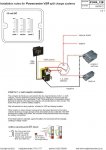
Enclosed a diagram, may help you.

Single output mains charger wired to say bank 2 ?, connect orange wire to terminal 2, simple as that.

Single output solar array ? do the same.

If it's on bank 1 fit orange to bank 1.

Life does not have to be complicated.

Brian


12b_inst.jpg
 
The important thing to know is that not all boats are the same.
Any boat you are in charge of, you need to know a certain amount about the electrics.
You never know what quaint ideas previous owners might have had.

Once upon a time, life was simpler. When you switched a 1-both-2 battery switch to 'off', you knew the batteries were isolated. Which can be handy to know in a crisis.
These days, you can't assume anything much, boats are full of 'clever' systems where the battery isolators don't isolate the batteries and all sorts of 'progress'.
It's quite common for people to not really understand what the battery switches on their boats actually do.

The big question is often what exactly do they want the switches to do?
It's not so simple these days with multiple charging sources like solar and shore power.
 
Indeed, there are several systems on my boat that bypass the battery switches. The Eberspacher requires this to avoid damage, for instance.
 
Enclosed a diagram, may help you.

It would if i was fitting one of your VSRs, but i'm not. The diagram i posted clearly shows that i would be fitting a "standard" VSR, such as a Victron, BEP, BlueSea. Durite etc. Which invalidates your comment made about my schematic.

Single output mains charger wired to say bank 2 ?, connect orange wire to terminal 2, simple as that.

Single output solar array ? do the same.

If it's on bank 1 fit orange to bank 1.

So i've moved you orange wire to one of the batteries, the system now performs how it would in my schematic, more or less. But you've moved the goalposts, you were suggesting dual solar controllers and multi output battery charges last time you posted.

Life does not have to be complicated.

Indeed it shouldn't be, but posting on PBO tends to make it so. My schematic was the correct way to wire the type of VSR that the schematic depicted, as anyone can verify by checking out the fitting instructions for Victron, BEP, BlueSea. Durite etc.
 
The important thing to know is that not all boats are the same.
Any boat you are in charge of, you need to know a certain amount about the electrics.
You never know what quaint ideas previous owners might have had.

Once upon a time, life was simpler. When you switched a 1-both-2 battery switch to 'off', you knew the batteries were isolated. Which can be handy to know in a crisis.
These days, you can't assume anything much, boats are full of 'clever' systems where the battery isolators don't isolate the batteries and all sorts of 'progress'.
It's quite common for people to not really understand what the battery switches on their boats actually do.

The big question is often what exactly do they want the switches to do?
It's not so simple these days with multiple charging sources like solar and shore power.

Very true! I see some totally bizarre arrangements. As far as battery switches go, i like to keep it very, very simple.

A battery for the engine, connected to a battery switch.
Batteries for the domestic services, connected to the domestic switch.
An emergency switch, for various emergencies.

Day to day operation is as simple as it can be, arrive at boat, turn domestic switch on. Prepare for departure, turn engine battery on. End of trip, turn switches off before you leave. No different to turning the lights on and off in your house or the ignition on and off in your car.

Charging systems can vary a lot, depending on a number of factors. A simple VSR is suitable for many (not all) installations, this schematic shows how i connect my isolators switches and includes the VSR wiring:

Charging-2-banks-VSR.png


The same switching arrangement works equally well with diode/FET based split charging devices:

Charging-2-Batteries-One-Engine-with-ArgoFET.png


Lots of other ways to get multiple banks charged from multiple sources, no one system works for every installation, but the basic switching arrangement is good for almost every system, although there are obviously exceptions, like the big motor sailor i rewired, which had 6 battery banks, 5 charging sources and an inverter:eek:
 
Looking at the way Lithium batteries are getting cheaper, give it a couple of years and old codgers wil lbe banging on about 'the good old days of lead acid when everything was simple'.

The first 'yacht' I sailed had a car battery , a masthead tricolour/ all round white combo, two switches and two croc clips.
It didn't hold us back.
 
Before this thread descends to the usual fight between electrical specialists, here is a proven way to manage a 1,2,both,off switch.
Rule 1 - never use Both.
Leave the switch on the domestic bank, in my case 2, always. A domestic battery bank is perfectly capable of starting a small yacht engine. The bank will then charge when the engine is running and on solar when it is not.
Leave switch 1 as an emergency starter. Occasionally, dependent upon your use of the boat, switch to it, start the engine and charge it for 30 minutes, then switch back to 2.
I have been using this regime for 25 years and never had a failure to start or any flat batteries. We run a fridge 24/7 throughout the season in Greece, so our demands are fairly high.
Quite like that idea, it keeps it simple, I think I'll adopt it

I was told not to start my engine off my 'leisure battery' though as they are not designed for the job. But I also read in reality there is very little diffenence between leisure batteries and starter batteries
 
Quite like that idea, it keeps it simple, I think I'll adopt it
I was told not to start my engine off my 'leisure battery' though as they are not designed for the job. But I also read in reality there is very little diffenence between leisure batteries and starter batteries
Some even have a CCA rating in their spec. I'd certainly assume that any with that rating quoted are suitable for, at least occasional, engine starting.
 
Apparnetly my beta 16 needs 350-400 cca
My leisure battery is 700cca

So makes sense just to leave switch to leisure battery all the time and have the other as a back up

It's not as if batteries cost a fortune either.
 
I was told not to start my engine off my 'leisure battery' though as they are not designed for the job. But I also read in reality there is very little diffenence between leisure batteries and starter batteries
Welcome to the totally confusing world of boat electrics.

Disclaimer I have a @halcyon system and love its simplicity and the custom made switching panel.
 
Thanks all
This is only a small 23ft boat so solar arrays are not practical but l will fit a small panel that just trickle charges when the boat is on its swinging mooring (most of the season).
I will stick with Vic's regime of using the house battery most of the time and remembering to charge the engine one occasionally. I will see how l go.
 
Thanks all
This is only a small 23ft boat so solar arrays are not practical but l will fit a small panel that just trickle charges when the boat is on its swinging mooring (most of the season).
I will stick with Vic's regime of using the house battery most of the time and remembering to charge the engine one occasionally. I will see how l go.

Vyvs regime ;)
 
You've posted this several time Vyv and it's one sensible way of using the switch, i understand it's favoured in the US. There can be a downside to this method though, cranking the engine from the domestic bank can cause voltage drops and spikes and play havoc with the electronics. It obviously doesn't apply in your case though.
My domestic bank has 3 x 110Ah batteries, which may account for no voltage drops. I think in the past when the bank only had two batteries there were occasions when the plotter would beep for low voltage but I don't remember it ever turning off.
 
Apparnetly my beta 16 needs 350-400 cca
My leisure battery is 700cca

So makes sense just to leave switch to leisure battery all the time and have the other as a back up

It's not as if batteries cost a fortune either.
Thats a big CCA, wonder why. All the Yanmars, 2, 3 and 4 cylinder, are 200 CCA. Maybe one is the 'cold' spec and the other the 'warm' one.
 
400CCA is a pretty modest battery.
I've just bought a 16Ah motorbike battery which is 210CCA.
I think engine and vehicle makers specify a stout CCA so that the battery will do the job when it's getting quite old or not 100% charged, rather than indicating how many amps are actually needed to start the engine.
Weak batteries can kill starter motors, so it's good practice to have an 'ample' start battery, unless you're lugging it around on a motorbike. Using a battery near its CCA rating probably shortens its life too, motorbike batteries commonly don't last long.
 
I have ditched the 1,2,both switch in mine and changed to three separate switches as per your setup. It is some much more full proof, just switch on the engine and house switches when you get on the boat and switch them off when you leave. Each battery is running what it is designed for and the VSR makes sure that the alternator and solar charges both batteries automatically. It is also the only system that lets you easily isolate a bad battery rather than joining a bad and good battery together.

Very true! I see some totally bizarre arrangements. As far as battery switches go, i like to keep it very, very simple.

A battery for the engine, connected to a battery switch.
Batteries for the domestic services, connected to the domestic switch.
An emergency switch, for various emergencies.

Day to day operation is as simple as it can be, arrive at boat, turn domestic switch on. Prepare for departure, turn engine battery on. End of trip, turn switches off before you leave. No different to turning the lights on and off in your house or the ignition on and off in your car.

Charging systems can vary a lot, depending on a number of factors. A simple VSR is suitable for many (not all) installations, this schematic shows how i connect my isolators switches and includes the VSR wiring:

Charging-2-banks-VSR.png


The same switching arrangement works equally well with diode/FET based split charging devices:

Charging-2-Batteries-One-Engine-with-ArgoFET.png


Lots of other ways to get multiple banks charged from multiple sources, no one system works for every installation, but the basic switching arrangement is good for almost every system, although there are obviously exceptions, like the big motor sailor i rewired, which had 6 battery banks, 5 charging sources and an inverter:eek:
 
Top