Battery consumption of a fridge?

I believe Victron are doing balance modules for multiple battery systems, for lead acid/AGM etc etc.... (lithium style)
was talking to them at METS, maybe of help for you???!!!

Rob, yes this is a serious point as unless I'm mistaken you cannot mix and match deep discharge service batteries with simple lead acid cranking ones even in the reasonably new el. victrons like the one I have...

Which brings out another Q, can you use deep discharge batteries like the ones MM mentions for cranking?
I mean, would 24V200Ah deep discharge start a couple of 7lt straight six lumps of metal?
er, preferably EVERY time and without having to resort to paralleling them with the service ones?

sorry many Qs here, but that's still unclear to me.

cheers

V.
 
Yep V, I can confirm all your Qs, because that's precisely what I've always had onboard.
My boat was originally built with huge 12V/280Ah/80kg (!) deep cycle batteries: 2 of them for engines (hence with 24V/280Ah) and 4 for domestic (24V/560Ah in total).
I never had any problem with them, but that was an OTT setup, driven by the commercial heritage of the yard.
So, after the first replacement with the same batteries (which almost broke the back of one of the yard workers...), I moved to the current lighter setup, as previously explained.
And aside from replacing the domestics with eight 12V/100Ah batteries (actually 110Ah, hence reaching 440Ah in total, vs. the previous 560), I used only TWO of the very same batteries for engines start - which means only 110Ah vs. the previous 280 (!).
But even after such big "downsizing", I never had to resort to paralleling to start the 6.6 liters engines.

Anyhow, I've always used the very same batteries (FLA deep cycle) for both starting and domestic.
I suppose that the possibility to mix different types depends from jfm suspicion above.
If he's correct, whatever you connect to the secondary charger output is going to be charged in the same way as whatever is connected to the primary output demands, which obviously is not good if you have different battery types
But due to the different usage profile of starting and domestic batteries, as I said I would think/hope that chargers with multiple outputs should handle different charging profiles for each output anyway, also assuming that the batteries are of the same type.

No idea about how the balance modules mentioned by Rob actually work, I'll try to find out sometime.
 
Last edited:
- that the charger can handle its two outputs separately.
And of course, I also assumed that the Victron Multiplus that I'm going to install this winter can do the same.

AFAIRemember, that second DC output on the Victron, is just a Tickle charger without any intelligence,
the purpose is to use that for the starting battery's and just keep these topped up.

there is only "one" DC output that has some programmable options; battery type , charge current, charge curve, etc...


regarding your drawing's,
just one practical remark,

In my setup I had:
one copper bar connecting all screw terminals of 6 battery's
on top of one of these terminals I had the connection of the charger / load cable.
so the impedance to that battery was noticeably "less" than the impedance to alle other battery's. (impedance of the connection surface with the copper bar X2 ...)
THAT battery suffered a lot more punishment and was broken after one season !

your first drawing symbollically shows that problem, compared to the second drawing (sorry difficult to explain)
(only the connection of the wiring, nothing to do with the configuration)
 
The Victron Phoenix charger has three outputs. Only one of which is suitable for the trickle charger.
The other two have a common neutral. I have not worked out yet if it is smart enough to alter its algorithm for each of these outputs. I suspect they are just paralleled outputs to a common charging rail...
I currently have one in my workshop that I am looking at.
Bit miffed that there is no Victron software for mac.... maybe have to get a windows netbook....
 
unless I'm mistaken you cannot mix and match deep discharge service batteries with simple lead acid cranking ones... can you use deep discharge batteries like the ones MM mentions for cranking?
V.
Vas, check out Anna's post #64 above. At this size of battery, there is no meaningful difference between "cranking" and "deep". AOTBE the chemistry is the same and they can be charged by the same charger (with usual splitter of course)
 
...jfm suspicion above.
If he's correct, whatever you connect to the secondary charger output is going to be charged in the same way as whatever is connected to the primary output demands, which obviously is not good if you have different battery types
But due to the different usage profile of starting and domestic batteries, as I said I would think/hope that chargers with multiple outputs should handle different charging profiles for each output anyway, also assuming that the batteries are of the same type.
It is only a suspicion MapisM, I'm not 100% sure. Going by the Mastervolt manuals, I think I'm right, but still not 100% sure. I think Bart shares my suspicion. I really don't think it matters though, for the Faberge egg reason. When I look at the digital read out on my 3-output charger it might show 60 amps going into the house batteries but it generally shows 0 amps or 0.1amps trickle (out of a maximum 10Amps each from the two "slave" charge outputs) going to each engine battery bank. So, even if they are being presented with the slightly "wrong" charge voltage, they seem to be happy and aren't taking any current. Feels ok to me as a way to treat a lump of lead, even if not Mr Faberge's eggs :D
 
Been far, far, far too busy with work related problems recently, but thought I'd make time to wade back in and give my thoughts.

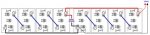
Regarding MapisM's proposed setups, as JFM said, both are spot on in terms of uniform impedance throughout the circuit. The only this I would add is that if your charger supports Kelvin measurement points (a.k.a 4-wire charging or separate voltage sense wires) then the sense wires should be connected as close to the most +VE and -VE terminals on any one series string. After all, that is the voltage that charger needs to be concerned with... and given the circuit is now totally balanced, battery string 1 and battery string 2 should have the same terminal voltages across them. I have even been un-lazy enough to illustrate what I mean:

Layout_W_Sense.jpg

If your charger doesn't support Kelvin measurement points, I would strongly recommend finding one that does - although most chargers for this size of battery bank probably will.

Regards to isolating both batteries and charging separately, again, as JFM points out, it's probably not worth it. If your hotel loads are >100A to 200A max, and you can crank from only one set of series connected batteries, then it can be done by literally having two chargers (or a charger with two independently controlled outputs) and 'isolating' the batteries with BIG battery combining diodes (common cathodes connected to the load, and all anodes connected to each series battery string's positive terminal). This would be a technically superior solution, but I doubt it'd make economic sense.

Take the simple system of batteries in parallel + 1 charger, then you have:
- 8 batteries in total @£800, which will last 3 years
- 1 charger @ £700, which will last 10 years(?)
This gives an equivalent annual cost of £337

Now, take a perfect system, and assume it'll improve battery life by 33% (probably nowhere near this much in reality) and separate them with diodes and have two separate (smaller) chargers that, then you have:
- 8 batteries in total @£800, which will last 4 years
- 2 chargers @ £425 each, which will last 10 years
- 1 big set of diodes @ £150(?) which will last 10 years
This gives an equivalent annual system cost of £300

That's a 22 year wait before breakeven! Given that, by then, LiFePO4 batteries will be similar in cost to lead-acids, you will have changed your boat, you will have suffered unexpected anomalous failures of at least one of the additional components needed in the more complex system, I can't see it ever coming close to being economic.

Although...
The name of the game is boating, not nurturing batteries like they were Faberge eggs.
. ABSOLUTE BLASPHEMY!!! Batteries are the most important things in the world and must be treated as though they are your very own children... speaking as a battery engineer, of course :P

With regard to chargers with independently controlled, full current outputs, I have also had a look at Victron's range (which I know fairly well). They definately have some with multiple full current outputs, but I honestly can't see in their documentation if they control the outputs separately or not.
I doubt they do, though - I think they just have current mirrors for a master channel. Except for the mechanical enclosure and input filter, to have a charger with more than one full current, fully controller output, you'd need all the rest of the innards of two (or more) completely separate chargers anyway. If it were me, I'd rather spend a little bit more and have the reliability / redundancy that two totally separate chargers would offer, if I really wanted / needed fully independent control.

Mixing deep cycles with high discharge (cranking batteries) is not a good idea. But using large DCs as HDs is generally fine. Would 200Ah at 24V of DCs start two 7l engines reliably? Hmm, pass. Without knowing minimum voltages and peak currents the engines would crank at, its impossibly to tell. At a guess, I'd say you'd be looking at about 300A at 24V and could probably tolerate a voltage drop to about 15V at the starter before the engine's ECU gave up trying and the EMF in the starter motor was too low. Therefore, you need a battery system with a complete loop impedance (including cabling) of lower than 30 milliohms. Given it's a big battery array, with not insignificant cable runs, your copper will probably make up as much impedance as the internal impedance of the batteries, therefore you have to have 6V blocks with an internal resistance value of <3.75 milliohms. I can't find an internal resistance spec for the Trojans, but I'd say an array of 4 in series would start the engines just about, but two parallel strings of 4 in series should probably do the job fairly well.
 
if your charger supports Kelvin measurement points...
...
I have even been un-lazy enough to illustrate what I mean...
LOL, unlazy, I like that in an engineer! Even more so when on top of that, he/she gives free consultancy on a forum! :D :D
Must admit that I never heard of Kelvin measurement points, but I understand that the Victron Multiplus which I'm going to install has:
A) a temperature sensor, which "is isolated and must be mounted on the batteries minus pole". And I'm quoting the operating manual, but I'm not sure if this means on ANY minus pole, or what...?
B) a "Voltage Sense, for compensating possible cable losses during charging", specifying also to "use wire with a cross-section of 75mm2". I assume these are the sense wires which you mentioned, right? And if so, is my understanding correct that the proper way to connect them, in the two alternative layouts, is as follows?
T-105layout2.jpg


All understood/agreed re. the idea of double/separate recharge of each bank.
Btw, I'm glad to scrap that also because the electrician at my yard, more than likely, would have laughed at a request like that... :D

PS: don't take jfm too seriously on the faberge eggs story.
He says that boating is the name of the game, but he actually spends at least a half of his 48 hours days thinking about technicalities... :p
Stay tuned, I bet that the latest mod he just disclosed on the f/b top of his boat will be interesting to follow!
 
LOL, unlazy, I like that in an engineer!

So do my employers. Unfortunately, putting posts on boat forums, instead of doing 'proper work' is considered lazy by them! So, in essence, I can't be unlazy for being lazy! :p

A) a temperature sensor, which "is isolated and must be mounted on the batteries minus pole". And I'm quoting the operating manual, but I'm not sure if this means on ANY minus pole, or what...?

I think they want the sensor mounted to the -VE pole because the terminals are obviously a good thermal connection to the insides of the battery. They have probably specified the -VE pole on the grounds that the sensor is likely just a thermistor, and will likely be ground referenced. This way, there should be no potential difference between the the charger's 'system ground', the temperature sensor or the -VE pole, which reduces the risks in a fault condition. To this end, I'd probably mount it on the same -VE terminal that you have the -VE sense wire connected to.

B) a "Voltage Sense, for compensating possible cable losses during charging", specifying also to "use wire with a cross-section of 75mm2". I assume these are the sense wires which you mentioned, right? And if so, is my understanding correct that the proper way to connect them, in the two alternative layouts, is as follows?
T-105layout2.jpg

Yep, yeah and yes. All spot on.
 
As a rag and stick chap, have read this thread with great interest, a mine of good info, next year am going to overhaul my battery/charger set up and the info has been a great help in marshalling my thoughts on a way forward.

Many thanks Anna.

PS my total engine output is smaller than the potential out put of some of the battery banks illustrated here!
 
A) a temperature sensor, which "is isolated and must be mounted on the batteries minus pole". And I'm quoting the operating manual, but I'm not sure if this means on ANY minus pole, or what...?
B) a "Voltage Sense, for compensating possible cable losses during charging", specifying also to "use wire with a cross-section of 75mm2". I assume these are the sense wires which you mentioned, right? And if so, is my understanding correct that the proper way to connect them, in the two alternative layouts, is as follows?

Have you considered the build tolerance of the batteries ? batteries have a variation in internal build tolerance, giving a different volt for a set current. So you have say 50 amp passing through the 4 off 6 volt batteries, which you are charging 28 volt. The problem is that each battery may well not drop 7 volt, so you get some charged, others under charged, and the odd one over charged.

Back in 95 we did work on 24 charger for a mate who built 4x4 wheel chairs, into optimising capacity and battery life. It works with 12 volt banks as each bank can take a current relative to it requirement. So we investigated split bank charging, use 12 volt batteries and charge each parallel bank with two 12 volt chargers one connected to each bank, with power link between the two banks. You could have one charging output off and the second one still charging, depending on recharge level, plus you can draw 24 volt load supplied by the two charge outputs. It also allows you the ability to change one battery in a bank, and have a larger lower bank that when charge cesses, splits to maintain a 12 volt supply, but charges from the 24 volt system.

Brian
 
I have asked the mods to do it.
Just in case my comment came across as unpolite, of course there wasn't anything wrong with your title (and YOUR thread!).
I should instead apologize for stealing it somehow, though I'm sure you'll agree that by enlarging the initial topic it became even more interesting! :)
 
Have you considered the build tolerance of the batteries?
Well, yeah, but unless you accept either to:
a) go for huge 80kg batteries, as my boat used to have, hence reducing their total number (though some differences might still exist), or
b) spend a LOT more for top quality batteries like Lifeline (and again, tolerances are probably more strict, but some differences are still possible),
at the end of the day I think the problem is still the same using single 12V batteries or the same total number of 6V batteries, with twice the Ah.
I mean, between four pairs of 12V/100Ah batteries or two series of four 6V/200Ah batteries (both alternatives meaning about the same size and a decent weight of 30kg or so for each of the eight batteries, with the same total power of 24V/400Ah), in terms of potential recharging inefficiencies due to build tolerances, there's no difference, I reckon. Or am I missing something?

Regarless, your optimised charger does sound clever, but is there any "industrialised" solution like that on the market?
I think we all agreed previously that a custom made, special setup would only be worth the hassle for Fabergé eggs, rather than FLA batteries.... :D
 
I'll chase up the moderators to re-name this fred.

I need a pair of new batteries, I have always bought 110ah, 800cca lead acid jobs. Cheapest I could find. They do engine starting and about an hour of tiny of cabin lighting but not much else.

I can get them delivered from ebay for about £60 a piece. Why can't I go collect from a local (Southampton) supplier at that price?
 
I'll chase up the moderators to re-name this fred.

I need a pair of new batteries, I have always bought 110ah, 800cca lead acid jobs. Cheapest I could find. They do engine starting and about an hour of tiny of cabin lighting but not much else.

I can get them delivered from ebay for about £60 a piece. Why can't I go collect from a local (Southampton) supplier at that price?
Barden at Segensworth won't be far off, but tell them your a trade buyer. They won't question you and will get a decent discount.
 
Top