Battery Charger on 24/7 ?

If the batteries are in good shape they should have low self discharge and either a solar panel for trickle charging the house battery will do or plug the mains in from time to time. I usually put mine on for maybe 2 days a month during the winter. Don't see any benefit in leaving the charger on permanently.
 
Before I used low amp maintainers ... I had a timer plugged into socket - then dumb charger into that ....

The timer was set to give a couple of hours charge each 2 or 3 days .... later I upped it to every other day 2hrs in morning ... 2hrs in evening ... worked a treat .... due to adding Maplins splitter ... to look after twin batterys.
 
Before I used low amp maintainers ... I had a timer plugged into socket - then dumb charger into that ....

The timer was set to give a couple of hours charge each 2 or 3 days .... later I upped it to every other day 2hrs in morning ... 2hrs in evening ... worked a treat .... due to adding Maplins splitter ... to look after twin batterys.
Just don't do this with a smart charger as it'll start with the more aggressive profile every day!
 
When storing a lead acid long term with no load, ideally adjust the charger settings to match the storage voltage requirements for your battery type. These will be different to the normal cyclic charging settings.

Generally, for standby application manufacturers recommend disabling the bulk and absorption phases and keeping the battery at a steady voltage usually around 0.3 V (for a 12 V system) lower than the cyclic float voltage setting.

For example, for cyclic use, the ideal settings for a particular battery may be a bulk/absorption voltage of 14.6 V, an absorption time of 2 hours, then dropping to float voltage of 13.7 V. These settings would be changed to constant voltage of 13.4 V (0.3 V lower than the float setting) for long term storage with no load. Note: These voltages should be adjusted for temperature.

Some chargers will automatically adopt these values when they detect the battery is in storage, but this feature is rare (I have only seen this in some Victron mains chargers). Most chargers will require manual adjustment of the voltage set points.

There are pros and cons between using mains or solar charging. With mains charging there is a risk of a neighbour unplugging the power supply. With solar charging there is the drawback that the battery voltage is not held completely steady and will drop slightly overnight, but this is of little consequence. Providing you not in an area of heavy snow, solar charging removes the risk of the charging source becoming disconnected and is usually the preferred option, but you do need to adjust the settings. Many solar regulators will perform a full bulk, absorptio, float cycle, every new solar day which is not ideal on fully charged battery.
 
Last edited:
I wouldn't leave a dumb charger on permanently, and some cheaper smart chargers, including the Aldidl one I had for many years, didn't restart if the power was cut temporarily.

My solution would be to go solar, with as much wattage as you can afford and have space for, and fit an MPPT controller that will feed both batteries. It will solve your charging problems through the winter and, more importantly, run your fridge and stuff at anchor during the summer.
 
We have both solar and shore power on 24/7, solar takes care of it most of the time, if not the Multiplus charger/ inverter takes care of it, all automatic and set for AGM profile, starter battery trickled charged by Multiplus if needed, being all victron kit can override remotely if needed.
 
I wouldn't leave a dumb charger on permanently, and some cheaper smart chargers, including the Aldidl one I had for many years, didn't restart if the power was cut temporarily.

My solution would be to go solar, with as much wattage as you can afford and have space for, and fit an MPPT controller that will feed both batteries. It will solve your charging problems through the winter and, more importantly, run your fridge and stuff at anchor during the summer.

I don't know any normal Charger that will restart on resumption of shore power ... the Lidl one as I have - on reconnection to power defaults to voltage display of battery - same as any other smart car charger ...
I can live with that as the yard is only 10 minutes drive from my house ... once Superanne is finished repairs next spring - she will return to home and be 100m down garden ... with other boat still 10mins away.

I understand that I am lucky in this ...
 
Hello all, looking for advice please re charging my battery bank !

This is my first winter owning a boat (33ft Bavaria, 10 years old).

I have a sealed, lead acid engine battery and 2 unsealed lead acid leisure batteries.

There is a small, quite old solar panel stuck to the coachroof which seems to keep the leisure batteries at a reasonable level of charge. I’m pretty sure the solar panel isn’t connected to the engine battery (which is located remotely from the other batteries).

I also have a AC to DC charger (it is supplied by shore power and has a ’boost’ and ‘float’ function).

My questions are these…..

Is there any problem in leaving the charger switched on permanently?

Is this ‘best practice’ through the winter given that I won’t be using the boat and that presumably the output from the solar panel is likely to be pretty poor?
Replace the Cristec charger with Victron Bluesmart IP22 Blue Smart IP22 Charger - Victron Energy

If the batteries are not being used the charger wil enter storage mode to keep them at a lower voltage than float. I have fitted dozens of these to customers boats, who all leave the chargers on 24/7, never had an issue.
 
Chargers in the CTEK range (perhaps others as well) will perform a similar function (float/pulse) automatically so are well suited for batteries that are left unattended for long periods.

I use a CTEK on the car while away. Boat Trojan domestic batteries are left on charge via solar and Victron Smartsolar when away but I turn absorption down to 14.5v. Sealed la engine battery is isolated and not charged and will still start engine OK after 2-3 months.
 
Replace the Cristec charger with Victron Bluesmart IP22 Blue Smart IP22 Charger - Victron Energy

If the batteries are not being used the charger wil enter storage mode to keep them at a lower voltage than float. I have fitted dozens of these to customers boats, who all leave the chargers on 24/7, never had an issue.
Victron do make an effort to program in an excellent charging algorithm. It is one of the few chargers that will drop drown to appropriate voltages for storage automatically. Unfortunately their otherwise excellent solar controllers do not do this.

However, if you have any charger with infinitely adjustable set points, you can manually modify the charging parameters and achieve exactly the same thing. If you are leaving the boat for some time with no load this is worth doing.
 
Unfortunately their otherwise excellent solar controllers do not do this.
Have you requested it? They add all sorts of stuff in firmware updates, recently a few updates to make different devices work better together. I wouldn't be surprised to see them update the whole range soon with a more integrated approach given the direction they are going. Would be nice to see them ditch most of their networking options too and move 100% to a bus setup as I think for many it's too late when we realise it's an option!
 
Have you requested it? They add all sorts of stuff in firmware updates, recently a few updates to make different devices work better together. I wouldn't be surprised to see them update the whole range soon with a more integrated approach given the direction they are going. Would be nice to see them ditch most of their networking options too and move 100% to a bus setup as I think for many it's too late when we realise it's an option!
It is a feasible capability to incorporate into a solar controller, but it is much harder to implement than a mains charger. When away mains charging I don't think it is feature we are likely to see soon.

A mains charger can easily recognise the need for storage, as the battery voltage remains constant. This does not happen with a solar controller, even when the battery has no load. The voltage drops overnight and will fall below the bulk return voltage. This initiates a new bulk/absorption float cycle. Some controllers (such as Victron) will modify the absorption time, but this is still not ideal for a fully charged battery.

Fortunately, you can manually adjust the set points of many solar controllers so they correctly maintain a battery in storage mode. This change is also needed on the majority of mains chargers that do not have an automatic storage mode.
 
Last edited:
When paired with a BMV though, it would be able to see if power had been used, and paired with a Cerbo it could see that over weeks or months. There are lots of clever things they can still add, and I expect they will start to do so. They already have the ability for chargers and MPPTs to work together to sync up charge profiles via the Cerbo
 
There are lots of clever things they can still add, and I expect they will start to do so. They already have the ability for chargers and MPPTs to work together to sync up charge profiles via the Cerbo
I agree Victron have done a great job. They completely reconfigured and improved the charge algorithm of the MPPT controllers several years ago and have added various tweaks and improvements since.

The ability to sync the charge state of several devices is one added capability that is well worth taking advantage of, especially if you have multiple solar controllers (this is a stand alone feature of the Bluetooth controllers and does not require a Cerbo BTW).
 
Last edited:
With the Cerbo it also pulls in my phoenix charger. Can't remember what the setting is called but it needs manually enabling
 
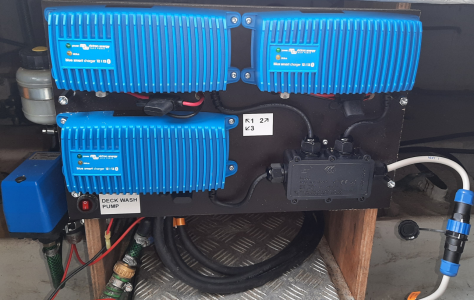
I'm impressed by a Noco (US) 26A workshop charger and the 3x Victron IP67 (EU, Netherlands) setup recently fitted to the boat.
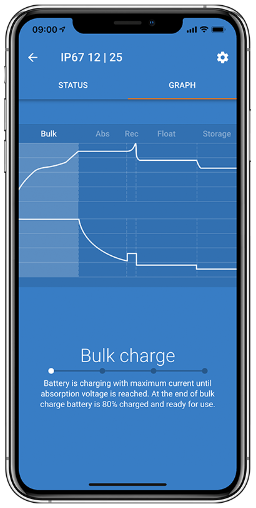
These Victron's are Bluetooth connected to the Victron Connect app, monitoring batteries, charge cycles etc.. The setup with a separate charger for each bank is to ensure individual charge regimes and monitoring.
Even during winter on the hard, I can easily monitor things without climbing the boat (phone pic borrowed from Victron, not my actual).
1702015048195.png1702014611719.png

If interested, the original thread about the project is here

If you require remote monitoring Victron also offers this (web-based). Look for their VRM solution.
 
Last edited:
Top