Batteries for a 30ft liveaboard

Some of the "drop in" LiFePOs do come with a BMS but I believe most (all?) do not monitor individual cells but just the 12V unit. According to the "experts" the individual 3.2V cells can get out of balance in a 12 combo which can lead to imbalance in charging and death of the cell.

Here's a link to a very interesting, somewhat technical article written by someone that sells and installs LiFePO systems.

Of Service to you, Professional Engineering Opinion on AGM vrs Lithium - Cruisers & Sailing Forums

No that really isn't correct. I'm afraid the posts you linked to sounds like someone who should be taking lithium rather than installing it. Go back in a week or two to see the replies - that group does have some experts, I don't think he's one. People with the experience he claims don't tend to do 180 degree screeching U-turn in their explanations.

But I also don't think you have understood him correctly. If an internal BMS was only monitoring voltage at pack level rather than cell level then the battery would not last long. Pack level management has been tried but becomes a problem when cells begin to go out of balance. So for example a battery protect that stops a charging source at 14.6 volt sounds OK in principle since no cell will go above 3.65v. But that is only true if the cells are balanced. Once imbalance sets in then the four cells might be at 3.5, 3.5. 3.5 and 4.0 and still be charging. The fourth is being damaged. So internal BMSs work at cellular level and have some balancing capacity between cells.
 
Last edited:
No that really isn't correct. I'm afraid the posts you linked to sounds like someone who should be taking lithium rather than installing it. Go back in a week or two to see the replies - that group does have some experts, I don't think he's one. People with the experience he claims don't tend to do 180 degree screeching U-turn in their explanations.

But I also don't think you have understood him correctly. If an internal BMS was only monitoring voltage at pack level rather than cell level then the battery would not last long. Pack level management has been tried but becomes a problem when cells begin to go out of balance. So for example a battery protect that stops a charging source at 14.6 volt sounds OK in principle since no cell will go above 3.65v. But that is only true if the cells are balanced. Once imbalance sets in then the four cells might be at 3.5, 3.5. 3.5 and 4.0 and still be charging. The fourth is being damaged. So internal BMSs work at cellular level and have some balancing capacity between cells.

Read the article at this link. Expresses many of the same concerns and I can without hesitation tell you that this guy knows his business and needs no tranquilizers. I have followed his articles for years and read how he conducts his testing. He is also on ABYC committees and helps write the standards. LiFePO4 Batteries On Boats - Marine How To

One comment he makes right at the beginning that reflects my concerns. Referring to whether he recommends LiFePO systems, he is reluctant because it is "so expensive, and so easy to damage or ruin"

Regarding BMS, I can confirm from research and reading articles from a number of sources that many of the drop in DIY LiFePO batteries only monitor the pack and not the individual cells. Supposedly the cells are balanced individually before assembly into a pack and from all research, good quality, well balanced cells will probably not need rebalancing if properly charged and maintained.

Bottom line for me, I'll stick with FLA deep cycle batteries for now. Sure I see some recommendations on drop in systems, don't worry, no problem, etc. But with FLA you have much lower up front expense, less time and work invested in purchase, setup and installation, easier to replace if something goes bad, available anywhere AND if something does go bad I'm not out a few thousand quid. This by the way from a boater with a degree in EE and 45 years of owning, rebuilding, maintaining, delivering and otherwise messing about in boats.

For those that want to give it a go I'm happy to see it. In fact the more that try it the better. So far most seem to have good experiences but not too many have had systems in place for the 5-10 years it takes to amortize the cost and confirm that the batteries did last as long as anticipated. I do know of at least one, very experienced marine electronics tech that killed over $2,000 worth of batteries when he made a mistake in the initial charge/balance. I'll wait until LiFePO version 3.1 comes out, the prices are down and the bugs are 99% out of the system.
 
I'm going to stop responding now as this is too far from the original purpose of the thread, other than to say that your endorsement of the Rod Collins paper is correct. I've quoted him on this forum many times.

Quite right, Hope we have not thoroughly confused the OP with my blatant hijacking of the thread.

I am glad we agree on Mr Collins, otherwise I would think the less of you. :D
 
Solar is silent and in the Adriatic, there is enough sunshine that over the last 2 years I have never needed anything other than solar and my normal engine usage. In the UK, Scandinavia and Baltic, a wind gen would probably make a lot of sense, but in the med, solar is king IMO.

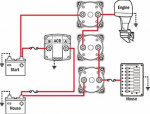
There is an output from the engine labelled "Alternator" which charges the starter battery. The service batteries are then charged via the Victron Cyrix-ct 230 combiner.

My 1,2,both switch is getting a bit gritty so replacing with 3 switches and Cyrix. Bearing in mind the Cyrix is bi-directional, with it connected directly between the engine and domestic batteries it will charge the engine battery when solar is charging domestics. If the solar regulator is set to a higher charging voltage for the domestics, than is appropriate for the start battery, would it be better to connect it across the isolator switches? I don't want to be banging 14.8 into start battery when domestics are on bulk.
 
My 1,2,both switch is getting a bit gritty so replacing with 3 switches and Cyrix. Bearing in mind the Cyrix is bi-directional, with it connected directly between the engine and domestic batteries it will charge the engine battery when solar is charging domestics. If the solar regulator is set to a higher charging voltage for the domestics, than is appropriate for the start battery, would it be better to connect it across the isolator switches? I don't want to be banging 14.8 into start battery when domestics are on bulk.

If you have deep cycle batteries that need charging at 14.8v the Cyrix is not the best solution. I'd be inclined to fit a Victron Argofet to allow the alternator to charge both banks and only connect the solar controller to the domestics. The engine battery should be able to look after itself, but if not, there are a few options to keep it topped up. A simple one would be a DC-DC converter set to the engine batteries float voltage.
 
If you have deep cycle batteries that need charging at 14.8v the Cyrix is not the best solution. I'd be inclined to fit a Victron Argofet to allow the alternator to charge both banks and only connect the solar controller to the domestics. The engine battery should be able to look after itself, but if not, there are a few options to keep it topped up. A simple one would be a DC-DC converter set to the engine batteries float voltage.

Thanks Paul but sods law, I already have a Cyrix!

Was thinking of connecting it to the engine side of the top switch and the house battery terminal on the bottom switch, both of which will be in close proximity to each other. Although ideally the Cyrix should be connected close to the batteries as is shown with the ACR, it should still function to parallel the batteries whenever the engine starts/charges but, stop the panels charging the starter battery.


1605282237686.png
 
Thanks Paul but sods law, I already have a Cyrix!

Was thinking of connecting it to the engine side of the top switch and the house battery terminal on the bottom switch, both of which will be in close proximity to each other. Although ideally the Cyrix should be connected close to the batteries as is shown with the ACR, it should still function to parallel the batteries whenever the engine starts/charges but, stop the panels charging the starter battery.


View attachment 102806

That will work as you describe it Graham. It does, as you say, only charge the engine battery if the engine isolator is turned on. If that's enough to keep the engine battery properly charged, job done. If the engine battery doesn't get enough charge you'll need a rethink, fingers crossed.
 
Here's my quick and dirty summary of the battery types.

1. FLA (Flooded Lead Acid). This is the regular liquid filled battery. Come in a few sub types: starter and deep cycle are the two main ones. Trojan T105 is a high quality deep cycle.

2. Sealed lead acid batteries. Comes in AGM and Gel types.

3. Lithium. Also comes in various types but when not otherwise specified for boats usually means LiFePO (Lithium Ferrous Phosphate).

Which to use?

1. FLA up front cost the lowest for the most capacity. Also most robust and tolerant of abuse for those that don't have electrical expertise.

2. AGM and Gel. No maintenance since they're sealed so good for installation in hard to access spots. Much more expensive than FLA and less tolerant of abuse. Will accept a higher rate of charge

3. Lithium. Very high initial cost but with proper care can be the cheapest in the long run. But they can be easily damaged if you aren't careful or do not have a proper BMS (Battery Management System).

Again I'd add Pure Lead Carbons into the mix here . They are in effect AGMs but which cost a bit more. However, with a lot of benefits. They are a lot cheaper than Lithium, are heavy enough to contribute to ballast, and you can really abuse them: deep cycle, lots of cycles, and very fast charge. I see them as heavy, cheap Lithiums.

Only Leoch sell them at present (I think) but they are new designs and I'm sure others will start releasing theirs.
 
Again I'd add Pure Lead Carbons into the mix here . They are in effect AGMs but which cost a bit more. However, with a lot of benefits. They are a lot cheaper than Lithium, are heavy enough to contribute to ballast, and you can really abuse them: deep cycle, lots of cycles, and very fast charge. I see them as heavy, cheap Lithiums.

Only Leoch sell them at present (I think) but they are new designs and I'm sure others will start releasing theirs.
Yes there are several variations on the basic types I mentioned. There's are the Oasis Firefly carbon foam AGM and several types of lithium batteries, enough to fill a small book I think.
 
Anyone used these:
12v 100AH Leoch Pure AGM Lead Carbon PLH+ C100 Deep Cycle Leisure Battery NCC Class A

or these:
12V 115AH Leoch AGM Lead Carbon Deep Cycle Battery (LDC12-115-G31-DT) (SLCA-12130 DT)

Both look like excellent products. I'm thinking of getting 4 superior lead carbon AGMs, which will give a big increase in usable charge, with faster recharge times compared to my 3off FLAs. Wondered about the pure lead carbon, and whether the extra cost (with slightly smaller capacity?) would be worth the extra?

Any real-life experiences?
 
Again I'd add Pure Lead Carbons into the mix here . They are in effect AGMs but which cost a bit more. However, with a lot of benefits. They are a lot cheaper than Lithium, are heavy enough to contribute to ballast, and you can really abuse them: deep cycle, lots of cycles, and very fast charge. I see them as heavy, cheap Lithiums.

I'm not sure if there is a convincing argument that they are cheaper than LFP (at least not DIY) if you compare like-for-like over their lifetimes. But for anyone looking for an advanced drop-in replacement battery with higher cycles, faster charging and less vulnerability to sulfation than other lead acids then lead-carbon looks to be a better way to go than lithium, not primarily because of cost but because there are less complications in creating a safe system.
 
Last edited:
Anyone used these:
12v 100AH Leoch Pure AGM Lead Carbon PLH+ C100 Deep Cycle Leisure Battery NCC Class A

or these:
12V 115AH Leoch AGM Lead Carbon Deep Cycle Battery (LDC12-115-G31-DT) (SLCA-12130 DT)

Both look like excellent products. I'm thinking of getting 4 superior lead carbon AGMs, which will give a big increase in usable charge, with faster recharge times compared to my 3off FLAs. Wondered about the pure lead carbon, and whether the extra cost (with slightly smaller capacity?) would be worth the extra?

Any real-life experiences?

I think these battery types are both quite recent, so probably difficult to find anyone who has useful real-life experience already. FWIW, I installed a new house bank with three batteries similar to the second link (90 Ah rather than 115) earlier this year. They have been fine, as one would presume.
Looking at the data sheets, I find it is not so simple to compare the two types. For instance, when it comes to cycle life it could be interpreted that the pure lead carbons (1st link) would give quite a few more cycles than the other alternative. But Leoch uses two different types of graphs to express their performance in this respect.
For the pure lead carbon, the graph is very simple, but one wonders how cycle life is defined. For batteries from the second category, the graph is more sophisticated (and useful), as it also takes capacity loss into account.
 
Top